
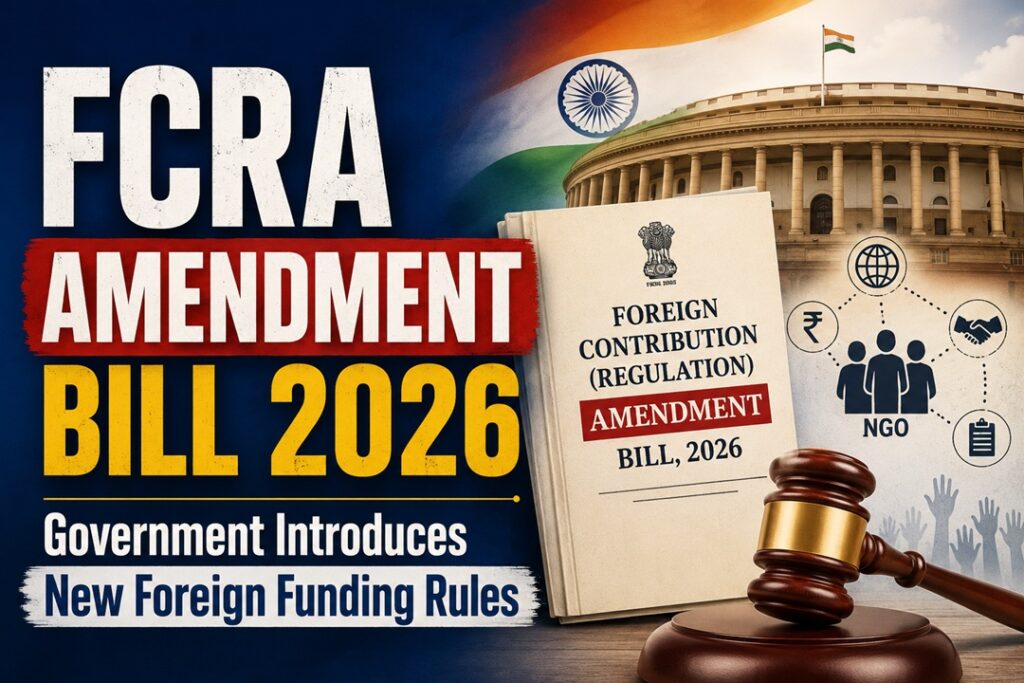
Government Introduces Foreign Contribution (Regulation) Amendment Bill, 2026
Context
The Union Government has listed the Foreign Contribution (Regulation) Amendment Bill, 2026 for consideration during the Monsoon Session of Parliament.
The proposed legislation seeks to establish a centralized mechanism for the takeover, management, transfer, and disposal of assets belonging to civil society organizations whose FCRA registrations are cancelled, surrendered, not renewed, or allowed to lapse. The Bill expands the existing regulatory framework by introducing detailed provisions governing the treatment of foreign-funded assets after an organization’s registration ceases.
Foreign Contribution (Regulation) Amendment Bill, 2026
Overview
What is the Foreign Contribution (Regulation) Amendment Bill, 2026?
The Foreign Contribution (Regulation) Amendment Bill, 2026 proposes significant amendments to the Foreign Contribution (Regulation) Act, governing how non-governmental organizations (NGOs), charitable trusts, educational institutions, religious organizations, and other voluntary bodies receive, utilize, and manage foreign contributions.
Unlike earlier versions of the FCRA, which primarily regulated the inflow and use of foreign funds, the 2026 amendment introduces provisions for the ownership, management, and disposal of assets created wholly or partly through foreign contributions after an organization’s FCRA registration ends.
Salient Features of the Bill
Expanded Definition of Registration Cessation
The Bill considers an FCRA registration to have ceased if it is:
- Cancelled by the Central Government.
- Voluntarily surrendered by the organization.
- Not renewed upon expiry.
- Allowed to lapse due to failure to apply for renewal within the prescribed period.
Creation of a Designated Central Authority
The Bill establishes a Designated Authority that will automatically assume control over:
- Unutilized foreign contributions.
- Immovable and movable assets created wholly or partly through foreign funding.
- Other properties acquired using foreign contributions after the FCRA registration ceases.
Transfer and Disposal of Vested Assets
The Designated Authority may:
- Transfer assets to government ministries, departments, or public authorities.
- Dispose of assets through public auction.
- Deposit proceeds from sales, along with remaining foreign contributions, into the Consolidated Fund of India (CFI).
Special Provision for Religious Institutions
Where vested assets include places of worship, the Designated Authority must transfer their management to an approved institution while preserving their religious character and intended purpose.
Liability of Office Bearers
The Bill places legal responsibility on key office bearers, including:
- Directors
- Trustees
- Partners
- Executive committee members
These individuals must demonstrate that they exercised due diligence to avoid liability for organizational violations.
Reduced Criminal Penalties
The amendment:
- Reduces the maximum imprisonment for FCRA violations from five years to one year.
- Requires prior approval of the Central Government before criminal investigations or prosecutions can begin.
Why is the Bill Needed?
Preventing Misuse of Foreign Contributions
The amendment seeks to prevent foreign donations from being diverted towards activities considered harmful to:
- National security.
- Public order.
- Communal harmony.
- Constitutional governance.
Example: Preventing foreign funding from supporting unlawful or extremist activities.
Managing Assets of Inactive Organizations
Many NGOs have created public assets such as schools, hospitals, clinics, and community centres using foreign funding. The Bill provides a legal framework to manage these assets if organizations become inactive or cease operations.
Example: Ensuring a foreign-funded rural hospital continues serving the community after the NGO closes.
Strengthening Financial Transparency
The Bill aims to improve monitoring and auditability of foreign contributions by ensuring complete traceability of foreign funds entering India’s voluntary sector.
Example: Strengthening oversight of high-value foreign grants and their utilization.
Regulating Large Foreign Funding
The legislation seeks to ensure that foreign philanthropic funding remains consistent with India’s national priorities and legal framework.
Example: More than ₹55,000 crore in foreign contributions were received by over 13,000 organizations between 2019 and 2022, highlighting the need for stronger oversight.
Filling Legal Gaps in Asset Governance
The existing FCRA framework contains limited provisions regarding ownership and management of assets after an organization’s registration ceases. The amendment establishes a statutory mechanism for handling such assets.
Concerns Raised by Civil Society Organisations
Permanent Loss of Community Assets
Organizations voluntarily shifting to domestic funding may permanently lose assets legally built using foreign grants.
Example: A charitable hospital established decades earlier with foreign funding may be transferred to the Designated Authority if the organization does not renew its FCRA registration.
Difficulty in Exiting the FCRA System
Organizations may effectively be compelled to continue renewing their registrations indefinitely simply to retain ownership of their existing infrastructure.
Seizure of Jointly Funded Assets
Assets financed only partly through foreign contributions may still become fully vested in the Designated Authority.
Example: A college built using 80% domestic funding and 20% foreign grants may still be taken over.
Broad Executive Powers
Critics argue that expressions such as “public interest” provide broad administrative discretion for cancellation or non-renewal decisions without clearly defined statutory safeguards.
Example: Organizations may lose their registrations without a mandatory prior hearing or a clear statutory appeal process.
Impact on Minority and Community Institutions
Some civil society groups fear that allegations relating to religious conversion or public harmony could be used to initiate regulatory action against educational, charitable, or cultural institutions before allegations are conclusively established.
Example: Local complaints could trigger provisional regulatory action against minority-run trusts.
Way Forward
Introduce Proportionate Asset Protection
Only the identifiable portion of an asset financed through foreign contributions should be eligible for government vesting, while domestically funded portions remain protected.
Facilitate Transition to Domestic Funding
Organizations should be permitted to voluntarily exit the FCRA framework and continue operations solely through domestic donations without forfeiting legally created assets.
Strengthen Due Process
The Bill should:
- Provide mandatory hearings before asset vesting.
- Establish a statutory right of appeal against cancellation or non-renewal decisions before the High Court.
Clearly Define Regulatory Grounds
Terms such as “public interest” should be precisely defined to minimize arbitrary administrative action.
Safeguard Essential Social Infrastructure
Special protections should be provided for:
- Schools
- Hospitals
- Community centres
- Places of worship
to ensure uninterrupted public service even if ownership changes.
Conclusion
The Foreign Contribution (Regulation) Amendment Bill, 2026 seeks to strengthen oversight of foreign funding while creating a structured legal mechanism for managing assets after an organization’s FCRA registration ends. While the Bill aims to improve transparency, accountability, and national security, concerns remain regarding asset forfeiture, procedural safeguards, and the autonomy of civil society organizations. A balanced approach that combines effective regulation with judicial oversight, proportional asset protection, and fair procedural safeguards will be essential to preserve both national interests and the independence of India’s voluntary sector.
Source : The Hindu