
Vande Mataram Amendment Bill, 2026: Proposal to Extend Legal Protection to the National Song
Context
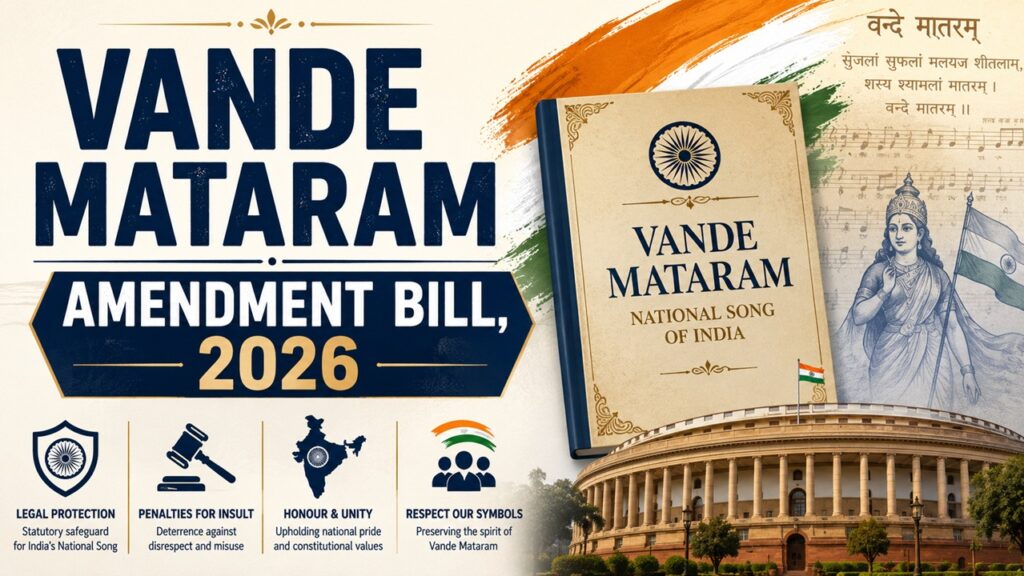
The Rajya Sabha introduced the Prevention of Insults to National Honour (Amendment) Bill, 2026 on 24 July 2026. The Bill seeks to amend the Prevention of Insults to National Honour Act, 1971 to extend statutory protection to Vande Mataram, India’s National Song. If enacted, it would make the intentional disruption of the singing of Vande Mataram a punishable offence, similar to offences relating to the National Anthem. The proposal forms part of the Union Government’s commemorative initiatives marking the 150th anniversary of Vande Mataram and has generated significant constitutional, legal, and political debate regarding national symbols, freedom of conscience, and fundamental rights.
Prevention of Insults to National Honour (Amendment) Bill, 2026
What is the objective of the Bill?
Legal recognition for the National Song
The amendment seeks to provide Vande Mataram with statutory protection by bringing it within the scope of the Prevention of Insults to National Honour Act, 1971.
Existing legal position
At present, the Act criminalises intentional insults to:
- The National Flag
- The Constitution
- The National Anthem (Jana Gana Mana)
The National Song is presently not covered under the Act.
Proposed expansion
The Bill proposes that intentionally preventing or disrupting the singing of Vande Mataram would become a punishable offence carrying penalties identical to those applicable to the National Anthem.
Part of a larger commemoration
The legislation forms part of the Union Government’s year-long programme commemorating the 150th anniversary of Vande Mataram, along with protocols regulating its performance during official ceremonies.
Constitutional debate
The proposal has revived discussions concerning:
- Constitutional status of the National Song
- Freedom of conscience and religion
- Freedom of speech and expression
- Historical interpretation of Indian nationalism
What are the major provisions of the Amendment Bill?
Current provisions under the 1971 Act
Section 3 presently penalises any person who:
- Intentionally prevents the singing of the National Anthem; or
- Disturbs an assembly engaged in singing the National Anthem.
Punishment
The offence is punishable with:
- Imprisonment up to three years, or
- Fine, or
- Both.
Repeat offenders are liable to a minimum imprisonment of one year.
Proposed amendment
The Bill proposes to amend Section 3 by extending the same legal protection to Vande Mataram.
Accordingly, any person who:
- Deliberately prevents the singing of the National Song; or
- Disturbs an assembly singing Vande Mataram,
would face the same punishment applicable to offences involving the National Anthem.
Government’s justification
The Statement of Objects and Reasons refers to Dr. Rajendra Prasad’s statement made on 24 January 1950 in the Constituent Assembly.
He declared that:
- Jana Gana Mana would be India’s National Anthem.
- Vande Mataram would enjoy equal honour because of its historic contribution to the freedom movement.
According to the Government:
- Vande Mataram enjoys symbolic national importance.
- However, no statutory protection presently exists against its deliberate disruption.
- The amendment seeks to remove this legal gap.
What is the historical evolution of Vande Mataram?
Literary origin
- Written by Bankim Chandra Chattopadhyay in 1882.
- Published in his novel Anandamath.
Contribution to India’s freedom movement
The song became one of the strongest symbols of India’s anti-colonial struggle, particularly during the Swadeshi Movement (1905) following the partition of Bengal.
The first two stanzas praise the motherland through imagery of nature and inspired generations of freedom fighters.
Debate surrounding the later stanzas
The later verses portray India through Hindu goddesses such as:
- Durga
- Lakshmi
They also contain religious and militant symbolism.
Sections of the Muslim community argued that these verses:
- Conflict with monotheistic beliefs.
- Could alienate non-Hindu communities.
Several Congress leaders believed compulsory use of the entire song might deepen communal divisions.
What happened in the Congress Working Committee (1937)?
The controversy culminated during the Congress Working Committee meeting held in Calcutta in October 1937.
The settlement was:
- Moved by Rajendra Prasad
- Supported by Sardar Vallabhbhai Patel
- Discussed in the presence of Mahatma Gandhi
- Finalised after consultation with Rabindranath Tagore
Tagore’s recommendation
Rabindranath Tagore advised that:
- Only the first two stanzas should be sung during public and official functions.
- These verses celebrate the motherland without invoking sectarian religious imagery.
The recommendation was unanimously accepted and became the convention followed thereafter.
Position adopted by the Constituent Assembly
On 24 January 1950, Constituent Assembly President Dr. Rajendra Prasad announced that:
- Jana Gana Mana would be India’s National Anthem.
- Vande Mataram would receive equal honour because of its historic role in India’s freedom struggle.
However,
- No constitutional provision granted the National Song legal status equal to the National Anthem.
- This distinction has continued since Independence.
What is the constitutional and legal position?
Constitutional framework
Article 51A(a) lists among the Fundamental Duties:
- Respect for the Constitution.
- Respect for the National Flag.
- Respect for the National Anthem.
The National Song is not mentioned.
Prevention of Insults to National Honour Act, 1971
The Act presently provides statutory protection only to:
- National Flag
- Constitution
- National Anthem
Bijoe Emmanuel v. State of Kerala (1986)
In this landmark judgment, the Supreme Court held that students belonging to the Jehovah’s Witnesses faith could not be compelled to sing the National Anthem, provided they stood respectfully during its rendition.
The Court ruled that compulsory participation violated:
- Article 19(1)(a) — Freedom of speech and expression.
- Article 25 — Freedom of conscience and religion.
Supreme Court observation (2017)
The Supreme Court observed that:
While the Constitution recognises the National Anthem, there is “no concept of a National Song” in law.
The observation reaffirmed the constitutional distinction between the National Anthem and the National Song.
What objections have been raised?
Congress’ position
The Congress argues that the amendment forms part of a broader attempt to redefine Indian nationalism.
Senior Congress leader Jairam Ramesh stated that the 1937 Congress Working Committee decision represented a collective decision of the national movement rather than political appeasement.
He noted that the settlement had the support of:
- Mahatma Gandhi
- Rajendra Prasad
- Vallabhbhai Patel
- Maulana Abul Kalam Azad
- Subhas Chandra Bose
- Govind Ballabh Pant
- Acharya J.B. Kripalani
along with Rabindranath Tagore’s advisory role.
Constitutional objections
Rajya Sabha MP John Brittas argued that:
- Rajendra Prasad’s 1950 statement carried symbolic value but did not create constitutional equality with the National Anthem.
- Article 51A(a) intentionally excludes the National Song.
- Parliament reflected this distinction in the 1971 Act.
He further argued that criminalising conduct relating to Vande Mataram could affect rights guaranteed under:
- Article 14 — Equality before law.
- Article 19(1)(a) — Freedom of speech and expression.
- Article 21 — Right to life and personal liberty.
- Article 25 — Freedom of conscience and religion.
Concerns regarding the 2026 Government Protocol
Legal scholars have criticised the Government Protocol Order dated 28 January 2026, which directs that all six stanzas of Vande Mataram be played at specified official events while attendees stand at attention.
Critics argue that:
- It departs from the 1937 convention of limiting official use to the first two stanzas.
- It may conflict with the principles laid down in Bijoe Emmanuel, which held that patriotic expression cannot be made compulsory against an individual’s conscience.
Concerns raised by Muslim organisations
Several Muslim organisations contend that making participation in Vande Mataram effectively compulsory may violate constitutional guarantees relating to:
- Freedom of conscience.
- Freedom of religion.
Their concerns primarily relate to the later stanzas containing references to Hindu deities and religious symbolism.
Way Forward
The Prevention of Insults to National Honour (Amendment) Bill, 2026 represents an important development in India’s evolving legal framework governing national symbols. While the Government argues that the amendment merely grants statutory protection to a song that played a historic role in India’s freedom struggle, critics maintain that it alters a constitutional distinction preserved since Independence.
The debate extends beyond the legal status of Vande Mataram and raises broader constitutional questions regarding patriotism, individual liberty, freedom of expression, freedom of conscience, and religious pluralism. Going forward, any legislative framework concerning national symbols must balance respect for India’s national heritage with the constitutional values of democracy, equality, and fundamental rights.
Source : The Hindu