
Heatwaves and Lightning Gain Official Disaster Status in India
Context
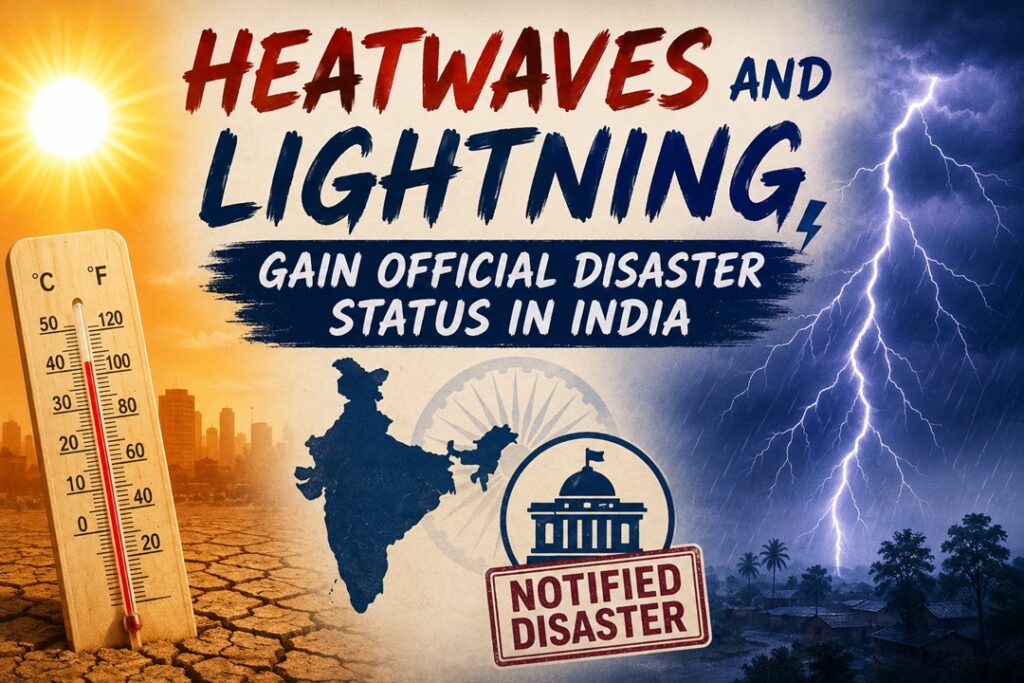
The Ministry of Home Affairs (MHA) has officially brought heatwaves and lightning under the notified natural calamities eligible for assistance through the State Disaster Response Fund (SDRF) and National Disaster Response Fund (NDRF) for the 2026–31 period.
Why is the Decision Important?
The move strengthens India’s disaster-response framework by recognizing two increasingly severe weather hazards as eligible for structured relief and financial assistance.
With this addition, the number of officially recognized natural calamity categories rises from 12 to 14.
Understanding Notified Natural Calamities
- Notified natural calamities are hazards formally recognized under the Disaster Management Act, 2005 for providing government-supported relief and response.
- Heatwaves and lightning now join hazards such as cyclones, droughts, earthquakes, floods, tsunamis, hailstorms, landslides, avalanches, cloudbursts, pest attacks, fires and cold waves.
- Their inclusion enables states to access established disaster-response mechanisms instead of depending primarily on limited local resources.
Heatwave and Lightning: Key Trends in India
- Major cause of weather-related deaths: Lightning accounts for more than 2,000–2,500 deaths annually in India and represents a significant share of fatalities from extreme weather events.
- Strong rural exposure: A large proportion of lightning fatalities occur in rural areas, particularly among farmers, agricultural labourers and tribal communities working outdoors.
- Growing heat-health burden: Summer heatwaves have resulted in thousands of reported heatstroke cases, alongside deaths across several States.
- Economic losses: Apart from human casualties, lightning and extreme heat cause damage to livestock, crops, electrical infrastructure and livelihoods.
Major Vulnerability Zones
1. Eastern India – Lightning Hotspot
Odisha, Jharkhand, Bihar and West Bengal experience frequent lightning activity. Moisture from the Bay of Bengal interacting with unstable continental air contributes to intense thunderstorms.
2. North-Western and Central India – Heatwave Belt
Rajasthan, Punjab, Haryana, Delhi, Uttar Pradesh and Madhya Pradesh regularly face severe and prolonged heat conditions, with temperatures sometimes crossing 45°C.
3. Deccan and Western Peninsular Region – Compound Risk
Parts of Maharashtra, Telangana and Karnataka experience intense summer heat followed by thunderstorms and lightning during the pre-monsoon period.
4. North-East – High Lightning Exposure
States such as Assam, Meghalaya, Sikkim and Arunachal Pradesh experience substantial lightning activity because of mountainous terrain and strong atmospheric convection.
How Does Disaster Notification Work?
- Finance Commission: It assesses disaster-related expenditure, frequency, severity and financial requirements while recommending funding arrangements.
- MHA Approval: The Ministry of Home Affairs incorporates eligible hazards into the operational framework for disaster-response funds.
- SDRF as Primary Mechanism: States primarily use SDRF resources for immediate response and relief.
- Central Assistance: The Centre provides additional support through the NDRF when a disaster exceeds a State’s available response capacity.
- State-Level Mitigation: Separate mitigation resources can support measures designed to reduce future disaster vulnerability.
Why Were Heatwaves and Lightning Added?
Addressing Funding Constraints
Earlier, States dealing with hazards outside the notified list had limited flexibility to use SDRF resources under the local disaster provision. Formal recognition provides a more predictable financial mechanism.
Rising Human Casualties
Lightning has become one of India’s most lethal weather hazards, while extreme heat is increasingly contributing to illness and mortality.
Increasing Climate Extremes
Climate variability and warming are contributing to more frequent and intense episodes of extreme heat, while changing atmospheric conditions can influence severe thunderstorms and lightning.
Protecting Vulnerable Workers
Farmers, construction workers, street vendors, delivery personnel and other outdoor workers face disproportionate exposure to extreme temperatures and thunderstorms.
What Does the New Status Enable?
- Greater Access to Disaster Funds: States can use established SDRF/NDRF mechanisms for eligible relief measures.
- Better Preventive Infrastructure: Resources can support cooling centres, shaded public spaces, early-warning systems and lightning protection infrastructure.
- Stronger Heat Action Plans: States and cities can expand locally tailored Heat Action Plans and preparedness measures.
- Improved Early Warning: Greater integration of weather alerts with district-level response systems can help communities act before extreme events intensify.
- Public Health Coordination: Disaster management authorities can work more closely with health departments to monitor heat illness and weather-related casualties.
- Enhanced Worker Safety: Authorities can strengthen advisories, work-rest arrangements and emergency protocols for people exposed to extreme weather.
Way Forward
The notification marks a shift from treating heatwaves and lightning primarily as recurring weather events to managing them as major disaster risks requiring institutional preparedness and dedicated financial support.
Going forward, the focus should be on accurate early-warning systems, district-level vulnerability mapping, resilient infrastructure, public awareness, occupational safety and climate-responsive disaster planning.
Conclusion
The recognition of heatwaves and lightning as notified natural calamities represents an important expansion of India’s disaster-management architecture. It can improve access to relief funds while encouraging States to invest in prevention and preparedness. The larger objective should be to move from post-disaster compensation to anticipatory action, particularly for rural communities, outdoor workers and other groups most exposed to extreme weather.
Source : NIE