
e-Courts Mission Mode Project: Digitising India’s Justice Delivery System
Context
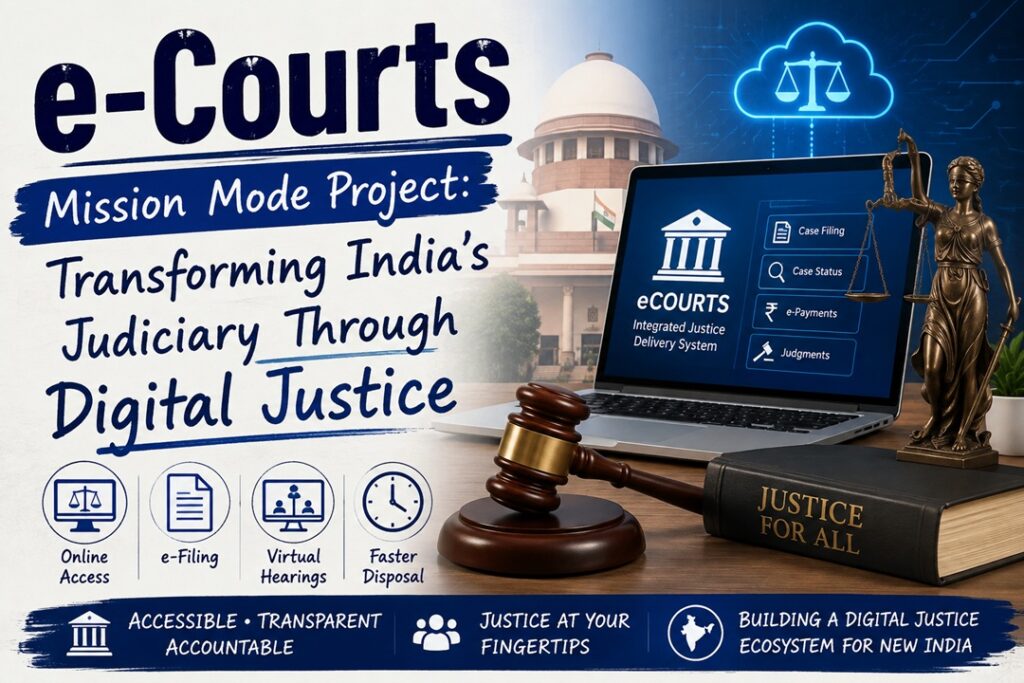
India’s judiciary is undergoing a major technological transformation, moving from traditional paper-driven procedures towards integrated digital systems under the e-Courts Mission Mode Project.
The initiative seeks to make judicial services more accessible, transparent, affordable and efficient by digitising court records, enabling online filing, expanding virtual hearings and connecting different institutions within the criminal justice system.
What is the e-Courts Mission Mode Project?
Launched: 2007
The e-Courts Mission Mode Project is a national initiative aimed at leveraging Information and Communication Technology (ICT) to modernise the judicial system.
Primary Objective
It seeks to:
- Digitise court proceedings and judicial records.
- Improve the speed and efficiency of case processing.
- Provide easier access to judicial information.
- Reduce dependence on physical court visits.
- Improve transparency and accountability.
- Make justice services more affordable and citizen-friendly.
- Strengthen coordination among different components of the justice system.
Why was Judicial Digitalisation Needed?
Continued Reliance on Paper Records
Traditional courts depend heavily on physical files and documents.
This can result in:
- Delays in retrieving records.
- Duplication of administrative work.
- Difficulty in preserving old documents.
- Risk of damage, misplacement or loss of records.
Gaps in Physical Infrastructure
Conventional courts cannot provide equal geographical access to all citizens.
Litigants, witnesses and lawyers may have to travel considerable distances to attend hearings or complete procedural formalities.
High Litigation Expenses
Physical court proceedings can impose additional costs through:
- Transportation.
- Accommodation.
- Loss of working days.
- Documentation and other incidental expenses.
These costs can be particularly burdensome for rural populations and economically weaker sections.
Delayed Justice
Manual procedures and paper-based workflows contribute to:
- Procedural bottlenecks.
- Accumulation of cases.
- Delayed hearings.
- Slow disposal of litigation.
Limited Access to Case Information
Earlier, citizens often had limited and inconvenient access to:
- Case status.
- Hearing dates.
- Court orders.
- Judgments.
- Other judicial documents.
Digital platforms seek to address these transparency and accessibility gaps.
Evolution of the e-Courts Programme
Phase I: Establishing the Digital Base (2011–2015)
The first phase focused primarily on creating the technological foundation required for digital courts.
Major Developments
- Computerisation of more than 14,000 courts.
- Creation of basic networking infrastructure.
- Introduction of ICT-enabled judicial services.
- Digitisation of several basic court functions.
This phase established the foundation for subsequent digital expansion.
Phase II: Expanding Online Judicial Services (2015–2023)
The second phase moved beyond basic computerisation and introduced several citizen-oriented digital services.
Important initiatives included:
- National Judicial Data Grid (NJDG).
- e-Filing.
- e-Sewa Kendras.
- Wider video-conferencing facilities.
- Online access to judicial information.
Video-conferencing infrastructure was expanded substantially, allowing greater participation in proceedings without requiring every stakeholder to be physically present in court.
Phase III: Creating Smart and Paperless Courts (2023–2027)
The third phase focuses on developing digital, paperless and intelligent courts.
Key Priorities
- Large-scale digitisation of legacy records.
- Paperless court processes.
- Virtual and hybrid hearings.
- Interoperability among judicial databases.
- Artificial Intelligence and Machine Learning.
- Optical Character Recognition (OCR).
- Data analytics.
- Automated transcription and translation.
- Improved digital access to justice.
Major Achievements of e-Courts
National Judicial Data Grid: Improving Judicial Transparency
The National Judicial Data Grid (NJDG) is a public digital platform that provides information relating to cases, judgments and court orders.
It enables monitoring of judicial activity across different levels of the judiciary.
Three Major Dashboards
The system provides dedicated dashboards for:
- Supreme Court.
- High Courts.
- District and subordinate courts.
Importance of NJDG
It helps:
- Make information on pending and disposed cases publicly accessible.
- Improve transparency in judicial administration.
- Support judicial planning.
- Monitor case pendency.
- Facilitate remote administrative supervision.
- Assist High Court and District Court authorities in managing workloads.
Thus, NJDG has become an important tool for data-driven judicial administration.
e-Filing: Taking Court Procedures Online
The e-Filing system allows lawyers and litigants to submit documents electronically without having to physically visit the court.
Major Features
- Online payment facilities.
- Electronic submission of Vakalatnamas.
- E-signatures.
- Online recording of oaths.
- Electronic application filing.
- Portfolio management for advocates and litigants.
- Collaborative case management for lawyers, juniors and colleagues.
- Dashboards for monitoring pending and completed cases.
- Ready-to-use templates for frequently filed pleadings.
Digitisation of Old Court Records
Legacy paper records are also being converted into digital formats.
This helps in:
- Faster document retrieval.
- Better preservation.
- Reduced physical storage requirements.
- Easier sharing of judicial records.
Multilingual Digital Justice
The e-Courts ecosystem is increasingly incorporating Indian regional languages alongside English.
This is important because language can be a significant barrier to accessing legal information.
Multilingual digital services can help citizens access:
- Court judgments.
- Orders.
- Case information.
- Filing services.
- Other judicial resources.
Virtual Hearings: Justice Beyond Courtrooms
Video-conferencing has reduced the need for physical presence in several judicial proceedings.
Who Benefits?
Remote hearings can assist:
- Litigants.
- Lawyers.
- Witnesses.
- Police officials.
- Prisoners.
- Experts.
- Other judicial stakeholders.
Advantages
- Lower travel expenditure.
- Reduced time requirements.
- Easier participation from remote locations.
- Better access for people unable to travel.
- Potential reduction in procedural delays.
Nyaya Shruti
Nyaya Shruti is a video-conferencing initiative designed to facilitate virtual testimony.
It can enable participation by:
- Accused persons.
- Witnesses.
- Police officials.
- Prosecutors.
- Forensic experts.
- Prisoners.
The system can reduce the logistical burden of transporting people to court and help expedite judicial proceedings.
Digital Integration of the Criminal Justice System
The digital transformation now extends beyond courts.
Several platforms connect police, prosecution, courts, prisons and forensic institutions, creating an integrated criminal justice ecosystem.
ICJS – Interoperable Criminal Justice System
The Interoperable Criminal Justice System (ICJS) facilitates electronic information exchange among:
- Police.
- Courts.
- Prisons.
- Prosecution agencies.
- Forensic institutions.
It enables digital sharing of information such as:
- FIRs.
- Charge-sheets.
- Court orders.
- Investigation reports.
- Other case-related records.
CCTNS – Crime and Criminal Tracking Network and Systems
CCTNS computerises police procedures and supports the digital management of criminal cases.
It covers processes ranging from:
- FIR registration.
- Investigation.
- Case documentation.
- Charge-sheet preparation.
It also facilitates monitoring of investigation-related deadlines.
ITSSO – Investigation Tracking System for Sexual Offences
ITSSO is designed to monitor investigations relating to sexual offences, particularly cases involving women and children.
It helps authorities track investigations against prescribed charge-sheet timelines.
e-Sakshya
e-Sakshya provides a digital mechanism for capturing and managing electronic evidence.
It seeks to ensure that evidence remains:
- Secure.
- Traceable.
- Authentic.
- Protected from unauthorised alteration.
e-Summons
The e-Summons system enables electronic generation and transmission of court summons.
It aims to make the process of serving notices:
- Faster.
- More transparent.
- Easier to monitor.
MedLEaPR
Medico-Legal Examination and Postmortem Reporting (MedLEaPR) is an online system supporting the digital preparation and management of medico-legal examination and postmortem reports.
It strengthens electronic coordination between hospitals and the justice system.
e-Forensic
The e-Forensic system supports end-to-end digital management of forensic cases.
It facilitates electronic handling and exchange of forensic information during judicial proceedings.
e-Prison
e-Prison is a cloud-based digital framework for prison and prisoner management.
It supports the electronic management of information relating to correctional institutions and inmates.
e-Prosecution
e-Prosecution establishes a digital workflow connecting investigating agencies with prosecution authorities.
It can facilitate:
- Timely legal opinions.
- Better case coordination.
- Faster communication.
- More efficient prosecution management.
NAFIS – National Automated Fingerprint Identification System
NAFIS provides a centralised biometric database for fingerprint identification.
It facilitates rapid comparison of fingerprints with criminal records and strengthens investigative capabilities.
Digital Tracking of Judicial Work
Digital platforms have made it easier for judges, lawyers and litigants to receive real-time or near-real-time case updates.
These include:
- Mobile applications.
- Web portals.
- SMS alerts.
- Email communication.
They reduce dependence on physical court visits for routine information.
The judiciary’s digital ecosystem handles a very large volume of electronic communication and portal traffic, demonstrating the growing scale of technology use in judicial administration.
The JustIS app also assists judges with case-management functions.
GPS-Based Monitoring of Summons Delivery
The National Service and Tracking of Electronic Processes provides a digital mechanism for monitoring the delivery of summons and other judicial processes.
It uses GPS-enabled web and mobile technologies to provide greater visibility into the service process.
Benefits
- Real-time tracking.
- Electronic documentation.
- Greater accountability.
- Faster delivery of notices.
- Better monitoring across districts and States.
This represents a shift from conventional paper-based service towards trackable digital process delivery.
e-Sewa Kendras: Citizen-Friendly Digital Assistance
e-Sewa Kendras have been established at court complexes to help citizens access digital judicial services.
They are particularly important for people who may lack:
- Digital literacy.
- Internet access.
- Knowledge of online court procedures.
Services Provided by e-Sewa Kendras
Case and Filing Assistance
They can help citizens with:
- Case-status information.
- Hearing dates.
- Certified copies.
- e-Filing.
- Digital signatures.
Digital Payment Services
Assistance may include:
- E-stamp facilities.
- E-payment services.
- Traffic challan-related services.
- Virtual court-related processes.
Virtual Court Support
They can assist citizens in accessing:
- Video-conference hearings.
- e-Mulakat jail visits.
- Virtual testimony services such as Nyaya Shruti.
Citizen Facilitation
They also support:
- Access to judgments and orders.
- Basic court-related queries.
- Information regarding legal-aid services.
Thus, e-Sewa Kendras act as a bridge between citizens and digital judicial infrastructure.
Artificial Intelligence in the Judiciary
Phase III is moving the judiciary towards greater use of Artificial Intelligence, Machine Learning and advanced analytics.
Potential applications include:
- Legal research.
- Document analysis.
- Case management.
- Speech-to-text conversion.
- Translation.
- Identification of filing defects.
- Judicial administration.
- Decision-support tools.
However, such technologies are intended to support judges rather than replace human judicial reasoning.
AI and Machine Learning Initiatives
AI-Based Transcription
AI and ML tools are being tested to transcribe oral arguments, including proceedings in Constitutional Bench matters.
Such technology can:
- Reduce manual transcription requirements.
- Create searchable records.
- Improve accessibility of proceedings.
- Assist legal research.
LegRAA – Legal Research and Analysis Assistant
LegRAA is an AI-enabled initiative designed to assist judges with:
- Legal research.
- Document analysis.
- Identification of relevant legal material.
It can potentially reduce the time required for searching and analysing large volumes of legal information.
Digital Courts 2.1
Digital Courts 2.1 seeks to provide judges and judicial officers with a paperless case-management environment.
It aims to provide a single digital interface for accessing case-related information and performing judicial tasks.
Key Technologies
ASR-SHRUTI – Supports automatic speech recognition and voice-to-text conversion.
PANINI – Supports translation and multilingual judicial workflows.
These technologies can assist in the preparation of orders and judgments.
eSCR: Expanding Access to Judgments
The eSCR platform provides digital access to Supreme Court judgments.
Judgments are also being translated into multiple Indian languages with technological support from the National Informatics Centre (NIC).
This can make important judicial decisions more accessible to citizens, students, lawyers and researchers across linguistic regions.
AI-Based Scrutiny of e-Filing
An AI-enabled tool developed with support from IIT Madras can assist in identifying defects in electronically filed petitions.
Its capabilities include:
- Detecting filing-related defects.
- Extracting metadata.
- Supporting automated scrutiny.
- Integration with electronic filing and case-management systems.
Such tools can reduce repetitive administrative work and improve the quality of electronic filings.
Key Benefits of e-Court Digitalisation
Faster Justice Delivery
Automation and online workflows can reduce administrative delays and accelerate case processing.
Greater Transparency
Digital access to case status, orders and judicial data improves accountability.
Lower Litigation Costs
Remote hearings and online filing reduce travel, accommodation and documentation expenses.
Wider Geographical Access
Citizens can access several judicial services without repeatedly travelling to courts.
Better Record Management
Digital records are easier to search, preserve, retrieve and share.
Improved Criminal Justice Coordination
Platforms such as ICJS connect different institutions and facilitate quicker information exchange.
Greater Inclusion
Multilingual services and e-Sewa Kendras can help bridge digital and linguistic barriers.
Data-Driven Judicial Administration
Platforms such as NJDG provide valuable information for monitoring pendency, planning resources and improving court management.
Challenges Ahead
Despite significant progress, digital transformation of the judiciary faces several challenges.
Digital Divide
Citizens without reliable internet access, smartphones or digital literacy may find online systems difficult to use.
Cybersecurity Risks
Digitisation of sensitive judicial and criminal records increases the importance of robust cybersecurity and data protection.
Infrastructure Gaps
Reliable connectivity, hardware and technical support are essential, particularly in remote courts.
Training Requirements
Judges, lawyers, court staff and citizens need continuous training to effectively use new digital platforms.
Interoperability
Different databases and institutions need compatible systems for seamless information exchange.
AI Governance
AI systems used in judicial environments require strong safeguards relating to:
- Accuracy.
- Bias.
- Explainability.
- Data protection.
- Human oversight.
What Lies Ahead?
Phase III aims to establish a more integrated, paperless and technology-enabled judiciary by 2027.
Future priorities include:
- Wider adoption of AI and Machine Learning.
- Complete digitisation of legacy records.
- Expansion of virtual and hybrid hearings.
- Greater multilingual access.
- Interoperable judicial databases.
- Advanced legal research tools.
- Automated transcription and translation.
- Stronger digital evidence management.
- Improved citizen-facing services.
The long-term objective is to create a justice delivery system that is faster, transparent, affordable, inclusive and accessible regardless of geographical location.
Conclusion
The e-Courts Mission Mode Project represents a fundamental shift from a paper-intensive judicial system to a digitally connected justice ecosystem.
From NJDG and e-Filing to virtual hearings, e-Sewa Kendras, ICJS and AI-based judicial tools, digital technologies are reshaping how courts function and how citizens interact with the justice system.
The next phase should focus on combining technological innovation with cybersecurity, accessibility, digital literacy, data protection and human judicial oversight so that digitalisation ultimately strengthens—not merely automates—the delivery of justice.
Source : PIB