
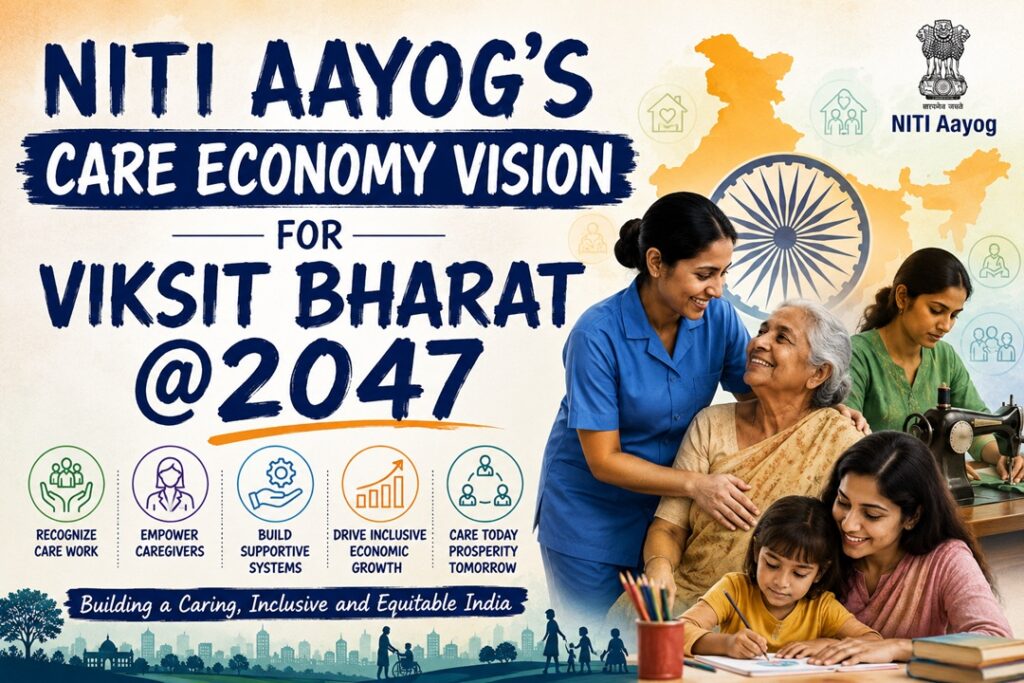
NITI Aayog’s Care Economy Vision for Viksit Bharat@2047
Context
NITI Aayog has released a landmark report titled “Reimagining Care: Strategies for Empowering Caregivers in Viksit Bharat@2047”. The report underlines the need to professionalise India’s caregiving workforce, strengthen social protection and create a structured care economy to meet the country’s rapidly changing demographic and social needs.
Understanding Caregiving and Care Workers
According to the World Health Organization (WHO) definition adopted in the report, caregivers are individuals who provide physical, emotional and social support to people who are unable to independently perform activities of daily living due to age, chronic illness or disability.
Formal Caregivers
- These are trained professionals such as personal care aides, home-health aides and geriatric assistants.
- They provide paid care in homes, hospitals, rehabilitation centres and institutional facilities.
- Their responsibilities may include non-medical assistance as well as certain clinical support services, depending on their training.
Informal Caregivers
- They include family members, relatives, friends and community volunteers.
- Their services are generally unpaid and provided outside formal employment structures.
- They remain the primary source of long-term care for elderly, disabled and chronically ill persons in India.
India’s Emerging Care Economy
Accelerating Demographic Ageing
India’s elderly population aged 60 years and above stood at around 149 million, or 10.5% of the total population, in 2022.
This figure is projected to reach 347 million, or 20.8% of the population, by 2050.
The rapid increase in the elderly population will significantly expand the requirement for long-term, home-based, institutional and palliative care.
Expanding Disability-Related Care Requirements
More than 26.8 million persons with disabilities, accounting for around 2.21% of India’s population, depend on family members or professional caregivers for varying levels of support.
The Rights of Persons with Disabilities (RPwD) Act, 2016, recognises 21 categories of disabilities, creating a substantial and diverse need for specialised care services.
Gender Imbalance in Unpaid Care
India’s unpaid care economy is heavily dependent on women.
According to the Time Use Survey, women spend approximately 299 minutes per day on unpaid domestic and caregiving activities, compared with just 97 minutes per day for men.
This unequal distribution of care responsibilities can restrict women’s participation in paid employment, education and economic opportunities.
Rapidly Growing Care Services Market
India’s care services market was valued at approximately USD 29.62 billion in 2023.
It is expanding at a CAGR of 13.76% and is projected to reach around USD 72.31 billion by 2030.
This indicates that caregiving has the potential to emerge as an important source of employment and economic activity.
Different Forms of Caregiving in India
Family-Centred Informal Care
Family members and relatives provide unpaid assistance to elderly, disabled and chronically ill persons within households.
This traditional system continues to constitute the core of India’s informal care structure.
Community-Oriented Care
Local volunteers, extended families, community groups and Self-Help Groups (SHGs) contribute to caregiving at the community level.
Examples include:
- Kudumbashree’s K4 Care
- Kerala’s Neighbourhood Network in Palliative Care
These initiatives demonstrate the potential of community institutions in addressing local care requirements.
Institutional Professional Care
Trained personnel provide round-the-clock services in:
- Old-age homes
- Rehabilitation centres
- Hospitals
- Specialised geriatric wards
- Long-term care institutions
Such caregivers are increasingly important as family-based care becomes difficult to sustain amid urbanisation and migration.
Home-Based and Palliative Assistance
Professional caregivers also provide services directly at patients’ residences.
These include:
- Bedside assistance
- Dementia care
- Support for elderly persons
- Chronic disease management
- Palliative care
- Assistance with daily activities
Home-based care can reduce the burden on hospitals and allow patients to remain within familiar surroundings.
International Models India Can Learn From
Japan – Long-Term Care Insurance and Overseas Workforce
Japan introduced a mandatory Long-Term Care Insurance (LTCI) system in 2000 to address the needs of its ageing population.
It has also introduced the Specified Skilled Worker (SSW) visa route to recruit foreign care workers.
Bilateral government-to-government arrangements help facilitate the recruitment and deployment of trained caregivers.
Germany – Insurance Support and Flexible Care Leave
Germany operates a mandatory Long-Term Care Insurance system.
Beneficiaries can choose between:
- Cash benefits for family caregivers, or
- Professional in-kind care services.
The Familienpflegezeitgesetz also provides protected care leave of up to 24 months, allowing workers to balance employment with caregiving responsibilities.
China – Skill Certification and Care Technology
China has established an eight-level national competency framework for caregivers.
It has also reduced mandatory formal educational requirements to broaden workforce participation, particularly in rural areas.
China is additionally promoting technological solutions in eldercare and has contributed to international standards such as IEC 63310 concerning eldercare robots.
Major Gaps in India’s Caregiving Framework
Weak Institutional Coordination
India does not currently have a single apex statutory authority dedicated to caregiving.
As a result, programmes and policies remain dispersed across areas such as:
- Health
- Social justice
- Labour
- Skill development
- Elderly welfare
This fragmented approach can result in duplication, gaps and weak coordination.
Absence of Uniform Training Standards
Caregiving courses differ considerably in:
- Duration
- Curriculum
- Skill requirements
- Certification
- Quality
Indian qualifications also lack adequate international alignment and mutual recognition in several major destination countries.
Limited Social Security and Worker Protection
Many formal caregivers continue to face:
- Low wages
- Inadequate health insurance
- Weak social-security coverage
- Poor working conditions
- Employment insecurity
- Workplace exploitation
The sector also remains inadequately integrated with broader social-protection frameworks.
Caregiver Fatigue and Workforce Attrition
Caregiving can involve significant emotional and physical stress.
The shortage of specialised training for conditions such as Alzheimer’s disease and dementia can increase caregiver burnout, emotional exhaustion and workforce turnover.
Migration-Driven Care Deficits
The movement of young people from rural areas to urban centres can leave elderly parents without traditional family support.
This rural-to-urban migration is gradually weakening informal care networks and increasing the demand for organised care services.
NITI Aayog’s Reform Agenda
Establish a National Caregiver Council
NITI Aayog recommends creating a National Caregiver Council (NCC) as an apex institutional mechanism under the Ministry of Social Justice & Empowerment.
The proposed body could:
- Regulate the caregiving sector
- Accredit training institutions
- Standardise caregiving courses
- Establish professional benchmarks
- Maintain a National Caregiver Registry
Create a National Caregiving Policy
A comprehensive national policy should recognise caregiving as an important allied health and social-care profession.
The framework should also address:
- Minimum wage standards
- Social-security benefits
- Worker protection
- Training and certification
- Career progression
- Employment conditions
Align Training with NSQF
Caregiver qualifications should be integrated with the National Skills Qualification Framework (NSQF).
The Recognition of Prior Learning (RPL) mechanism can help certify the skills of experienced informal caregivers and enable them to transition into the formal care workforce.
Expand Government-to-Government Mobility Channels
India can strengthen international caregiver mobility through strategic G2G partnerships.
Existing cooperation frameworks, including the India-Germany Triple Win programme and India-Israel arrangements, can be leveraged to prepare caregivers for overseas employment.
Training should cover:
- Foreign languages
- Cultural competency
- Destination-country regulations
- Professional caregiving standards
Strengthen Family Support and Respite Services
The caregiving ecosystem should also support families who continue to provide unpaid care.
Key measures include:
- Introducing formal care-leave provisions
- Establishing community-based respite centres
- Linking caregivers with Ayushman Arogya Mandirs
- Mobilising CSR funding for local care infrastructure
- Developing accessible community care services
Why Professionalising Caregiving Matters
A structured caregiving sector can generate multiple benefits for India:
Employment Generation:
The expanding care economy can create large numbers of jobs, particularly for women and semi-skilled workers.
Women’s Economic Empowerment:
Reducing the burden of unpaid care can allow more women to participate in formal employment and entrepreneurship.
Healthy Ageing:
Professional services can improve the quality of life of India’s growing elderly population.
Social Protection:
Formalisation can bring caregivers within systems of wages, insurance and social security.
International Employment Opportunities:
Standardised Indian qualifications can enable caregivers to access the growing global demand for care workers.
Inclusive Development:
A strong care ecosystem can support elderly persons, persons with disabilities and chronically ill individuals while reducing pressure on families.
Way Forward
India’s demographic transition makes caregiving an increasingly important component of its development strategy. The sector must move beyond its traditional perception as an unpaid household responsibility and evolve into a recognised, skilled and protected profession.
Creating a National Caregiver Council, introducing common training standards, expanding social-security coverage, recognising prior learning and developing international mobility pathways can help build a resilient care workforce.
A professional care economy can simultaneously address India’s ageing population, create employment, promote women’s economic participation and meet international demand for skilled caregivers.
Conclusion
Reimagining caregiving is essential for achieving the broader vision of Viksit Bharat@2047. By transforming care work into a formal and dignified profession, India can convert an often invisible household responsibility into a significant source of employment, social security, gender empowerment and economic growth.
Ultimately, a developed India must not only grow economically but also build systems that ensure its elderly, persons with disabilities and other vulnerable groups receive accessible, affordable and compassionate care.
Source : NITI Aayog