
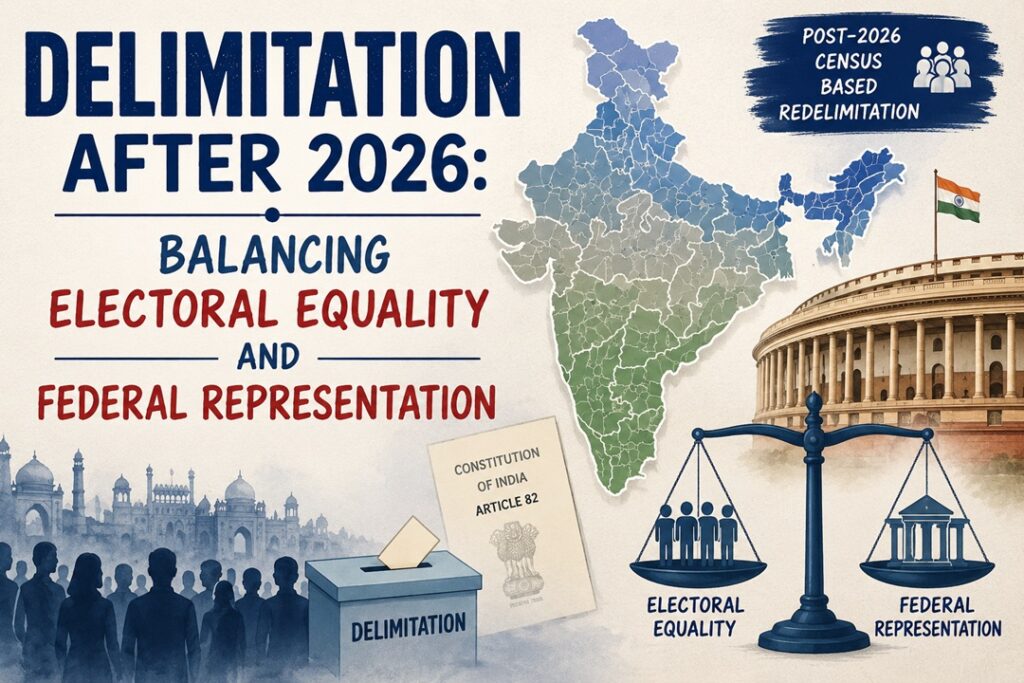
Delimitation After 2026: Balancing Electoral Equality and Federal Representation
Context
The proposed post-2026 delimitation exercise is generating intense discussion over the future distribution of Lok Sabha seats among States once the findings of the 2027 Census become available.
Why is Delimitation in Focus?
Meaning of Delimitation
- Delimitation refers to the legal exercise of determining or revising the boundaries of Lok Sabha and State Legislative Assembly constituencies according to changes in population.
- The process is undertaken by an independent Delimitation Commission, whose orders have the force of law and are generally not open to judicial challenge.
- Its fundamental purpose is to achieve greater equality in representation by ensuring that constituencies have broadly comparable populations.
Evolution of Delimitation in India
- First Commission, 1952: Established under the Delimitation Act, 1952, using the 1951 Census to determine the initial distribution of parliamentary and Assembly constituencies.
- Second Commission, 1963: Constituted after the 1961 Census and the reorganisation of States.
- Third Commission, 1973: Based on the 1971 Census and resulted in the Lok Sabha strength being raised to 543 seats.
- 1976 Constitutional Freeze: The 42nd Amendment froze the allocation of Lok Sabha seats among States based on 1971 population figures, encouraging States to pursue population-control measures without fear of losing political representation.
- 2002 Delimitation Exercise: The 84th and 87th Constitutional Amendments continued the inter-State seat freeze until after 2026, while allowing constituency boundaries within States to be revised using 2001 Census figures.
Constitutional Framework
Several provisions of the Constitution govern the delimitation process:
- Article 81: Provides for the composition of the Lok Sabha and envisages population-based distribution of seats among States, as far as practicable.
- Article 82: Requires Parliament to provide for readjustment of Lok Sabha constituencies and State-wise allocation after each Census through legislation.
- Article 170: Deals with the territorial division of States into constituencies for Legislative Assembly elections.
- Articles 330 and 332: Provide for reservation of seats for Scheduled Castes (SCs) and Scheduled Tribes (STs) in the Lok Sabha and State Assemblies based on population figures.
Potential Advantages of the Exercise
- Greater Representation Equality: Delimitation can address disparities in the number of people represented by individual MPs, strengthening the principle of one person, one vote, one value.
- Population-Based Representation: It can bring parliamentary representation in line with demographic changes, including migration, urbanisation and regional population growth.
- Implementation of Women’s Reservation: The constitutional framework for 33% reservation for women in Parliament and State Assemblies links its implementation to the post-2026 delimitation process.
- Revision of SC/ST Constituencies: Updated population figures can facilitate a fresh assessment of reserved constituencies and improve proportional representation.
- Technology-Enabled Boundary Mapping: Digitised Census information and modern GIS tools could make constituency mapping more systematic and potentially faster.
Major Concerns and Difficulties
- Population-Control Disincentive: States that successfully lowered fertility rates may see their relative parliamentary influence decline, while States with faster population growth could obtain more seats.
- North-South Representation Gap: Southern States argue that losing political weight despite contributing substantially to the national economy could disturb the existing balance between fiscal contribution and political representation.
- Possibility of Gerrymandering: Constituency boundaries can potentially be manipulated through practices such as packing opposition voters into a limited number of constituencies or cracking their concentration across several constituencies.
- Larger Lok Sabha: A substantial increase in the number of MPs could create difficulties relating to parliamentary functioning, constituency management and legislative coordination.
- Federal Friction: Differences among States over political representation could intensify debates surrounding fiscal transfers, resource distribution and the federal structure.
What Can Be Done?
- Adopt a Federal-Sensitive Formula: Instead of relying exclusively on population, India could explore mechanisms that expand the overall size of the Lok Sabha while preventing an excessive loss of representation for States that have stabilised their populations.
- Use Independent Digital Mapping: Open and transparent GIS-based constituency mapping can improve public confidence and reduce the possibility of politically motivated boundary changes.
- Reinforce the Rajya Sabha: A stronger federal role for the Upper House could provide additional safeguards for the interests of States if population-based Lok Sabha redistribution substantially changes the balance of power.
- Ensure Predictable Reservation Rotation: Clear and transparent procedures should govern the rotation of women, SC and ST reserved constituencies to ensure continuity and fairness.
Conclusion
The post-2026 delimitation exercise will be more than a technical redrawing of electoral boundaries; it will be a major test of India’s democratic representation and federal equilibrium. The challenge is to reconcile the principle of equal representation with the concerns of States that have successfully achieved demographic stabilisation.
A transparent, consultative and constitutionally grounded approach—supported by reliable Census data, independent mapping and broad political consensus—will be essential to preserve electoral fairness, federal trust and national unity.
Source : The Hindu