
Supreme Court’s New Framework for Gender-Sensitive Judgments
Context
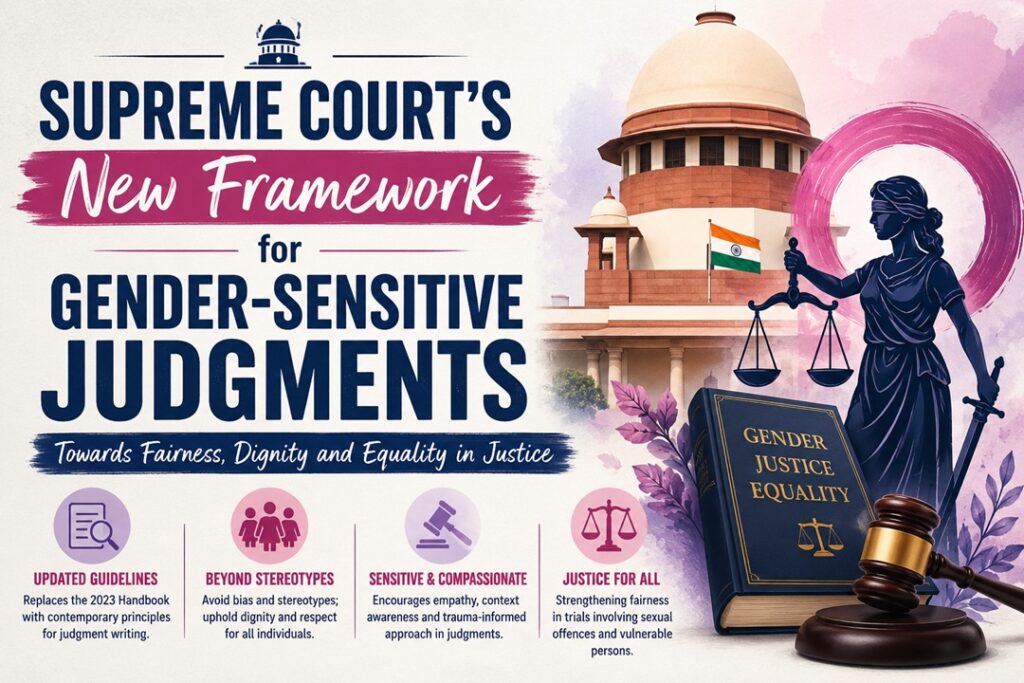
The Supreme Court has released ‘Judgments and Gender: Sensitivity and Compassion in Writing Judgments’, a report prepared by a committee headed by former Justice Aniruddha Bose.
The report replaces the 2023 Handbook on Combating Gender Stereotypes and provides updated, practical guidance for judges, prosecutors and lawyers dealing with sexual offences and cases involving vulnerable persons.
Judgments and Gender: Sensitivity and Compassion in Writing Judgments
About the Report
The publication is an official Supreme Court resource aimed at developing a trauma-informed, survivor-centric and compassionate judicial process.
While the 2023 handbook primarily focused on identifying gender stereotypes in judicial language, the new report goes further by examining the practical realities of trial courts.
It seeks to:
- Eliminate victim-blaming and patriarchal expressions.
- Protect the dignity, privacy and autonomy of survivors.
- Improve courtroom conduct and treatment of witnesses.
- Encourage trauma-sensitive judicial reasoning.
- Promote neutral and legally precise terminology.
- Strengthen safeguards for vulnerable witnesses and survivors.
Major Findings and Guidelines
1. Evidence-Based Review of Trial Judgments
The committee examined 125 trial court judgments from across India to identify recurring gender stereotypes, patriarchal expressions and insensitive approaches in judicial reasoning.
The exercise helped the committee develop recommendations based on actual courtroom practices rather than theoretical assumptions alone.
2. Replace the Term ‘Prosecutrix’
The report recommends moving away from the procedural expression ‘prosecutrix’.
Depending on the circumstances, courts are encouraged to use terms such as:
- Victim
- Survivor
- Complainant
The objective is to use language that recognizes the individual’s experience rather than reducing the person to a procedural role.
3. Avoid Morality-Based and Chastity-Oriented Language
Judgments should avoid expressions suggesting that sexual violence has destroyed a woman’s:
- Chastity
- Honour
- Purity
- Soul
- Family reputation
- Social standing
Such terminology can reinforce patriarchal ideas and shift attention away from the criminal act and the rights of the survivor.
4. Focus on Bodily Autonomy and Dignity
Sexual offences should be described primarily as violations of bodily autonomy, bodily integrity and personal dignity.
Judicial reasoning should also acknowledge the serious physical and psychological consequences that may follow sexual violence.
5. Adoption of the SOGIESC Framework
The report encourages courts to use the Sexual Orientation, Gender Identity, Expression and Sex Characteristics (SOGIESC) framework.
This promotes respectful and inclusive judicial language while ensuring that court proceedings are sensitive to the experiences of LGBTQIA+ persons.
6. Witnesses Must Be Treated with Dignity
The report emphasizes that witnesses should be treated as guests of the court.
Courts should minimize:
- Excessive waiting periods.
- Unnecessary adjournments.
- Intimidating courtroom environments.
- Disrespectful treatment.
- Procedural practices that increase anxiety or distress.
7. Restrictions on Offensive Cross-Examination
The report stresses the importance of statutory safeguards under the Bharatiya Sakshya Adhiniyam, 2023 (BSA).
Questions concerning a survivor’s previous sexual history should not be used merely to shame, humiliate or attack character.
Judges are expected to prevent indecent, scandalous, offensive or irrelevant questioning.
8. Trauma-Informed Evaluation of Testimony
Judges should avoid automatically drawing adverse conclusions from:
- Delayed reporting.
- Minor inconsistencies in testimony.
- Absence of physical injuries.
- Differences in how survivors describe traumatic experiences.
The report recognizes that trauma does not affect every individual in the same manner.
Why Gender Sensitivity Is Important in the Judiciary
Preventing Secondary Victimization
A survivor may experience further trauma through insensitive questioning, hostile cross-examination, unnecessary repetition and graphic descriptions in court judgments.
A compassionate judicial process can reduce this form of secondary victimization.
Challenging Rape Myths and Gender Stereotypes
The guidelines seek to challenge assumptions that a survivor’s credibility depends on:
- Clothing.
- Lifestyle.
- Previous relationships.
- Sexual history.
- Behaviour.
- Delay in filing a complaint.
Such factors should not be allowed to become substitutes for legally relevant evidence.
Encouraging Survivors to Seek Justice
A judicial system that protects dignity can increase confidence among survivors in approaching law-enforcement agencies and courts.
Eliminating humiliating or character-based judicial commentary is therefore important for improving access to justice.
Strengthening Constitutional Values
Gender-sensitive adjudication supports constitutional principles of:
- Equality.
- Dignity.
- Privacy.
- Personal liberty.
- Bodily autonomy.
These principles are closely connected with the fundamental rights framework, particularly Article 21 of the Constitution.
Making Guidelines Relevant to Trial Courts
The report attempts to bridge the gap between theoretical guidance and actual courtroom conditions.
It responds to the concern that earlier guidelines required greater adaptation to the practical realities of Indian trial courts and the needs of judges, lawyers, witnesses and survivors.
Challenges in Implementing the Framework
Deep-Rooted Patriarchal Attitudes
Changing established attitudes among legal professionals and judicial officers remains a major challenge.
Continuous training and institutional sensitization will be necessary to change courtroom culture.
Problematic Cross-Examination Practices
Defence questioning can sometimes move from legitimate testing of credibility to personal attacks on the survivor.
Judicial officers therefore need to exercise active control over courtroom questioning.
Inadequate Court Infrastructure
Many trial courts may not have:
- Separate waiting areas.
- Safe deposition facilities.
- Child- or vulnerable-witness-friendly spaces.
- Adequately trained support personnel.
Such infrastructure is important for protecting vulnerable witnesses.
Limited Awareness of Support Schemes
The report highlights inadequate awareness regarding support mechanisms.
According to the survey discussed in the report, 80.7% of respondents were unaware of the Witness Protection Scheme or statutory victim-compensation frameworks.
Procedural Delays
Repeated adjournments can force survivors to revisit traumatic incidents multiple times.
Long delays may increase psychological distress and discourage continued participation in legal proceedings.
Recommendations of the Supreme Court Committee
1. Regular Judicial Empathy Training
State Judicial Academies should institutionalize continuous training covering:
- Gender sensitivity.
- Trauma awareness.
- Emotional intelligence.
- Communication skills.
- Compassionate courtroom management.
Legal knowledge should therefore be complemented by appropriate interpersonal and behavioural skills.
2. Greater Use of In-Camera Proceedings
Courts should proactively use in-camera proceedings where legally required or appropriate to protect survivors and vulnerable witnesses.
Identity protection through pseudonyms or initials should also be ensured in judicial records in accordance with applicable law.
3. Pre-Trial Counselling and Support
Survivors should receive appropriate legal and psychological assistance before proceedings begin.
Such support can help them understand courtroom procedures, reduce anxiety and prepare for the trial process.
4. Stronger Judicial Control Over Cross-Examination
Presiding judges should intervene when questioning becomes:
- Offensive.
- Scandalous.
- Irrelevant.
- Humiliating.
- Moralistic.
- Focused unnecessarily on sexual history or character.
The court should ensure that legitimate defence rights do not become a means of victim harassment.
5. Standardized and Neutral Terminology
The report encourages courts to adopt a consistent glossary based on neutral, respectful and legally accurate terminology.
Problematic expressions such as ‘prosecutrix’ and outdated morality-based descriptions should be avoided where more appropriate legal terminology is available.
Significance for the Indian Justice System
The report is significant because it attempts to transform gender sensitivity from merely a question of word choice into a broader question of judicial conduct and courtroom administration.
Its approach recognizes that justice is not limited to determining guilt or innocence. The manner in which proceedings are conducted can also affect the dignity, confidence and psychological well-being of survivors and witnesses.
The framework therefore places emphasis on:
Dignity + Privacy + Bodily Autonomy + Trauma Awareness + Fair Procedure
At the same time, gender-sensitive procedures must operate within the broader principles of due process, fair trial and the rights of the accused.
Conclusion
The Supreme Court’s 2026 report marks a shift from largely theoretical guidance on gender-sensitive language towards a practical and compassionate model of judicial functioning.
By discouraging patriarchal and morality-based expressions, promoting trauma-informed assessment of testimony, regulating inappropriate cross-examination and strengthening protection for vulnerable witnesses, the framework seeks to make the justice process more respectful and accessible.
Its success, however, will depend on effective implementation at the trial-court level through continuous judicial training, institutional monitoring, appropriate infrastructure and greater awareness of survivor-support mechanisms.
Ultimately, gender-sensitive adjudication is not about compromising judicial neutrality; it is about ensuring that equality, dignity, bodily autonomy and fair procedure remain central to the administration of justice.
Source : The Hindu