
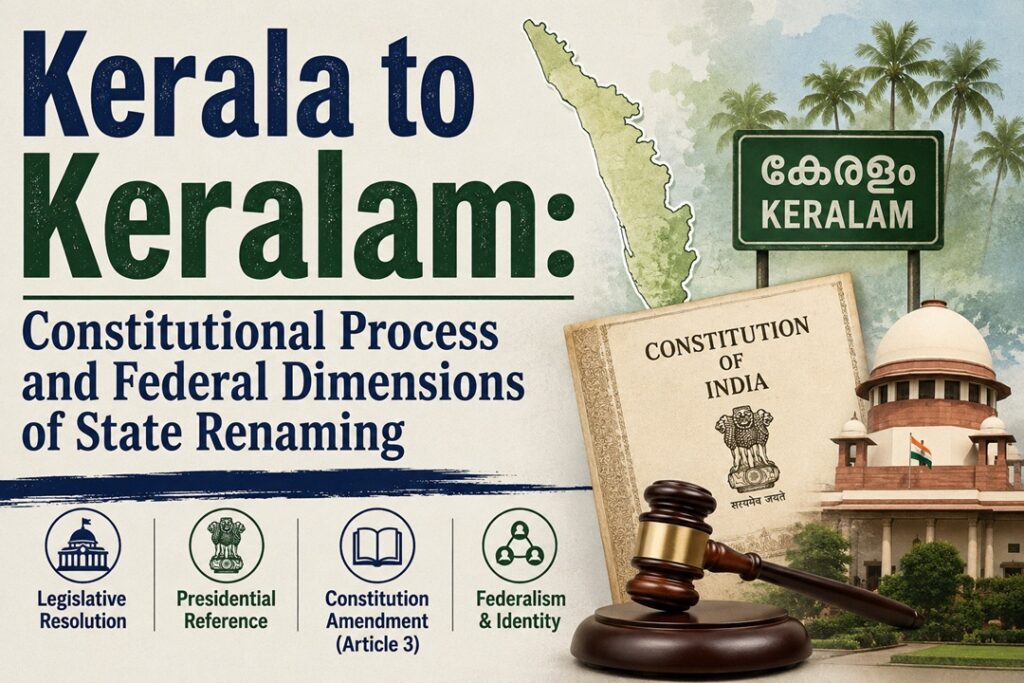
Kerala to Keralam: Constitutional Process and Federal Dimensions of State Renaming
Context
The Union Cabinet approved the proposal to rename the state of Kerala as “Keralam” in February 2026.
The proposal seeks to align the state’s official constitutional name with “Keralam”, the name traditionally used in Malayalam, while reflecting the region’s linguistic, historical and cultural identity.
Why Has Kerala Been Proposed to Be Renamed Keralam?
Origin of the Proposal
The initiative traces back to a unanimous resolution of the Kerala Legislative Assembly passed on 24 June 2024, requesting a change in the First Schedule of the Constitution.
The proposal was subsequently examined by the Union Government and relevant departments.
Presidential Reference and Assembly Approval
In June 2026, President Droupadi Murmu referred the proposed legislation to the Kerala Legislative Assembly for its views.
In July 2026, the Assembly unanimously approved all 10 clauses contained in the Presidential reference, allowing the proposal to move ahead in the constitutional process.
It was the first Presidential reference of this nature received by the Kerala Assembly.
Linguistic and Cultural Rationale
The demand for “Keralam” is primarily rooted in:
- Language: “Keralam” is the Malayalam name traditionally used for the state.
- Cultural heritage: The term is closely associated with Kerala’s historical and regional identity.
- Malayalam-speaking State: The demand is connected with the historical movement for creating a unified Malayalam-speaking region.
- Linguistic reorganisation: Kerala was formed on linguistic lines on 1 November 1956, observed as Kerala Piravi.
Thus, the proposed change aims to bring the constitutional nomenclature closer to the name commonly used in Malayalam.
Constitutional Framework Governing State Renaming
Article 3 of the Constitution
Article 3 gives Parliament the authority to:
- Establish a new State;
- Increase or reduce the area of an existing State;
- Modify the boundaries of a State; and
- Change the name of a State.
Therefore, a State Legislature cannot independently alter the constitutional name of the State.
The ultimate legal authority to rename a State rests with Parliament.
How Does the State Renaming Process Work?
1. Proposal from the State
A renaming initiative can begin with a resolution of the concerned State Legislature.
In Kerala’s case, the Legislative Assembly unanimously adopted such a resolution on 24 June 2024.
2. Union Government Examination
The proposal is then examined by the Ministry of Home Affairs (MHA) and other relevant government departments.
For Kerala, the proposal received concurrence from the Department of Legal Affairs and the Legislative Department.
3. Reference by the President
Under the proviso to Article 3, a Bill affecting a State’s name, area or boundaries must be referred by the President to the concerned State Legislature for its views.
President Droupadi Murmu referred the Kerala proposal to the State Assembly in June 2026.
4. State Legislature Gives Its Views
The concerned State Legislature gets an opportunity to express its opinion.
The Kerala Assembly unanimously endorsed all 10 provisions referred to it.
However, these views are not binding on Parliament. Parliament can proceed with the legislation even if a State Legislature does not agree with the proposed change.
5. Consideration by Parliament
After the State Legislature’s views are obtained, the Bill can be introduced in Parliament only with the President’s recommendation.
It must then be approved by both Houses of Parliament through a simple majority.
6. Presidential Assent
Once both Houses pass the legislation, it is sent to the President.
Following Presidential assent and notification of the law, the official name of the State is changed.
7. Modification of the First Schedule
The First Schedule of the Constitution, which contains the names of States and Union Territories, would be modified to replace “Kerala” with “Keralam.”
Importantly, a State’s renaming under Article 3 does not require the special constitutional amendment procedure under Article 368. It can be achieved through an ordinary law enacted by Parliament.
State Renaming vs Changing the Name of India
| Aspect | Renaming a State | Changing “India” to “Bharat” |
|---|---|---|
| Constitutional provision | Article 3 | Article 1 |
| Legislative route | Ordinary law | Constitutional Amendment |
| Majority required | Simple majority | Special majority under Article 368 |
| Constitutional provision affected | First Schedule | Article 1 |
| Role of Parliament | Final authority | Constitutional amendment required |
Article 1 currently provides that “India, that is Bharat, shall be a Union of States.”
Replacing “India” entirely with “Bharat” would therefore require an amendment to Article 1 under Article 368.
Such an amendment would require:
- A majority of the total membership of each House of Parliament; and
- At least two-thirds of members present and voting in each House.
Supreme Court’s Position on India and Bharat
The Supreme Court has considered petitions seeking replacement of the term “India” with “Bharat.”
- In 2016, the Court declined to entertain the plea.
- In 2020, it directed that the petition be treated as a representation before the appropriate government rather than ordering a constitutional change.
The present constitutional position therefore continues to recognise both “India” and “Bharat” under Article 1.
Why Is the Keralam Proposal Important?
Strengthening Federal Interaction
The case highlights the relationship between State-level initiatives and Parliament’s constitutional authority under Article 3.
Recognition of Linguistic Diversity
The proposal reflects India’s plural linguistic and cultural traditions and the constitutional framework’s accommodation of regional identities.
Constitutional Adaptability
Article 3 provides a relatively flexible mechanism for changing the territorial configuration and nomenclature of States without invoking the more stringent Article 368 amendment process.
Cooperative Federalism
The process involves multiple constitutional actors — the State Legislature, President and Union Government, followed by Parliament’s final consideration.
Way Forward
Any proposal to rename a State should be assessed through:
- Constitutional and legal requirements;
- Historical and linguistic evidence;
- Administrative practicality;
- Broad democratic agreement; and
- The need to minimise administrative disruption.
The proposed transition from Kerala to Keralam demonstrates how India’s constitutional framework can accommodate changing linguistic and cultural aspirations.
At the same time, Article 3 preserves the federal balance: States may initiate demands for change and express their views, but the final constitutional authority to alter a State’s name remains with Parliament.
Source : News on Air