
MSME Development (Amendment) Bill, 2026: Strengthening India’s Small Business Ecosystem
Context
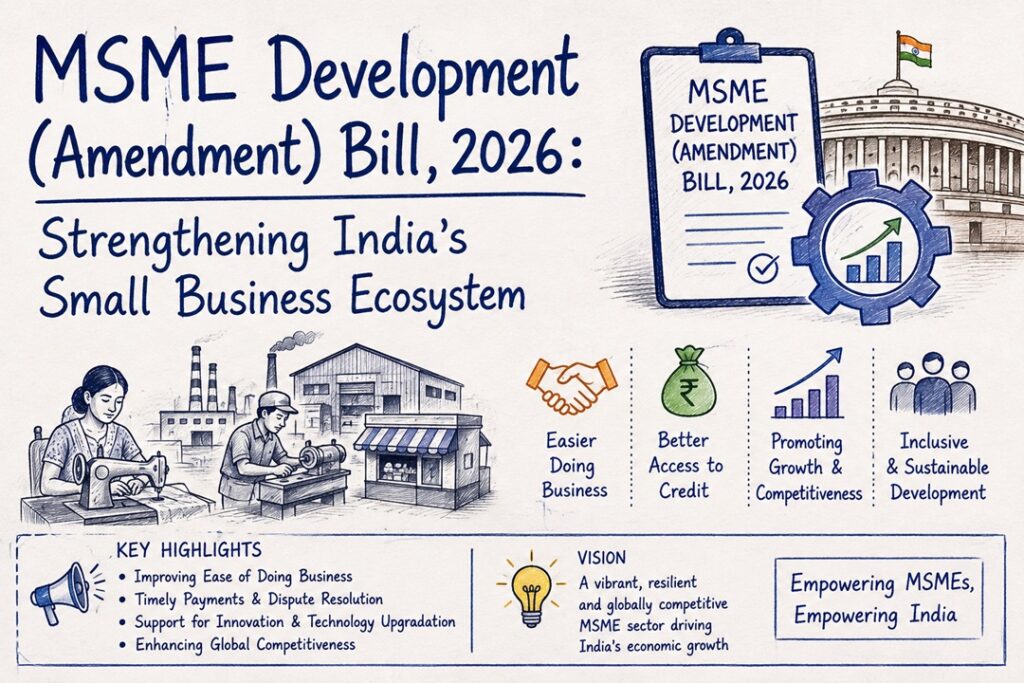
The Micro, Small and Medium Enterprises Development (Amendment) Bill, 2026, was recently passed by Parliament in August 2026. The legislation seeks to modernise the regulatory framework for MSMEs, address delayed payments, improve dispute resolution and promote ease of doing business.
MSMEs: Backbone of the Indian Economy
The Micro, Small and Medium Enterprises Development Act, 2006 provides the principal legal framework for the MSME sector. The proposed amendments aim to create a more supportive environment for enterprise expansion, competitiveness and formalisation.
Key Economic Contributions
According to the Economic Survey 2025–26:
- GDP contribution: 31.1%
- Manufacturing output: 35.4%
- Exports: 48.58%
MSME Sector: Scale and Emerging Trends
As of August 2026:
- Registration: Around 9.16 crore MSMEs are registered on the Udyam platform.
- Employment: The registered enterprises collectively provide employment to more than 40 crore people.
- Transformation: Technology adoption and IT-enabled systems are increasingly reshaping MSME operations.
- Geographical reach: MSMEs operate across rural, semi-urban and urban regions and are becoming increasingly integrated with formal supply chains.
Major Changes Proposed by the 2026 Amendment
Revised Basis for MSME Classification
MSMEs will continue to be categorised using:
- Investment in plant, machinery or equipment; and
- Annual turnover.
Simplified MSME Registration
The Bill provides that filing the MSME memorandum will be free and voluntary.
The Central Government may establish a national MSME platform, while States can introduce their own platforms. Enterprises registered through these systems can also access benefits under State-level schemes.
TReDS: Tackling the Delayed Payment Problem
The Trade Receivables Discounting System (TReDS) is an electronic mechanism that enables MSMEs to obtain finance against their trade receivables.
Compulsory TReDS for CPSEs
Central Public Sector Enterprises (CPSEs) will be required to settle invoices raised by MSMEs through TReDS, helping address persistent payment delays.
Wider State-Level Adoption
States may require their Public Sector Enterprises, authorities and other notified entities to use TReDS for settling eligible MSME invoices.
Revamping the MSEFC System
The Bill enables States to establish multiple Micro and Small Enterprises Facilitation Councils (MSEFCs).
States are also expected to provide:
- Adequate infrastructure;
- Digital dispute-resolution facilities; and
- Trained personnel.
The objective is to make delayed-payment dispute settlement faster and more efficient.
Time-Bound Mediation and Arbitration
The proposed framework introduces specific timelines for resolving payment disputes.
Mediation
The MSEFC or mediator is required to complete mediation within 90 days from the first appearance.
Reference to Arbitration
If mediation fails, the MSEFC must refer the matter to arbitration within 30 days.
Arbitral Decision
The arbitral authority is expected to issue its award within 90 days after completion of pleadings.
Strengthening Recovery of MSME Dues
The Bill contains measures intended to improve the recovery of amounts awarded to MSME suppliers.
- Courts may release a portion of the deposited amount to MSME suppliers while applications remain pending.
- Where an application to set aside an award remains pending for more than six months, at least 50% of the awarded amount is to be paid.
- Settlements reached through mediation and arbitral awards under Section 18 may be recovered as arrears of land revenue.
- Recovery may be undertaken by the District Collector, Deputy Commissioner or another notified authority having jurisdiction over the buyer’s assets.
Moving Towards Decriminalisation
The amendment also adopts a graded approach towards certain offences.
Furnishing Incorrect Information
- First occurrence: Warning
- Subsequent occurrence: Penalty
Failure to Disclose Dues
- First occurrence: Warning
- Second occurrence: Penalty
- Further occurrences: Fine
This approach seeks to reduce excessive criminalisation while retaining accountability for repeated violations.
Digital and Institutional Support for MSMEs
Udyam: Formalising Small Enterprises
The Udyam Registration platform provides MSMEs with free and paperless registration based on self-declaration, giving enterprises formal recognition.
Micro enterprises outside the GST and Income Tax systems can also receive recognition through verification by authorised partners.
TReDS: Improving Working Capital Access
TReDS allows MSMEs to discount or finance trade receivables electronically. The system operates under regulatory guidelines issued by the Reserve Bank of India.
Online Dispute Resolution
The ODR Portal, launched in June 2025, provides Micro and Small Enterprises with a low-cost digital mechanism for resolving delayed-payment disputes, including smaller-value claims.
MSE Facilitation Councils
MSEFCs provide an institutional mechanism for dealing with disputes arising from delayed payments to Micro and Small Enterprises.
Key Concerns Before the MSME Sector
Despite the proposed reforms, several structural challenges remain.
Weak Enforcement
Delays in implementing MSEFC decisions can prevent MSMEs from receiving payments within a reasonable timeframe.
Limited Institutional Capacity
Newly established councils may face shortages of funding, technology and trained personnel.
Financing Constraints
Many MSMEs continue to face difficulties obtaining institutional credit because of collateral requirements and limited access to formal finance.
Fear of Losing Benefits
Enterprises may hesitate to expand beyond eligibility thresholds because crossing the limits can result in the withdrawal of certain incentives.
Regulatory Compliance
GST, labour, environmental and other regulatory requirements continue to create compliance costs, particularly for smaller enterprises.
Technology and Global Competition
Limited technological modernisation can reduce the ability of Indian MSMEs to compete with imported products and globally integrated enterprises.
Way Forward
The MSMED (Amendment) Bill, 2026 seeks to build a more responsive institutional framework for India’s MSME sector.
By improving payment mechanisms, digitising registration and dispute resolution, expanding institutional capacity and reducing unnecessary criminal penalties, the reforms can help MSMEs transition from small-scale enterprises to competitive and scalable businesses.
Effective implementation, however, will depend on adequate funding, stronger enforcement mechanisms, wider digital adoption and easier access to institutional credit.
Source : PIB