
India’s Growing Reliance on U.S. LPG: Energy Security and Emerging Challenges
Context
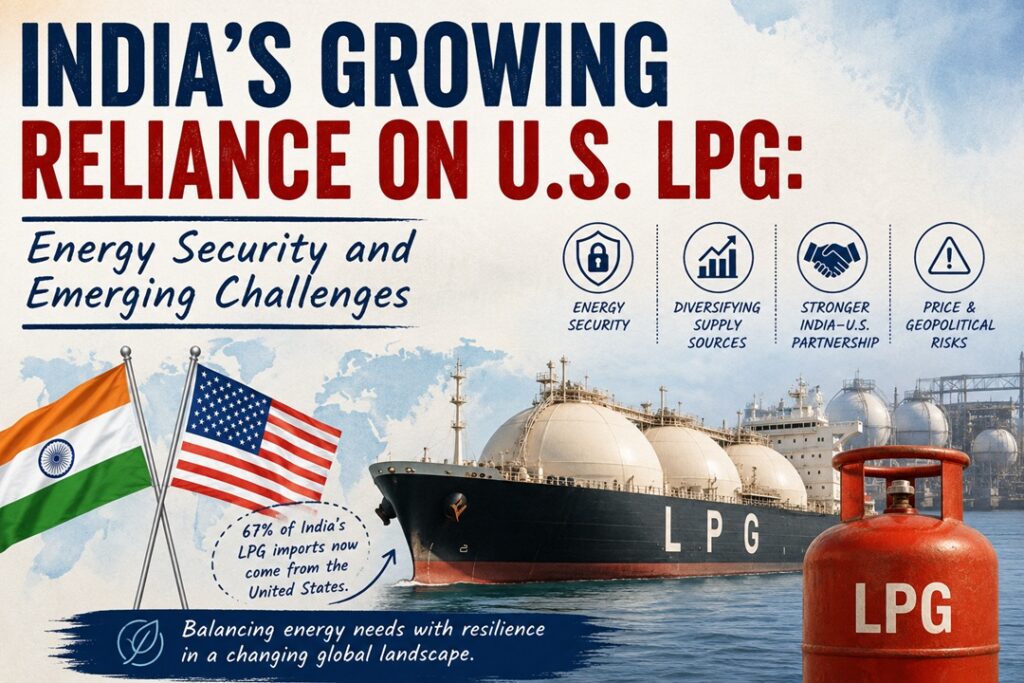
The Union Minister of Petroleum and Natural Gas stated that around 67% of India’s LPG imports are now sourced from the United States. This shift comes amid supply uncertainties in West Asia and rising LPG prices, prompting India to diversify its import sources and strengthen energy security.
India’s Shift Towards U.S. LPG Supplies
What is the Significance?
India is the world’s second-largest LPG importer, with annual consumption exceeding 34 million metric tonnes for household cooking and industrial requirements. In response to supply disruptions and sharp price increases in the Gulf region, Indian state-owned Oil Marketing Companies (OMCs) entered into long-term agreements to procure about 2 million tonnes of LPG from the U.S. in 2026.
This diversification has helped address short-term supply concerns in West Asia, but it has also increased India’s exposure to longer shipping routes, currency fluctuations and geopolitical risks.
How is LPG Produced?
Key Components
Liquefied Petroleum Gas primarily consists of propane (C₃H₈) and butane (C₄H₁₀). It is a highly energy-dense and flammable fuel that burns relatively cleanly.
Major Sources of LPG
- Natural Gas Processing: Nearly 60% of global LPG production comes from Natural Gas Liquids (NGLs) recovered from wet natural gas through cooling, absorption and fractionation.
- Petroleum Refining: Around 40% is obtained as a by-product during crude oil refining processes such as atmospheric distillation, catalytic cracking and hydroprocessing.
- Liquefaction: Propane and butane are separated from impurities and compressed or cooled into liquid form, allowing efficient storage and transportation.
Factors Behind India’s Increasing U.S. LPG Imports
Strait of Hormuz Supply Risks
A large proportion of India’s traditional LPG imports travelled through the Strait of Hormuz. Geopolitical tensions and potential disruptions along this route have encouraged India to seek alternative suppliers.
Rising Gulf LPG Prices
Saudi Aramco’s benchmark LPG prices increased significantly during 2026, making U.S. propane from the Mont Belvieu market more competitive despite its higher transportation costs.
Domestic Supply-Demand Gap
India’s LPG requirement continues to rise, while domestic production has not expanded at the same pace. This widening gap has increased dependence on overseas supplies.
Long-Term Procurement by OMCs
Public-sector oil companies have entered into long-term contracts for U.S. LPG to improve supply predictability and ensure uninterrupted cooking-gas availability for more than 33 crore domestic consumers.
Expansion of U.S. Shale Production
The rapid growth of shale gas production has generated large quantities of propane and butane in the U.S., creating substantial exportable surpluses and making the country an important alternative LPG supplier.
Risks Associated with LPG Supply Disruptions and Concentration
Household and Political Impact
LPG is an essential household fuel in India. Any sudden shortage or sharp increase in prices can raise household expenditure and generate significant social and political pressure.
Growing Financial Pressure on Oil Companies
When global LPG prices rise while domestic retail prices remain controlled, OMCs may face substantial under-recoveries, increasing the government’s fiscal burden.
Exchange Rate Exposure
U.S. LPG cargoes are generally priced in dollars. Therefore, depreciation of the Indian rupee or tighter global financial conditions can increase the domestic cost of imported LPG.
Higher Freight and Transit Time
Shipments from the U.S. can take considerably longer than supplies from the Persian Gulf. Longer voyages increase transportation costs and expose cargoes to greater maritime risks.
Geopolitical Dependence
Excessive reliance on one major external supplier could expose India to trade restrictions, geopolitical pressure or non-tariff barriers during periods of diplomatic or commercial tensions.
Strategies to Strengthen India’s LPG Security
Increase Domestic LPG Availability
Domestic refineries can be encouraged to channel a greater share of propane and butane streams into the LPG supply chain, thereby reducing import dependence.
Broaden the Supplier Base
India should expand long-term procurement from countries outside the Persian Gulf, including Indo-Pacific producers such as Australia, to create multiple alternative supply routes.
Develop Dedicated LPG Reserves
India can establish larger strategic LPG storage facilities, including underground caverns, to maintain adequate stocks during prolonged international supply disruptions.
Encourage Alternative Cooking Technologies
Greater adoption of induction cooking, solar-powered cooking systems and other clean-energy alternatives can gradually reduce the growth of household LPG demand.
Strengthen Financial Risk Management
OMCs can make greater use of currency and commodity hedging instruments while exploring rupee-based settlement mechanisms with suitable trading partners to reduce exchange-rate risks.
Conclusion
India’s increasing procurement of LPG from the United States represents an important response to geopolitical uncertainty and disruptions affecting traditional West Asian supply routes. However, greater dependence on long-distance U.S. shipments also creates challenges related to freight costs, currency movements and geopolitical exposure.
A resilient LPG strategy should therefore combine diversified imports with stronger domestic production, adequate strategic reserves, alternative energy sources and effective financial risk management. Such measures can help India balance immediate energy-security requirements with its long-term objective of greater energy independence.
Source : The Hindu