
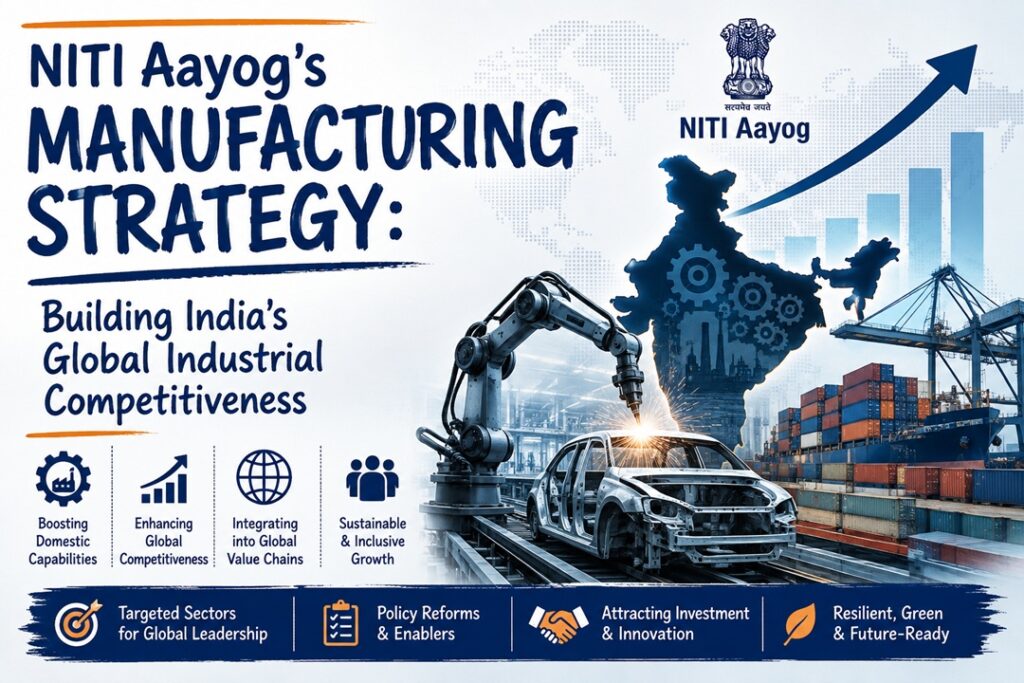
NITI Aayog’s Manufacturing Strategy: Building India’s Global Industrial Competitiveness
Context
NITI Aayog, along with knowledge partner CRISIL Intelligence, has released “Key Sectors to Position India as a Global Manufacturing Hub (Volume-I)”. The report identifies high-potential industries and suggests policy interventions to help India become a competitive global manufacturing destination by Viksit Bharat@2047.
Inside the NITI Aayog Assessment
From 62 Sectors to 12 Strategic Areas
- The study initially examined 62 sectors using a market size-growth framework.
- After a four-phase assessment, 12 sectors with strong potential for scale, exports and employment were shortlisted.
Manufacturing’s Role in the $30-Trillion Economy
- Manufacturing currently contributes around 17.5% of GVA.
- The report seeks to expand manufacturing capabilities as part of India’s ambition to build a USD 30 trillion economy by 2047.
Turning India’s Young Workforce into an Advantage
- India’s median age of approximately 28 years provides a substantial labour-force advantage.
- The objective is to generate formal and high-productivity employment through stronger industrial ecosystems.
Measuring India Against the Best
- The report compares India’s manufacturing capabilities with leading industrial economies such as China, Vietnam, Singapore, Germany and South Korea.
- Such benchmarking is intended to identify gaps in productivity, technology, scale and infrastructure.
Four Industries Under the First Volume
Chemical Value Chains
- India’s chemical market is projected to expand from $200–220 billion in FY25 to $290–310 billion by FY30.
- The strategy prioritises specialty chemicals such as agrochemicals, dyes and pigments while addressing shortages of critical feedstocks.
Textile Transformation
- The textile sector is targeted to reach around $350 billion, including $100 billion in exports by FY30.
- Greater emphasis is proposed on man-made fibres and technical textiles, alongside productivity improvements in cotton-based segments.
Building a Domestic Telecom Ecosystem
- India needs to move beyond assembling telecom equipment towards producing high-value components.
- Priority areas include 5G/6G equipment, routers, GPON systems and optical transmission products.
- The objective is to increase exports and domestic value addition under NTP-25.
Creating an End-to-End Solar Industry
- India’s solar capacity stood at about 106 GW in March 2025, against a 2030 target of 280 GW.
- The report recommends developing an integrated supply chain covering polysilicon, ingots, wafers, cells and modules.
Sectors Lined Up for the Next Stage
The other eight shortlisted areas to be covered in subsequent volumes are:
- Electronics
- Automobiles
- Pharmaceuticals
- Capital Goods
- Defence and Drones
- Steel
- Food Processing
- Leather and Footwear
What Is Holding Manufacturing Back?
Imported Inputs Remain a Weak Link
- India remains dependent on foreign sources for several essential industrial inputs.
- Methanol and acetic acid have around 85–90% import dependence, while solar wafers and telecom ICs also face substantial external dependence.
Tax and Tariff Mismatch
- Inverted duty structures can raise production costs and weaken domestic manufacturers.
- For example, PTA and MEG carry 18% GST, while MMF fibre and yarn attract 5%.
Small Scale, Limited Modernisation
- More than 80% of textile units and several chemical processors operate as small MSMEs.
- Fragmentation, limited financing and older technologies prevent firms from achieving economies of scale.
Logistics Still Needs an Upgrade
- Logistics expenditure is estimated at around 8% of GDP.
- Inadequate specialised berths, storage infrastructure and multimodal connectivity affect the movement of industrial goods.
Productivity and Innovation Deficit
- Labour productivity in segments such as textiles is nearly 50% below the general industry benchmark.
- Low private-sector R&D spending further limits technological advancement.
NITI Aayog’s Proposed Action Plan
Secure Critical Inputs at Home
- Expand domestic production of important chemical feedstocks.
- Use VGF and PLI support to encourage investment in upstream solar manufacturing, including wafers and ingots.
Make the Duty Regime More Competitive
- Rework GST and customs structures across manufacturing value chains.
- Reduce duties on essential raw materials where domestic production remains insufficient.
Develop Ready-to-Operate Industrial Clusters
- Create integrated manufacturing hubs equipped with common utilities, effluent-treatment systems and streamlined approval mechanisms.
- Such clusters can reduce infrastructure costs for individual manufacturers.
Connect Factories to Efficient Logistics Networks
- Modernise ports with specialised chemical berths, bulk-liquid storage and automated cargo handling.
- Strengthen rail-road connectivity through PM Gati Shakti.
Push Technology, R&D and Export Partnerships
- Provide stronger incentives for industrial research.
- Promote technology-transfer partnerships and joint ventures in advanced manufacturing.
- Develop strategically balanced FTAs with major international markets.
Why This Matters for India
The report shifts the focus from simply expanding manufacturing capacity to building complete, competitive and technology-intensive value chains. Greater domestic sourcing, efficient logistics, larger industrial clusters and stronger innovation capabilities can help Indian firms compete more effectively in international markets.
Way Forward
India’s manufacturing ambition will require sustained implementation rather than isolated policy measures. Building upstream capabilities, improving infrastructure, encouraging technological innovation and helping firms achieve scale can strengthen exports, create productive jobs and improve India’s resilience within global supply chains.
The successful execution of these measures can provide an important industrial foundation for achieving Viksit Bharat@2047.
Source : PIB