
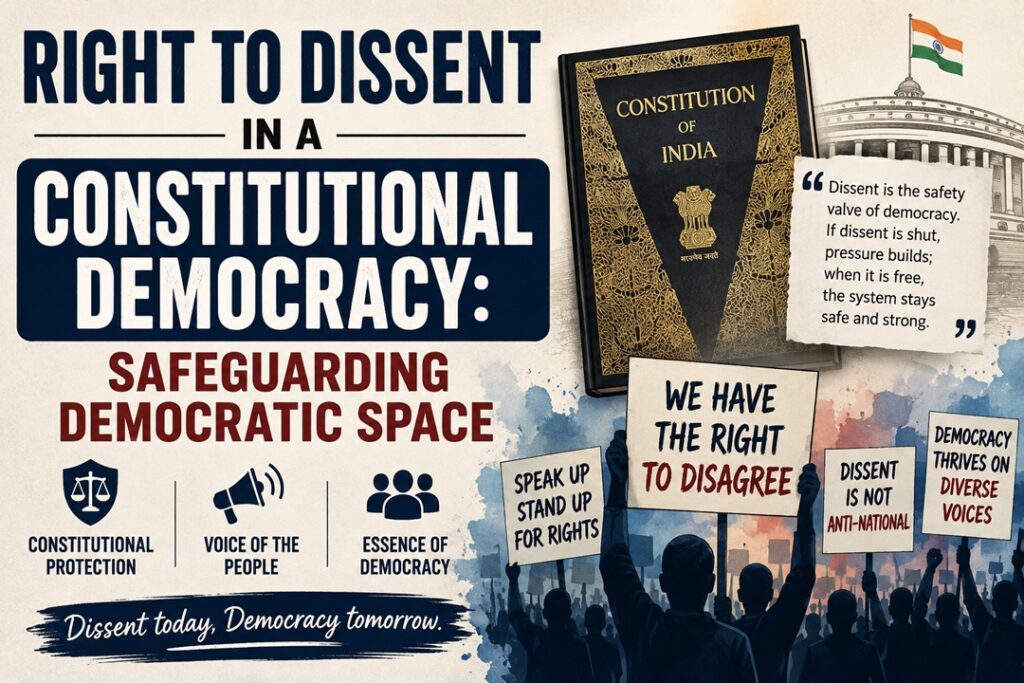
Right to Dissent in a Constitutional Democracy: Safeguarding Democratic Space
Context
Recent protests and subsequent government responses in India have renewed concerns about the shrinking space for democratic disagreement and peaceful civic participation.
Understanding Dissent in a Constitutional Republic
Dissent refers to the constitutional freedom of citizens to question, criticise, oppose, or challenge government policies and actions through lawful and peaceful means.
In a constitutional democracy, disagreement with those in power is not a favour granted by the government; it is protected through fundamental rights and institutional safeguards.
“Dissent is the safety valve of democracy. If dissent is not allowed, the pressure cooker may burst.”
The ability to question authority, express criticism, organise peaceful protests, and demand accountability is central to democratic governance.
When such freedoms are restricted through excessive criminalisation, prolonged detention, arbitrary limitations on speech, or restrictions on peaceful assembly, democratic institutions can become weaker.
Dissent also helps ensure that government authority remains accountable, transparent, responsive, and subject to public scrutiny.
A constitutional democracy is a system in which majority rule operates within limits established by the Constitution, fundamental rights, laws, and independent institutions.
Constitutional Foundations of the Right to Disagree
Although the Constitution of India does not expressly use the term “right to dissent”, the principle emerges from several fundamental rights under Part III.
Article 19(1)(a) – Guarantees freedom of speech and expression, allowing citizens to express opinions, criticise public authorities, and question governmental decisions.
Article 19(1)(b) – Guarantees the right to assemble peacefully and without arms, providing constitutional protection for peaceful demonstrations, rallies, and public meetings.
Article 21 – Protects life and personal liberty. Judicial interpretation has expanded its scope to safeguard individuals against arbitrary deprivation of liberty and state action.
Fearless Citizenship – The constitutional framework envisages citizens who can question authority without unreasonable fear or intimidation.
Judicial Recognition of Dissent
The Supreme Court has repeatedly recognised peaceful protest and freedom of expression as important components of constitutional democracy.
Ramlila Maidan Incident (2012) – The Supreme Court recognised the importance of the fundamental right to peaceful protest while examining the police action against demonstrators.
Shreya Singhal v. Union of India (2015) – The Court struck down Section 66A of the Information Technology Act, strengthening protection for online freedom of speech and expression.
Why Dissent Matters for Democracy
Democratic Watchdog – Public criticism helps citizens identify administrative failures, corruption, policy gaps, and systemic weaknesses.
Check on Authoritarianism – Continuous scrutiny discourages the concentration and arbitrary exercise of political power.
Forces Public Accountability – Opposition and criticism require governments to explain and justify important decisions.
Protects Vulnerable Voices – Dissent gives disadvantaged and underrepresented communities a platform to raise concerns and demand equal treatment.
Drives Social Transformation – Peaceful movements and public campaigns have historically contributed to legal, political, and social reforms.
Improves Public Policy – Constructive criticism can expose weaknesses in existing policies and encourage alternative approaches.
Protects Civil Liberties – Freedom to speak, assemble, and express disagreement strengthens the broader framework of fundamental rights.
Preserves Pluralism – Democratic societies remain resilient when citizens are free to hold diverse and competing viewpoints rather than being forced into conformity.
Barriers to Meaningful Democratic Dissent
Criminalisation of Opposition – Broad or stringent legal provisions may sometimes be invoked against activists, journalists, students, or protesters for activities that involve peaceful political disagreement.
The criminal justice system should primarily address genuine offences rather than become a mechanism for suppressing lawful civic participation.
Prolonged Pre-Trial Detention – Lengthy incarceration before the conclusion of a trial can effectively turn the judicial process itself into a form of punishment.
Internet Restrictions – Internet shutdowns, content restrictions, and directions to remove online material can limit citizens’ ability to communicate and organise.
Digital Intimidation – Coordinated online harassment, trolling, and targeted campaigns can discourage individuals from expressing unpopular opinions.
Pressure on the Media – Legal, financial, or administrative pressures may make media organisations more hesitant to critically examine government actions.
Chilling Effect – Fear of arrest, investigation, or official retaliation can discourage citizens from exercising legitimate constitutional freedoms.
Expansive Criminal Charges – Protest participants may face serious criminal proceedings even where the underlying activity involves peaceful mobilisation.
Pressure on Civil Society – Investigative or regulatory mechanisms can create difficulties for organisations engaged in advocacy, rights-based activities, and public-interest campaigns.
Executive Overreach – Political criticism or administrative inconvenience should not automatically be treated as a threat to public order or national security.
Measures to Protect Democratic Space
Strengthen Judicial Safeguards – Courts should remain vigilant in protecting personal liberty, scrutinising restrictions on peaceful protest, and ensuring that detention is not used disproportionately.
Revisit Ambiguous Laws – Vaguely worded provisions that permit arbitrary restrictions on peaceful civic activity should be periodically reviewed.
Reform Police Training – Law-enforcement agencies should be sensitised to recognise peaceful assemblies as constitutional activities rather than automatically treating them as security threats.
Apply Proportionality – Restrictions on speech and assembly must satisfy the constitutional test of reasonableness under Article 19, including the permissible restrictions under Article 19(2).
Protect Institutional Credibility – Democratic institutions gain public trust when peaceful disagreement is treated as part of governance rather than as an inherent threat.
Balance Liberty and Public Order – Maintaining public safety is a legitimate state responsibility, but security measures must remain proportionate and consistent with fundamental rights.
Expand Civic Participation – Open channels for dialogue, consultation, criticism, and peaceful mobilisation can strengthen democratic resilience.
Way Forward
India’s position as the world’s largest democracy depends not only on elections and majority rule but also on the protection of constitutional freedoms, institutional checks, and peaceful disagreement.
A healthy democracy does not eliminate dissent; it creates mechanisms through which dissent can be expressed lawfully and constructively.
The objective should therefore be to ensure that criminal law remains an instrument of justice rather than political control, while citizens retain meaningful avenues to question authority, demand accountability, and participate in public life.
Ultimately, democratic strength lies not in the absence of disagreement, but in the constitutional capacity to accommodate and protect it.
Source : The Hindu