
Saptadhara: India’s Seven Pathways for the Next Phase of Development
Context
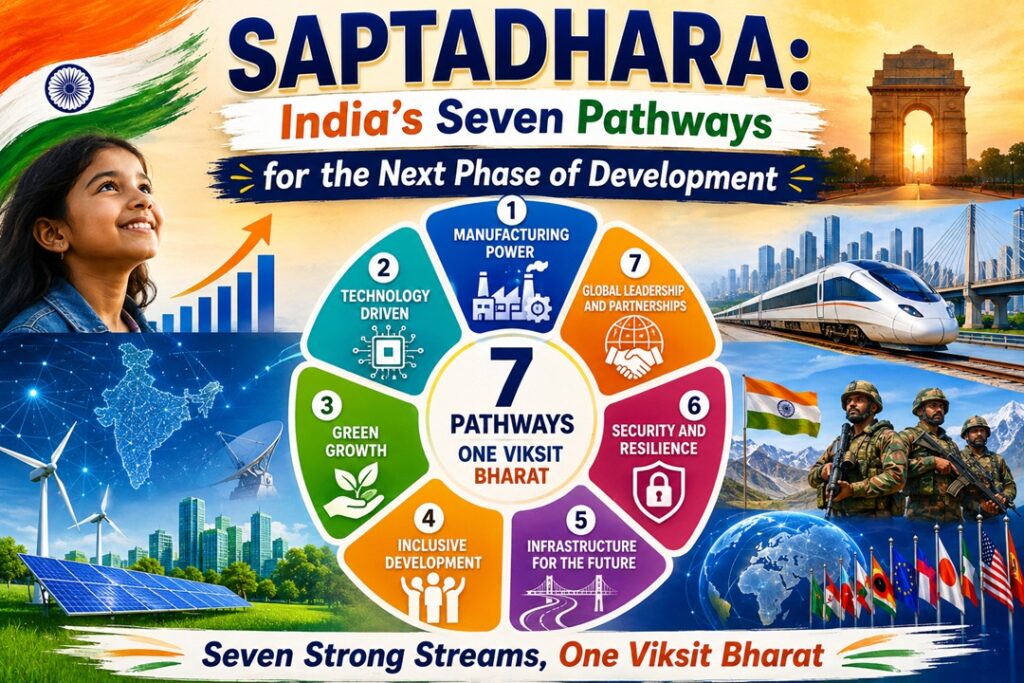
Addressing the nation on the 80th Independence Day, Prime Minister Narendra Modi outlined a broad development roadmap and highlighted the idea of Saptadhara, representing seven key streams that can shape India’s future growth trajectory.
What does Saptadhara represent?
The Prime Minister outlined seven interconnected pillars that can propel India towards higher growth and global competitiveness:
- Manufacturing Strength – Establish India as a major global production and supply-chain centre.
- Agriculture & Agro-Processing – Enhance farm productivity, processing, value addition and agricultural exports.
- Technology & Innovation – Build leadership in AI, quantum technologies, space, robotics, Digital Public Infrastructure and 6G.
- Infrastructure & Gati Shakti – Develop seamless, multimodal and integrated connectivity networks.
- Defence Capability – Strengthen indigenous defence production and emerge as a global supplier of defence technologies.
- Green & Blue Growth – Expand clean energy, green hydrogen and sustainable use of marine resources.
- Global Soft Power – Promote India’s culture, yoga, Ayurveda, tourism, sports and creative sectors worldwide.
Major themes emerging from the Independence Day address
- Viksit Bharat 2047 – India seeks to attain developed-nation status by 2047 through ambitious targets, sustained efforts and people’s participation.
- Aatmanirbharta – The focus remains on strengthening domestic production, reducing import dependence and creating resilient Indian supply chains.
- Economic progress – Expansion in defence manufacturing, electronics, mobile production, digital payments, patents and infrastructure was highlighted as evidence of India’s transformation.
- Industrial competitiveness – India needs to compete internationally through better cost efficiency, quality and scale while creating end-to-end domestic manufacturing ecosystems.
- Agriculture transformation – Greater emphasis was placed on natural and chemical-free farming, food processing, value addition and connecting Indian farms with international markets.
- Innovation ecosystem – India must transition from being primarily a technology user and market to becoming a leading centre for cutting-edge innovation in AI, quantum technology, space, robotics and 6G.
- Integrated infrastructure – Gati Shakti is expected to improve multimodal transport, logistics efficiency, highways, railways, waterways and port connectivity.
- Defence indigenisation – Indigenous defence technologies, self-reliance, cybersecurity capabilities and higher defence exports remain important strategic objectives.
- Sustainable development – Renewable energy, green hydrogen, energy storage, nuclear power, offshore resources and coastal development were identified as important components of future growth.
- Cultural and creative influence – Yoga, Ayurveda, tourism, wildlife, sports, animation, VFX, gaming and other creative industries can enhance India’s international soft power.
- Energy resilience – The vision includes expanding nuclear capacity, securing critical minerals, strengthening offshore exploration and advancing solar, hydrogen and piped-gas infrastructure.
- Youth-led growth – Start-ups, Skill India, sports initiatives, education, research and emerging technologies were presented as important drivers of India’s future.
- AI capacity building – The Prime Minister announced an ambitious goal of providing AI-related skills to one crore young people.
- Women-led development – Women’s achievements through initiatives such as Lakhpati Didi, along with their participation in STEM, defence and governance, were highlighted.
- Inclusive welfare – Schemes such as Ayushman Bharat and wider social-security coverage were positioned as tools for ensuring that economic development benefits the most vulnerable sections.
- National security – The decline in Naxal violence, combating extremism and strengthening a modern voluntary Civil Defence system were emphasised.
- Sports ecosystem – A nationwide talent-identification programme for children aged 5–15 and India’s aspirations for the 2036 Olympics were highlighted.
- Drug-free youth – A nationwide Nasha Mukt Yuva Abhiyan was proposed with participation from families, communities and civil society.
- Digital Census – Citizens, particularly young people, were encouraged to actively participate in the country’s first Digital Census.
- Global enterprises – India aims to develop internationally competitive companies across manufacturing, finance, pharmaceuticals, technology and professional services.
What is the broader vision behind Saptadhara?
- The Saptadhara framework presents Viksit Bharat 2047 as a comprehensive national mission combining self-reliance, industrial expansion, technological advancement, infrastructure development, defence preparedness, environmental sustainability and soft power.
- The central thrust is to transform India from a large consumer market into a globally competitive producer, innovator and exporter.
- The roadmap also places youth, women, technology and entrepreneurship at the centre of India’s long-term development strategy.
- Overall, the vision seeks to move beyond incremental progress towards faster, more inclusive and globally oriented economic transformation.
Source : PMO