
India’s UNSC Campaign for 2028–29: Pursuit of a Stronger Global Role
Context
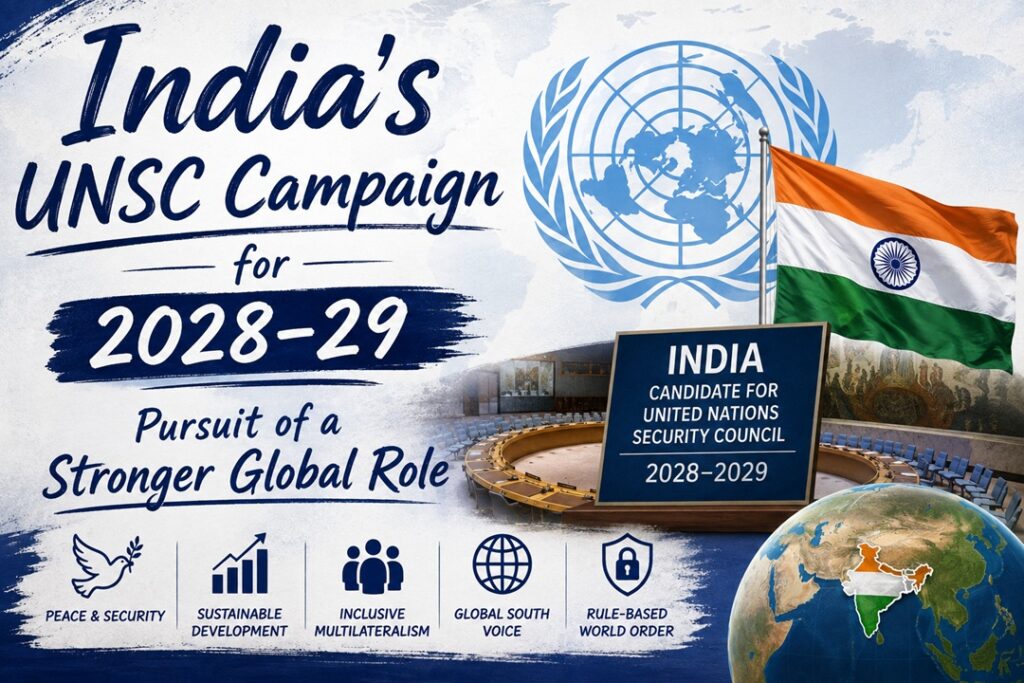
India has launched its campaign for a two-year term on the United Nations Security Council (UNSC) for 2028–29. The election for the Asia-Pacific seat is scheduled to take place in June 2027.
Understanding the United Nations Security Council
- UNSC – The United Nations Security Council is one of the six principal organs of the United Nations, established under the UN Charter.
- Core responsibility – Its primary mandate is to maintain international peace and security.
- Regional arrangement – UN members are organised into five regional groups: Africa, Asia-Pacific, Eastern Europe, Latin America and the Caribbean, and Western Europe and Others Group (WEOG).
- WEOG – The group includes countries such as the United States, Canada, Australia, New Zealand and Israel.
Membership and Seat Allocation
- Permanent members – The United States, United Kingdom, France, Russia and China form the permanent five (P5).
- Elected members – Ten non-permanent members are chosen by the UN General Assembly for two-year terms.
- Regional distribution – Africa receives three seats, Eastern Europe one, while Asia-Pacific and Latin America and the Caribbean get two seats each. WEOG also has two seats.
- Rotation system – Five elected members complete their terms every year, ensuring regular rotation among the non-permanent seats.
Why Does a Permanent UNSC Seat Matter for India?
- Exclusive veto authority – Each P5 country can independently block a substantive resolution through its veto.
- Decisive international influence – UNSC decisions can have binding implications for UN member states, including sanctions and authorisation of the use of force.
- Long-term strategic presence – Permanent membership provides continuous participation in global security decision-making instead of the limited influence available during a two-year elected term.
In essence, a permanent UNSC seat would give India continuous participation in global security decisions, veto rights and a greater ability to shape the international order.
India’s Case for Permanent Membership
- Demographic representation – India accounts for around 1.4 billion people, representing a significant share of the world’s population without permanent representation on the Council.
- Champion of developing nations – India has consistently raised the concerns of the Global South and works through platforms such as the L.69 Group to promote UNSC reform.
- Contribution to UN peacekeeping – India has served as a non-permanent UNSC member eight times and has been among the major contributors of personnel to UN peacekeeping operations.
- Growing global stature – India’s expanding economic, strategic and technological capabilities strengthen its argument for a larger role in international decision-making.
Major Hurdles Before India
- Difficult reform process – Expansion of permanent membership requires an amendment to the UN Charter, involving a two-thirds General Assembly majority and ratification by all existing P5 members.
- Geopolitical opposition – China remains opposed to India’s permanent inclusion, while the Uniting for Consensus (Coffee Club) group resists the creation of additional permanent seats.
- From support to implementation – Although the United States, France, the United Kingdom and Russia have expressed support for India, converting diplomatic backing into actual institutional reform remains challenging.
The Immediate Electoral Challenge
- Rival candidature – India is competing with Tajikistan for the single Asia-Pacific seat for the 2028–29 term.
- No guaranteed victory – Despite India’s economic weight, G20 membership and long association with the UN, elections within the organisation can produce unpredictable results.
- Need for diplomatic mobilisation – India will have to engage extensively with UN member states and build support well ahead of the voting process.
- Ninth UNSC term – If elected, India would serve its ninth term as a non-permanent member of the Security Council.
- Strategic significance – The election is important not merely for securing another temporary seat but also for advancing India’s broader case for permanent membership.
The Road Ahead for India
- India’s 2028–29 campaign extends beyond the immediate competition with Tajikistan and forms part of its broader diplomatic strategy.
- The campaign can help India deepen partnerships with developing countries and reinforce its position as a representative voice of the Global South.
- Previous UN elections have demonstrated that strong credentials alone do not guarantee electoral success.
- Experiences involving countries such as Germany, the Philippines and Kyrgyzstan underline the importance of regional solidarity, bilateral ties, political positions and outreach to smaller states.
- India’s successful election in 2010 demonstrates that sustained diplomatic engagement can secure broad international backing.
- With the vote scheduled for June 2027, the early commencement of the campaign gives India considerable time to strengthen its diplomatic outreach.
- India will need a sustained, inclusive and carefully calibrated campaign that combines its global standing with sensitivity towards the interests and priorities of UN member states.
Source : The Indian Express