
Pradhan Mantri Jan Dhan Yojana: Deepening Financial Inclusion
Context
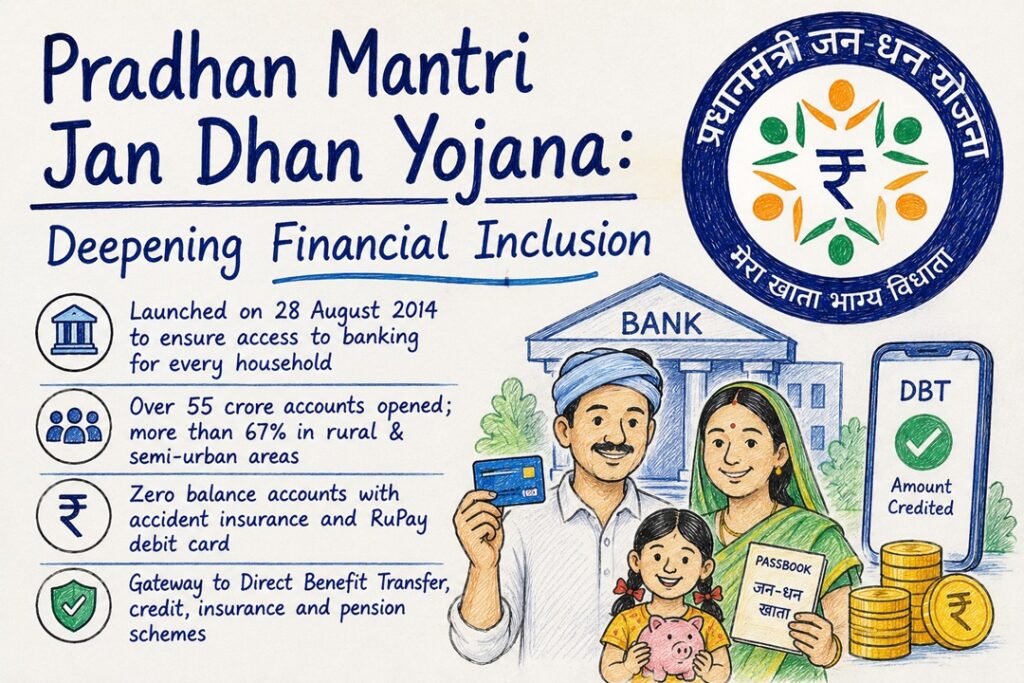
The Pradhan Mantri Jan Dhan Yojana (PMJDY), launched in 2014, has completed 12 years of advancing financial inclusion. As of 15 July 2026, it covered 58.77 crore beneficiaries, with deposits of about ₹3.12 lakh crore and nearly 40.94 crore RuPay debit cards issued.
What is PMJDY?
The Pradhan Mantri Jan Dhan Yojana is a National Mission for Financial Inclusion aimed at providing affordable access to basic financial services, including:
- Savings and deposit accounts
- Remittances
- Credit
- Insurance
- Pension
It seeks to bring economically weaker and financially excluded sections into the formal financial system. Accounts can be opened through bank branches as well as Business Correspondent (Bank Mitra) outlets.
Why is PMJDY Significant?
PMJDY has evolved beyond simply opening bank accounts. It provides the financial foundation for:
- Direct Benefit Transfer (DBT)
- Digital payments
- Government welfare delivery
- Insurance and pension enrolment
- Access to formal credit
- Financial empowerment of women and rural households
Thus, it has become an important component of India’s broader financial inclusion and Digital Public Infrastructure ecosystem.
Key Progress in Numbers
According to the Department of Financial Services, as of 15 July 2026:
- 58.77 crore total PMJDY beneficiaries.
- 45.73 crore accounts are in rural/semi-urban bank branches.
- 13.05 crore accounts are in urban/metro branches.
- 32.75 crore accounts are held by women.
- Deposits stand at approximately ₹3,12,413.78 crore.
- Around 40.94 crore RuPay debit cards have been issued.
This indicates that women and rural/semi-urban populations constitute a substantial share of the programme’s reach.
Major Features of the Scheme
1. Basic Banking for the Unbanked
PMJDY enables an unbanked person to open a Basic Savings Bank Deposit (BSBD) account, helping bring financially excluded households into the formal banking system.
2. Zero-Maintenance Balance Requirement
PMJDY accounts do not require the account holder to maintain a minimum balance, reducing the financial barrier for low-income households.
3. RuPay Debit Card
Account holders are provided a RuPay debit card, facilitating ATM, point-of-sale and digital transactions. New PMJDY accounts opened after 28 August 2018 are eligible for an enhanced ₹2 lakh accident insurance cover associated with the RuPay card, subject to applicable conditions.
4. Overdraft Facility
Eligible account holders can obtain an overdraft facility of up to ₹10,000, providing access to small amounts of formal credit for financial emergencies.
5. Direct Benefit Transfer
PMJDY accounts can receive government benefits and subsidies directly, helping reduce intermediaries and improve the efficiency of welfare delivery.
6. Linkage with Social Security
PMJDY accounts can be used for enrolment in major social-security schemes such as:
- Pradhan Mantri Jeevan Jyoti Bima Yojana (PMJJBY) – life insurance.
- Pradhan Mantri Suraksha Bima Yojana (PMSBY) – accident insurance.
- Atal Pension Yojana (APY) – pension support.
- MUDRA – access to credit for micro-enterprises.
Jan Dhan and the JAM Architecture
PMJDY forms the bank-account component of the JAM framework:
Jan Dhan + Aadhaar + Mobile
The combination enables:
- Identification of beneficiaries.
- Direct transfer of government assistance.
- Digital authentication.
- Faster payments.
- Reduced dependence on intermediaries.
This architecture has strengthened the ability of the government to deliver welfare benefits directly to intended beneficiaries.
Contribution to Women’s Financial Inclusion
Women constitute more than half of PMJDY beneficiaries. The latest official data records approximately 32.75 crore female beneficiaries out of 58.77 crore total beneficiaries.
Independent access to bank accounts can strengthen women’s:
- Control over household finances.
- Access to government benefits.
- Savings behaviour.
- Participation in digital payments.
- Access to formal financial services.
Thus, PMJDY has an important gender-inclusion dimension.
Rural and Semi-Urban Reach
Approximately 45.73 crore PMJDY beneficiaries are associated with rural and semi-urban branches, demonstrating the scheme’s extensive geographical reach.
The Bank Mitra/Business Correspondent network is particularly important in areas where conventional bank branches are difficult to access. It enables basic banking services closer to villages and underserved communities.
How PMJDY Supports Antyodaya
The scheme reflects the principle of Antyodaya, which focuses on prioritising the most disadvantaged sections of society.
By providing access to:
- Banking
- Savings
- Credit
- Insurance
- Pension
- Government transfers
PMJDY attempts to integrate economically vulnerable households into the formal financial system.
Major Challenges
1. Dormant or Low-Usage Accounts
Opening an account does not automatically translate into meaningful financial inclusion. Some accounts may remain inactive or be used primarily for receiving government transfers.
The next challenge is therefore to move from account ownership to regular financial activity.
2. Limited Access to Formal Credit
Although PMJDY provides an overdraft facility for eligible beneficiaries, awareness and utilisation of small-ticket formal credit remain important areas for improvement.
3. Last-Mile Banking Problems
Remote areas may face:
- Poor internet connectivity.
- Micro-ATM failures.
- Cash shortages.
- Limited banking infrastructure.
- Dependence on Business Correspondents.
These factors can affect the reliability of financial services.
4. Digital and Financial Literacy
As banking becomes increasingly digital, first-time users may face risks involving:
- Phishing.
- Fraudulent calls and messages.
- Fake UPI requests.
- ATM/card-related scams.
- Unauthorised transactions.
Financial inclusion therefore needs to be accompanied by financial and digital literacy.
5. Sustainability of Low-Balance Accounts
A large number of low-value accounts can increase servicing and transaction costs for banks. Strengthening the commercial sustainability of inclusive banking remains important.
Way Forward
From Account Opening to Financial Deepening
The focus should shift from merely providing accounts to ensuring active and productive use through savings, insurance, pensions and credit.
Strengthen Bank Mitra Services
The Business Correspondent network should receive:
- Better incentives.
- Regular training.
- Reliable connectivity.
- Improved digital devices.
- Adequate cash-management support.
Expand Financial Literacy
Financial education should be strengthened at the Gram Panchayat and community level, with special emphasis on first-time banking users, women and vulnerable households.
Improve Access to Small Credit
Transaction histories can increasingly support responsible access to small-ticket loans, helping micro-entrepreneurs, farmers and informal workers reduce dependence on informal lenders.
Strengthen Digital Security
Greater awareness about safe UPI, RuPay and mobile-banking practices is essential as rural populations increasingly enter the digital financial ecosystem.
Integrate Financial Services
Jan Dhan accounts can increasingly become gateways to a broader financial portfolio comprising:
Savings + Credit + Insurance + Pension + Investment + Digital Payments
Conclusion
The Pradhan Mantri Jan Dhan Yojana has transformed the scale of financial inclusion in India by bringing tens of crores of people into formal banking. With 58.77 crore beneficiaries, ₹3.12 lakh crore in deposits and 40.94 crore RuPay cards as of July 2026, the scheme has developed into a major financial infrastructure platform.
The next phase should move beyond “banking the unbanked” to “empowering the financially included.” Expanding meaningful credit, savings, insurance, pensions, digital literacy and secure transactions will be crucial for making financial inclusion a sustained instrument of inclusive growth and Viksit Bharat @2047.
Source : The Hindu