
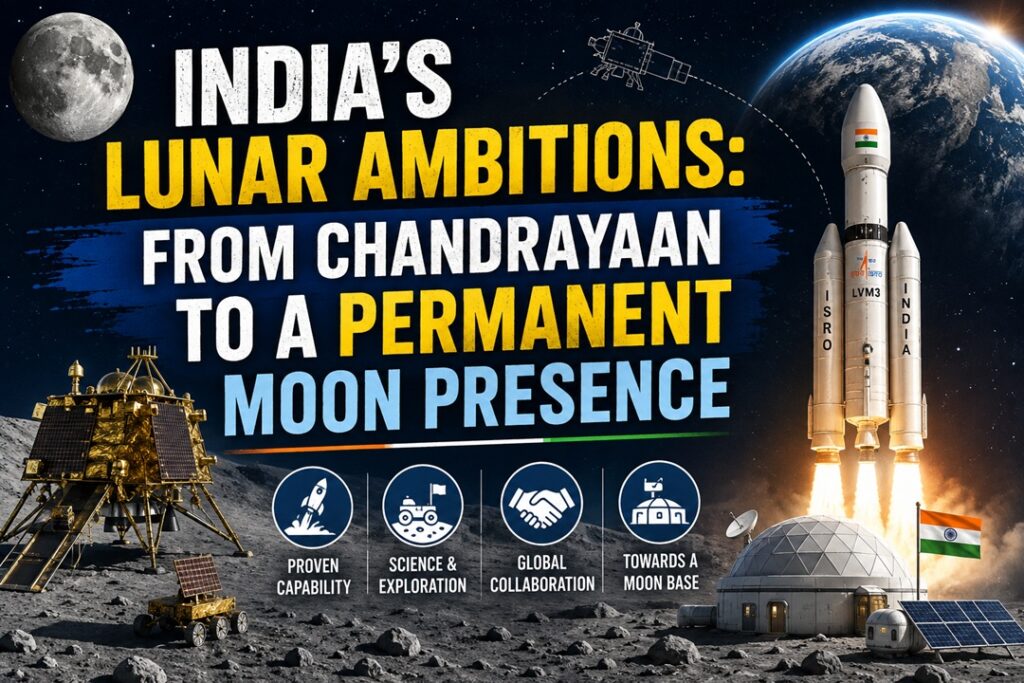
India’s Lunar Ambitions: From Chandrayaan to a Permanent Moon Presence
Context
At the ninth India-U.S. Civil Space Joint Working Group meeting in Bengaluru, NASA formally invited the Indian Space Research Organisation (ISRO) to participate in its proposed permanent lunar habitat or ‘Moon Base’ programme under the Artemis Accords framework.
India’s Evolving Lunar Strategy
What Does India’s Lunar Roadmap Entail?
- India’s space programme is gradually moving beyond robotic lunar exploration towards sustained human presence, surface infrastructure and long-term scientific activities on the Moon.
- India’s lunar strategy lies at the intersection of deep-space research, commercial space activity and strategic competition.
- New partnerships with the U.S. must be balanced with India’s engagement with other space powers, including China and Russia, while preserving strategic autonomy.
Major Lunar and Space Initiatives
- NASA Lunar Habitat Partnership: India could contribute to modular infrastructure near the lunar South Pole, an area of interest because of water-ice deposits and favourable sunlight conditions.
- Gaganyaan Cooperation: NASA’s support in astronaut training can strengthen India’s indigenous human-spaceflight programme.
- Joint Scientific Payloads: Greater coordination between NASA and ISRO can facilitate the deployment of scientific instruments on future Chandrayaan missions, building on the NASA-ISRO NISAR mission.
- BRICS Space Cooperation: India can continue engaging with non-Artemis space powers through multilateral platforms, enabling broader scientific collaboration.
Benefits for India’s Space Programme
1. Advanced Lunar Technologies
- Collaboration can provide access to expertise in life-support systems, lunar robotics, spacesuits, surface mobility and power systems.
- Such cooperation can accelerate India’s development of technologies needed for prolonged lunar operations.
2. Support for Human Spaceflight
- International astronaut-training opportunities can complement Gaganyaan and help India develop greater human-spaceflight capabilities.
- Experience gained through international missions can strengthen India’s operational preparedness.
3. Moving Beyond Robotic Exploration
- India can transition from individual missions such as Chandrayaan-3 towards sustained lunar surface and orbital operations.
- Future sample-return and human missions could become part of a broader long-term lunar strategy.
4. Opportunities for the Private Space Sector
- Participation in lunar projects could create new markets for Indian space-tech startups and aerospace manufacturers.
- Indian firms could gain opportunities in payload development, components, robotics and specialised supply chains.
Key Concerns and Constraints
1. Emergence of Competing Lunar Ecosystems
- Rival initiatives such as the Artemis programme and the International Lunar Research Station (ILRS) could lead to fragmented technical standards.
- Differences in communication, telemetry, navigation and docking systems may make future interoperability difficult.
2. Strategic Restrictions
- U.S. procurement and technology-access rules relating to entities with links to China could complicate India’s simultaneous engagement with multiple space partners.
- India will therefore need to carefully manage its partnerships without compromising its broader diplomatic space.
3. Launch and Payload Limitations
- India’s existing launch capabilities face limitations for transporting large payloads to cislunar space.
- Development of the Next-Generation Launch Vehicle (NGLV) will be important for future deep-space missions and large-scale lunar infrastructure.
4. Funding Gap
- India’s space budget remains significantly smaller than the resources available to NASA and its commercial lunar partners.
- Large-scale lunar infrastructure will therefore require efficient resource allocation and greater private-sector participation.
How Can India Maintain Strategic Autonomy?
Promote Interoperable Space Standards
- India should advocate open and compatible standards for communication systems, power interfaces, navigation and docking.
- This would prevent participation in one lunar programme from restricting future scientific cooperation.
Strengthen Global Space Governance
- India should continue working through the UN Committee on the Peaceful Uses of Outer Space (COPUOS).
- The principles of the Outer Space Treaty, including peaceful use and non-appropriation of celestial bodies, should remain central to lunar governance.
Build Indigenous Heavy-Lift Capacity
- Faster development of the NGLV, advanced propulsion and deep-space communication infrastructure can reduce dependence on foreign launch systems.
- Sovereign capabilities are essential for ensuring independent access to the Moon.
Pursue Balanced Space Diplomacy
- India should maintain productive relations with both Western and non-Western space agencies.
- A balanced approach can help India participate in emerging lunar initiatives while retaining its position as an independent and reliable space partner.
Way Forward
NASA’s invitation provides India with a significant opportunity to participate in the development of long-term lunar infrastructure and human exploration. However, India must avoid becoming overly dependent on any single space ecosystem.
A combination of international partnerships, indigenous launch capabilities, interoperable technologies and multilateral space diplomacy can enable India to expand its lunar footprint while protecting its strategic autonomy.
Conclusion
India’s lunar journey is evolving from exploration to sustained presence. Participation in NASA-led lunar initiatives can provide access to advanced technologies, scientific cooperation and commercial opportunities. At the same time, India must strengthen domestic capabilities and preserve open channels with other space powers. By combining strategic partnerships with technological self-reliance, India can emerge as an important contributor to the future lunar economy and the peaceful exploration of the Moon.
Source : The Hindu