
Communal Award and Poona Pact, 1932: Debate over Political Representation
Context
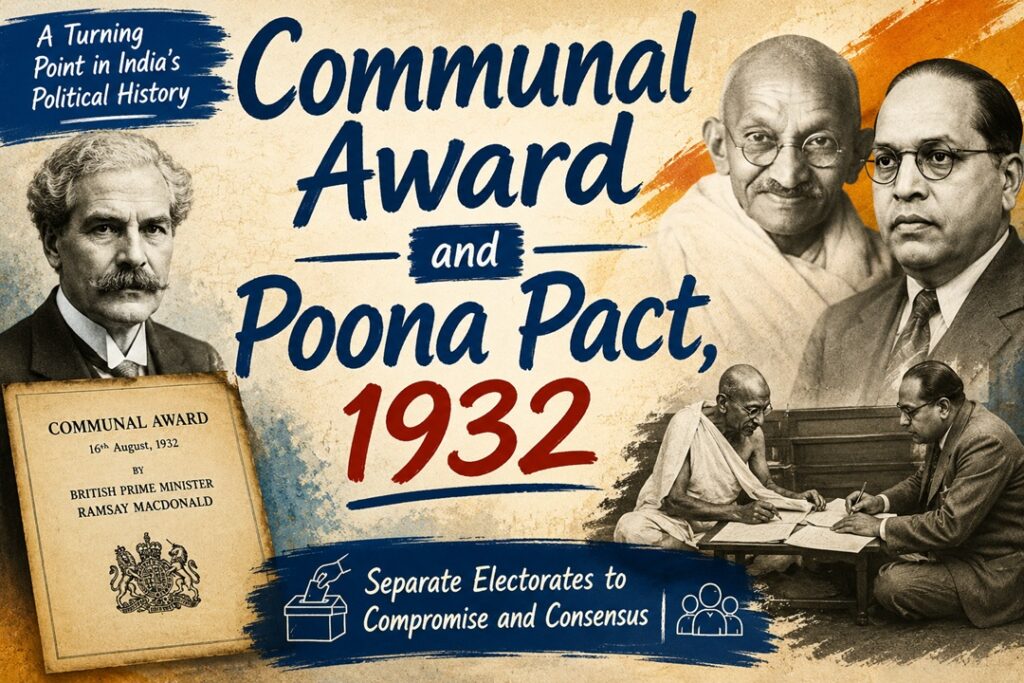
The Communal Award of 1932 and the Poona Pact that followed transformed the debate over political representation of the Depressed Classes, later constitutionally recognised as Scheduled Castes.
How did the issue of representation emerge?
- Evolution of communal representation – The British gradually introduced separate representation for different communities during colonial rule.
- Separate electorates were first extended to Muslims through the Indian Councils Act, 1909, and later expanded to other groups.
- Demand of the Depressed Classes – During the Round Table Conferences (1930–32), representation of the Depressed Classes became a major political question.
- Ambedkar’s leadership – Dr. B.R. Ambedkar emerged as the leading political voice of the Depressed Classes.
- He argued that centuries of social discrimination could not be eliminated merely through appeals to upper-caste conscience.
- The community needed independent political representation and leaders accountable to its own interests.
- Ambedkar therefore demanded separate electorates, allowing members of the Depressed Classes to choose their own representatives.
What were the key features of the Communal Award?
- Announcement – British Prime Minister Ramsay MacDonald declared the Communal Award on 16 August 1932.
- Status of Depressed Classes – The Award treated the Depressed Classes as a distinct minority for electoral purposes.
- Separate electorates – It granted them separate electorates for 20 years.
- Legislative representation – It provided 71 special/reserved seats for the Depressed Classes in provincial legislatures.
- The Award also continued or extended separate representation for communities such as Muslims, Sikhs, Indian Christians, Anglo-Indians and Europeans.
Why did Ambedkar insist on separate electorates?
- Political independence – Ambedkar believed that members of the Depressed Classes should be able to select representatives who genuinely reflected their concerns.
- Fear of dominant-caste influence – Under a joint electorate, candidates from the Depressed Classes could become dependent on votes and political support from caste Hindus.
- This could make elected representatives more responsive to socially dominant groups than to their own community.
- Political power as a tool of emancipation – Ambedkar regarded effective political representation as essential for overcoming entrenched social inequality.
- His demand therefore focused not simply on increasing the number of seats, but on securing autonomous political leadership and institutional safeguards.
Why was Gandhi against separate electorates for the Depressed Classes?
- Unity of Hindu society – Gandhi considered the Depressed Classes an integral part of Hindu society and opposed treating them as a separate political community.
- He feared separate electorates would permanently deepen the division between caste Hindus and the Depressed Classes.
- Concern over social fragmentation – Gandhi believed that such an arrangement could weaken broader Indian unity during the freedom struggle.
- Reform from within – He regarded untouchability as a grave social and moral wrong that caste Hindus themselves had to eradicate.
- Gandhi therefore opposed political separation, while remaining strongly committed to ending untouchability.
- Different approaches – Ambedkar believed that the social structure responsible for discrimination could not be relied upon to provide genuine political equality.
- He therefore prioritised political safeguards and independent representation.
Gandhi stressed social integration and moral transformation, whereas Ambedkar placed greater emphasis on political representation, legal safeguards and institutional power.
How did the Poona Pact come about?
- Gandhi’s fast – After the Communal Award, Gandhi began a fast unto death on 20 September 1932 at Yerwada Central Jail in Poona.
- He opposed separate electorates for the Depressed Classes on the grounds that they would permanently divide Hindu society.
- His fast generated intense political and public pressure for a settlement.
- Negotiations – Various leaders worked towards a compromise between Gandhi’s demand for a common electorate and Ambedkar’s insistence on effective political safeguards.
- Ambedkar initially resisted giving up separate electorates because he feared that doing so would weaken the political position of the Depressed Classes.
Major provisions of the Poona Pact
- The Poona Pact was signed on 24 September 1932.
- Separate electorates were withdrawn in favour of a joint electorate with reserved seats.
- The number of seats reserved for the Depressed Classes in provincial legislatures increased substantially from 71 to 148.
- The Pact also provided for 18% representation in the Central Legislature for the Depressed Classes.
- It included commitments concerning fair representation and educational and social advancement of the community.
- The British government subsequently accepted the Pact as a modification of the Communal Award.
- Thus, Ambedkar did not secure separate electorates, but he obtained significantly expanded legislative representation through reserved seats within a common electorate.
What was the long-term importance of the Pact?
- Foundation of reserved representation – The Pact strengthened the idea of reserving legislative seats for disadvantaged communities while retaining a common electorate.
- This principle later influenced the constitutional framework of independent India.
- Political empowerment – It highlighted that achieving substantive equality may require institutional mechanisms beyond formal equality before law.
- Gandhi–Ambedkar differences – The episode clearly revealed their contrasting approaches to caste.
- Gandhi emphasised social reform, integration and moral change.
- Ambedkar increasingly focused on constitutional guarantees, political representation and institutional protection.
- Negotiated compromise – Although Ambedkar relinquished his demand for separate electorates, he secured a considerable increase in reserved seats.
- The episode demonstrated his willingness to negotiate when an alternative mechanism could provide stronger representation.
- Post-Independence legacy – The principle of reserved political representation continued under the Constitution.
- Seats are reserved for Scheduled Castes and Scheduled Tribes in the Lok Sabha and State Legislative Assemblies.
- In the present 543-member Lok Sabha, 84 seats are reserved for Scheduled Castes and 47 for Scheduled Tribes.
- These constituencies function through a joint electorate: all eligible voters can vote, but only candidates belonging to the relevant reserved category can contest from that constituency.
Communal Award vs Poona Pact
| Aspect | Communal Award, 1932 | Poona Pact, 1932 |
|---|---|---|
| Electoral system | Separate electorates | Joint electorates |
| Representation of Depressed Classes | 71 seats in provincial legislatures | 148 reserved seats in provincial legislatures |
| Political objective | Independent community-based representation | Reserved representation within a common electorate |
| Ambedkar’s position | Accepted separate electorates | Accepted joint electorates as a compromise |
| Gandhi’s position | Opposed separate electorates | Accepted settlement based on joint electorates |
Why does the episode matter today?
- The Communal Award–Poona Pact episode remains important for understanding the evolution of affirmative political representation in India.
- It demonstrated the tension between social integration, political autonomy and substantive equality.
- The settlement also influenced the development of the reserved-seat system that continues for Scheduled Castes and Scheduled Tribes.
- Most importantly, the debate established that communities facing historical exclusion may require institutional safeguards to participate meaningfully in democratic politics.
Conclusion
The Communal Award and Poona Pact represented a defining debate over how historically oppressed communities could obtain meaningful political representation. Gandhi opposed separate electorates because he feared they would permanently divide Hindu society, while Ambedkar considered independent political power essential to overcoming structural discrimination. The Poona Pact replaced separate electorates with reserved seats in joint electorates while considerably increasing representation. Its wider legacy lies in the continuing principle that democratic equality may require specific constitutional and institutional safeguards for historically disadvantaged communities.
Source : The Indian Express