
Centre’s Fiscal Outlook for FY 2026–27: Balancing Fiscal Consolidation and Growth
Context
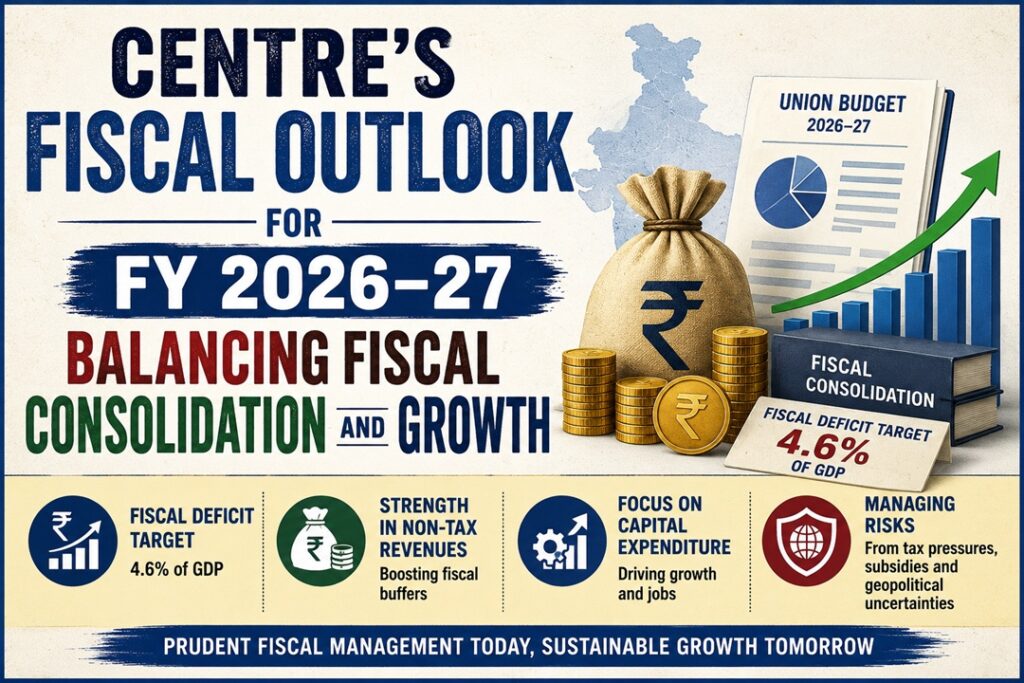
Former RBI Governor C. Rangarajan and economist D.K. Srivastava have assessed the Centre’s fiscal position for FY 2026–27, noting that strong non-tax revenues, including the RBI dividend, and sustained capital expenditure could provide a buffer against weaker tax collections, higher subsidies and geopolitical shocks. The fiscal outlook remains focused on maintaining fiscal consolidation while supporting economic growth and public investment.
What Does the Centre’s Fiscal Outlook Indicate?
Meaning of the Fiscal Outlook
- The Centre’s fiscal outlook refers to the expected financial position of the Union government during FY 2026–27.
- It covers government receipts, expenditure, borrowing requirements, subsidies, interest payments and capital investment.
- It indicates how the government balances the objectives of fiscal consolidation, economic growth and welfare expenditure.
- The Union Budget 2026–27 initially estimated the fiscal deficit at 4.3% of GDP, while the debt-to-GDP ratio was projected at 55.6%.
- The broader fiscal assessment discussed by economists considers whether the deficit can remain close to the targeted consolidation path despite emerging revenue and expenditure pressures.
What Do the Revenue Trends Reveal?
Tax Collections Show Signs of Weakness
- Gross Tax Revenue (GTR) increased by only 3.7% in Q1 FY 2026–27, according to the assessment cited in the discussion.
- GST collections contracted by 11%, while Personal Income Tax (PIT) increased by 6.8%.
- Union excise duty collections declined by 22.4% in Q1, following reductions in fuel duties intended to cushion consumers against elevated crude oil prices.
- The Union Budget had estimated FY 2026–27 GTR at ₹44.04 lakh crore, equivalent to 11.2% of GDP.
Non-Tax Revenue Provides a Cushion
- Non-tax revenue is emerging as an important support for the Centre’s finances.
- Budget 2026–27 estimated non-tax revenue at ₹6.66 lakh crore.
- A significant RBI dividend transfer strengthened receipts early in the financial year.
- By June 2026, the Centre had received ₹3.77 lakh crore in non-tax revenue, according to the government’s monthly accounts.
What Are the Major Expenditure Pressures?
Subsidy Commitments Are Rising
- Major subsidies increased sharply during Q1 FY 2026–27.
- The subsidy burden is particularly sensitive to movements in crude oil and other commodity prices.
- Higher international energy prices can increase the government’s expenditure on fertilisers and fuel-related support.
- The assessment suggests that annual subsidy expenditure could exceed the budgeted amount by around ₹50,000 crore if commodity-price pressures persist.
Interest Payments Remain a Major Obligation
- Interest payments constitute a substantial component of revenue expenditure.
- Up to June 2026, the Centre spent ₹3.46 lakh crore on interest payments.
- Total expenditure during this period stood at ₹13.57 lakh crore, or around 25.4% of the corresponding FY 2026–27 Budget Estimate.
Why Is Capital Expenditure Important?
Public Investment Supports Economic Activity
- Capital expenditure remains a key component of the government’s growth strategy.
- The Union Budget 2026–27 allocated ₹12.22 lakh crore for direct capital expenditure.
- When grants for creation of capital assets are included, effective capital expenditure is estimated at ₹17.15 lakh crore, or 4.4% of GDP.
- Central capital expenditure also recorded strong growth in Q1 FY27, helping support infrastructure creation and domestic industrial activity.
- Sustained public investment can crowd in private investment by improving connectivity, logistics and productive capacity.
Which Factors Could Create Fiscal Risks?
Impact of Tax Rationalisation
- Recent changes in GST rates and personal income-tax structures have resulted in an initial revenue sacrifice.
- The expected benefits from a broader tax base and higher compliance may take time to materialise.
- If tax collections remain subdued, the government could face pressure to either contain expenditure or mobilise additional revenue.
Energy Prices and West Asian Geopolitics
- Prolonged instability in West Asia can increase global crude oil prices.
- Higher crude prices affect India through increased import costs, inflationary pressures and subsidy requirements.
- They can also worsen the fiscal position if the government reduces fuel taxes or increases support for vulnerable sectors.
Pressure on State Finances
- State governments depend substantially on tax devolution and Finance Commission grants.
- The Centre’s monthly accounts showed that ₹2.63 lakh crore was transferred to states as tax devolution up to June 2026, ₹63,605 crore lower than in the corresponding period of the previous year.
- The 16th Finance Commission has retained the states’ share at 41% of the divisible pool.
- Greater reliance on non-shareable cesses can reduce the effective divisible pool and create Centre–State fiscal concerns.
How Is the Government Cushioning These Pressures?
RBI Dividend and Other Non-Tax Receipts
- The RBI dividend has strengthened the Centre’s non-tax revenue position.
- By June 2026, non-tax receipts formed a substantial portion of the government’s total receipts.
- Total receipts reached ₹10.49 lakh crore, equivalent to 28.7% of the corresponding FY 2026–27 Budget Estimate, by June.
Additional Revenue Mobilisation
- The government has also relied on measures involving windfall taxes and customs duties on selected commodities.
- Such measures can provide temporary revenue support but may not substitute for a stable expansion in the underlying tax base.
Front-Loaded Capital Spending
- Stronger capital expenditure in the opening quarter can support economic activity while maintaining the government’s focus on productive expenditure.
- This approach seeks to balance short-term demand support with long-term improvements in infrastructure and productive capacity.
What Should Be the Policy Priorities Going Forward?
1. Strengthen the Tax Base
- Expand GST registration and compliance.
- Reduce tax leakage and improve digital monitoring.
- Encourage formalisation of businesses and economic activity.
- Ensure that tax-rate rationalisation is accompanied by a sufficiently broad tax base.
2. Gradually Restore Fuel Tax Revenues
- If international crude prices stabilise, temporary reductions in fuel-related excise duties can be reviewed.
- Any restoration should be gradual so that it does not create a sudden inflationary burden on households.
3. Preserve Productive Capital Expenditure
- Infrastructure spending should remain protected from excessive compression during fiscal stress.
- Greater emphasis should be placed on projects with high economic multipliers and employment potential.
4. Improve Fiscal Coordination with States
- Predictable transfers are important for state-level infrastructure and welfare spending.
- The Centre should ensure that the design of cesses and surcharges does not excessively narrow the divisible tax pool.
- Greater transparency and predictability in intergovernmental transfers can strengthen cooperative fiscal federalism.
5. Manage Commodity and Currency Risks
- India needs stronger mechanisms to manage exposure to crude-price and exchange-rate volatility.
- Wider use of local-currency trade settlements and appropriate risk-management instruments could reduce vulnerability to external shocks.
What Is the Significance for Fiscal Consolidation?
Balancing Growth with Fiscal Prudence
- Fiscal consolidation does not necessarily require a sharp reduction in all government expenditure.
- The emphasis should be on improving the quality of expenditure, particularly by prioritising capital investment over unproductive revenue expenditure.
- Strong nominal GDP growth can improve the denominator effect and support gradual reduction in debt ratios.
- At the same time, excessive dependence on temporary non-tax windfalls should be avoided because such receipts may not recur every year.
Conclusion
The Centre’s fiscal outlook for FY 2026–27 reflects a combination of revenue-side weaknesses and expenditure-side pressures, offset partly by strong non-tax receipts and public capital investment. While the government’s Budget framework targets a fiscal deficit of 4.3% of GDP, emerging pressures from subsidies, tax collections, energy prices and intergovernmental transfers require careful monitoring.
The key challenge is to preserve fiscal credibility without sacrificing growth-supporting expenditure. A wider and more compliant tax base, prudent subsidy management, sustained capital expenditure and predictable fiscal transfers to states can help India maintain macroeconomic stability alongside long-term economic expansion.
Source : The Hindu