
Deemed Distribution Licence for Hyperscale AI Data Centres: Regulatory and Legal Concerns
Context
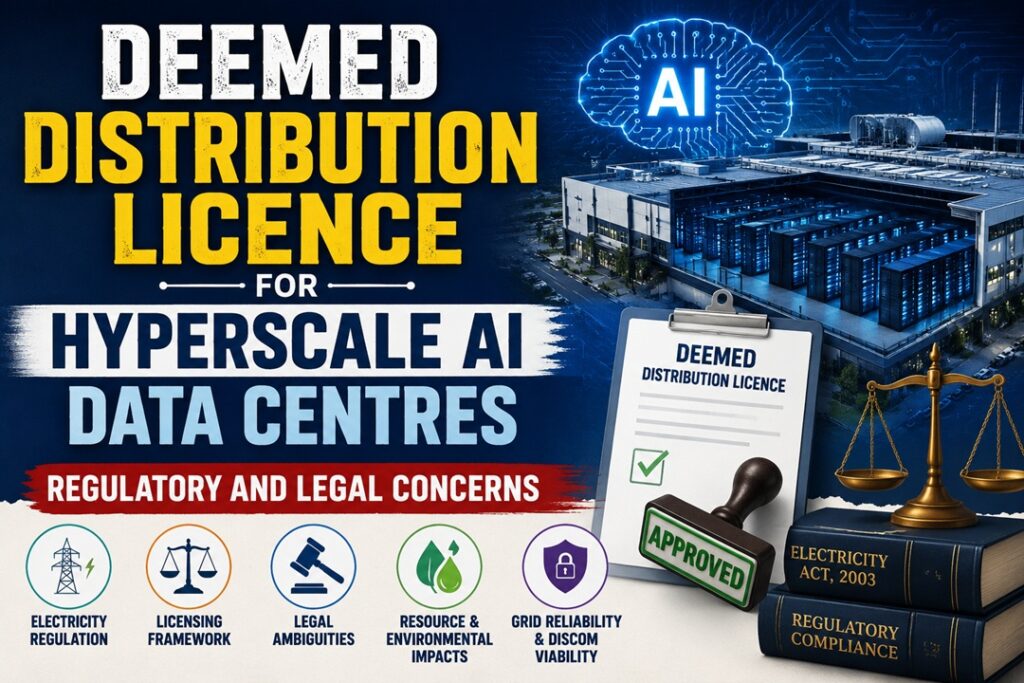
The Andhra Pradesh government’s proposal to introduce a Deemed Distribution Licence (DDL) for hyperscale AI data centres, including the proposed Google–Adani data centre project in Visakhapatnam, has triggered significant legal scrutiny and opposition from civil society.
What does the DDL proposal mean?
- Deemed Distribution Licence (DDL): It refers to a statutory arrangement under which an entity is treated as an authorised electricity distributor within a specified area without following the conventional distribution-licensing procedure.
- Andhra Pradesh has proposed DDL status for strategic data centres with a minimum connected load of 300 MW, enabling them to develop, procure and operate dedicated electricity networks.
How would the proposed arrangement function?
- Special Regulatory Status: The data-centre operator would be recognised as a deemed electricity distributor for a clearly defined geographical area.
- Independent Power Procurement: Operators could directly source electricity through Power Purchase Agreements (PPAs), renewable-energy projects, battery storage systems and power exchanges.
- Dedicated Electricity Supply: The entity would manage its own network and distribute electricity to consumers within its designated operational zone.
Why is DDL being considered for Large Data Centres?
- Coping with Massive Power Requirements: Hyperscale AI facilities require electricity on a scale comparable to large urban areas and need highly reliable, dedicated power infrastructure.
- Greater Access to Clean Energy: Direct procurement can help data-centre operators secure renewable electricity and integrate Battery Energy Storage Systems (BESS) to meet sustainability commitments.
- Boosting Technology Investments: Greater control over power infrastructure could make Andhra Pradesh more attractive to global technology companies and strengthen its position as an AI and digital-services hub.
- Lower Pressure on State Utilities: Private investment in substations, feeders and internal distribution infrastructure could reduce the immediate infrastructure burden on state-owned distribution companies.
What are the Major Legal and Economic Concerns?
- Questions Under the Electricity Act, 2003: The existing legal framework generally distinguishes between an electricity distributor and the consumer. Using distribution-licence provisions primarily for self-consumption raises questions about whether such an arrangement fits within the Act.
- Regulatory Authority of APERC: The Andhra Pradesh Electricity Regulatory Commission (APERC) has statutory responsibility for licensing and regulating electricity distribution. Critics argue that executive action cannot substitute for the Commission’s regulatory role.
- Revenue Loss for DISCOMs: Large consumers operating outside the conventional distribution system could reduce revenues from tariffs, wheeling charges and cross-subsidy mechanisms, potentially increasing financial pressure on state DISCOMs.
- Limited Legislative Foundation: Unlike Special Economic Zones (SEZs), where specific statutory provisions exist, there is no comparable central legislation clearly establishing DDL arrangements for standalone data-centre developments.
- Risk of Selective Grid Access: Multiple special distribution arrangements could progressively separate commercially attractive consumers from public utilities while leaving DISCOMs responsible for higher-cost and subsidised consumer categories.
What should be the Policy Response?
- Prefer Green Open Access Mechanisms: Existing Green Energy Open Access Rules can enable data centres to procure renewable electricity while continuing to pay applicable transmission and wheeling charges.
- Strengthen Independent Regulatory Oversight: APERC should undertake detailed assessments covering grid stability, consumer impact, infrastructure costs and the financial implications for DISCOMs.
- Create a Clear Legislative Framework: If specialised electricity-distribution arrangements are genuinely necessary for hyperscale data centres, they should be established through appropriate legislation rather than solely through executive orders.
- Safeguard Cross-Subsidy Arrangements: Large technology companies should contribute appropriately towards grid resilience and cross-subsidy obligations so that vulnerable and agricultural consumers are not adversely affected.
- Expand Captive Clean-Energy Infrastructure: Data-centre operators should be encouraged or required to develop additional renewable generation and energy-storage capacity alongside their high electricity demand.
Key Takeaway
Hyperscale AI data centres require reliable, uninterrupted and increasingly renewable electricity, but creating special distribution arrangements without clear statutory authority could affect regulatory independence and the financial health of public utilities. A transparent open-access framework, backed by independent regulatory scrutiny and, where necessary, explicit legislation, can help Andhra Pradesh attract digital investment while preserving the long-term stability of the electricity sector.
Source : FRONTLINE