
Gendered Digital Equity: Bridging the Gap from Digital Access to Women’s Digital Agency
Context
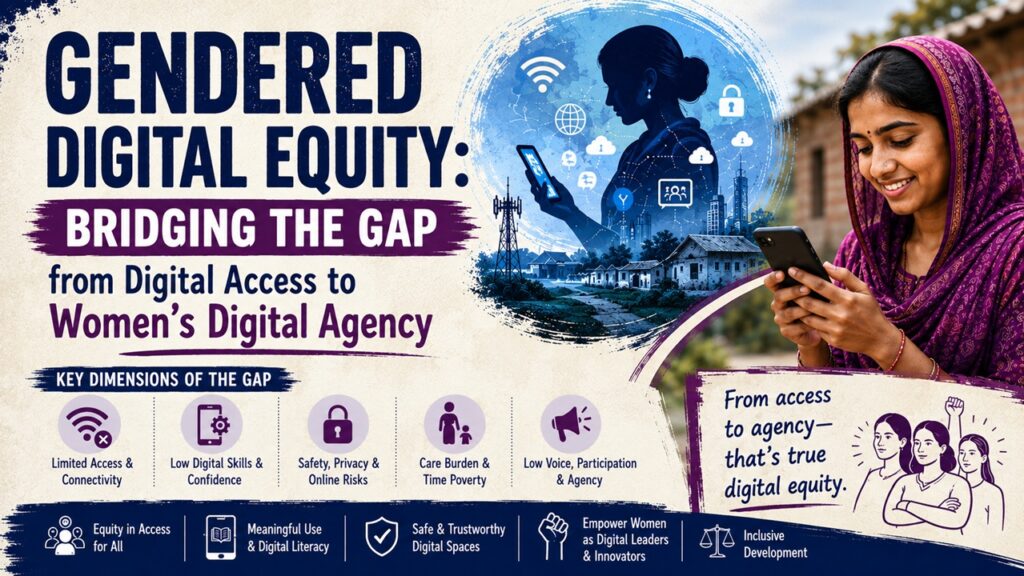
The National Family Health Survey-6 (2023–24) indicates that women’s internet usage has nearly doubled. However, the expansion of digital connectivity has not automatically translated into greater digital autonomy, ownership, safety, financial independence or decision-making power for women.
Understanding Gender-Responsive Digital Equity
- Gendered digital equity – It means ensuring that women have meaningful and independent access to digital technologies, along with ownership, skills, privacy, safety, financial autonomy and decision-making power.
- It extends beyond basic connectivity and enables women to use digital tools independently for education, employment, healthcare, finance and civic participation.
- SDG 5 – Digital equity is closely associated with Sustainable Development Goal 5, which seeks to achieve gender equality and empower women and girls.
What Does NFHS-6 Reveal About Women’s Digital Access?
- Women’s internet use has increased substantially, reflecting the expansion of digital connectivity across India.
- However, significant gender-based disparities remain in device ownership, quality of access, digital skills, privacy and freedom of usage.
- Greater connectivity has not necessarily produced greater digital empowerment.
- The focus therefore needs to shift from simply getting women online to ensuring meaningful and independent digital participation.
Government Measures to Promote Women’s Digital Inclusion
- Pradhan Mantri Gramin Digital Saksharta Abhiyan (PMGDISHA) – Provides basic digital literacy to rural households, with particular attention to women and disadvantaged groups.
- Digital India Programme – Expanded access to technology-driven public services and promoted digital governance.
- Rural Broadband Connectivity – Broadband infrastructure has been strengthened to reduce connectivity disparities between rural and urban areas.
- PMGDISHA, 2017 – Imparts foundational digital skills to rural citizens, particularly marginalised communities, with women forming a significant share of beneficiaries.
- NMEICT and Digital Learning Platforms – SWAYAM and the National Digital Library provide online educational resources and opportunities to build digital and technological capabilities.
- Pradhan Mantri Jan Dhan Yojana (PMJDY) – Increased women’s access to formal banking, creating a foundation for digital payments and Direct Benefit Transfers.
- Bank Sakhis and Business Correspondents – Women at the grassroots level facilitate banking transactions and improve digital financial literacy in rural communities.
- Stand-Up India and MUDRA – Provide financial support to women entrepreneurs, helping them establish and expand technology-enabled businesses.
- Womaniya on GeM – Enables women-owned enterprises to participate in government procurement and access broader markets through the Government e-Marketplace.
- Mahila E-Haat – Provides women entrepreneurs and Self-Help Groups with an online platform to showcase and market their products.
- Digital Safety Mechanisms – Cybercrime reporting systems, including the 1930 helpline, and women’s help desks provide avenues to address online fraud, harassment and other cyber threats.
Key Barriers to Women’s Digital Empowerment
- Persistent Gender Gap – Digital access remains lower among women at around 64.3%, compared with 80.5% among men.
- Rural–Urban Divide – Women’s digital access stands at approximately 58.6% in rural areas, against 77.3% in urban areas.
- Affordability and Skill Deficits – High device and connectivity costs, inadequate digital literacy and limited technological skills restrict meaningful participation.
- Patriarchal Restrictions – Social norms may lead to women’s use of mobile phones and digital platforms being monitored or restricted.
- Cybersecurity and Safety Risks – Fear of online harassment, fraud and privacy violations can discourage women from using digital services independently.
- Shared Device Dependence – Household device-sharing can reduce privacy and autonomy, particularly when women access sensitive health or financial services.
- Financial Dependence – Even when women earn through digital or other economic activities, control over financial decisions may remain with other family members.
- Intersectional Disadvantages – Caste, class, disability, religion, ethnicity, age and location can deepen existing digital inequalities.
Measures Required to Close the Digital Gender Divide
- Expand Device Ownership – Provide targeted subsidies, vouchers and affordable credit to encourage individual mobile ownership among women.
- Integrate digital-device assistance with existing welfare and social protection programmes.
- Strengthen Digital Capabilities – Develop gender-sensitive digital literacy programmes covering technology use, online services, cybersecurity and digital finance.
- Involve women, girls, parents, teachers and community leaders in digital-skills programmes.
- Incorporate online safety and cybersecurity education into schools and community-based training.
- Protect Ownership and Privacy – Promote individual device ownership and ensure women can use digital technologies without undue restrictions.
- Develop accessible and assistive digital technologies for women with disabilities.
- Deepen Financial Inclusion – Design digital financial services and applications around women’s needs and circumstances.
- Combine digital financial services with community-based networks and peer-support systems.
Moving from Digital Access to Digital Agency
- India needs to progress beyond measuring the number of women who have internet access and assess whether they can use technology independently, safely and meaningfully.
- The digital inclusion pathway should move from connecting and equipping women to protecting them, enabling ownership, strengthening decision-making and enhancing agency.
- Digital empowerment should ultimately be reflected in women’s ability to use technology for education, employment, healthcare, financial independence, rights and informed choices.
- The real measure of digital inclusion is therefore not simply how many women are online, but how many can exercise meaningful control over their digital lives and use technology to expand their choices and opportunities.
Source: The Indian Express