
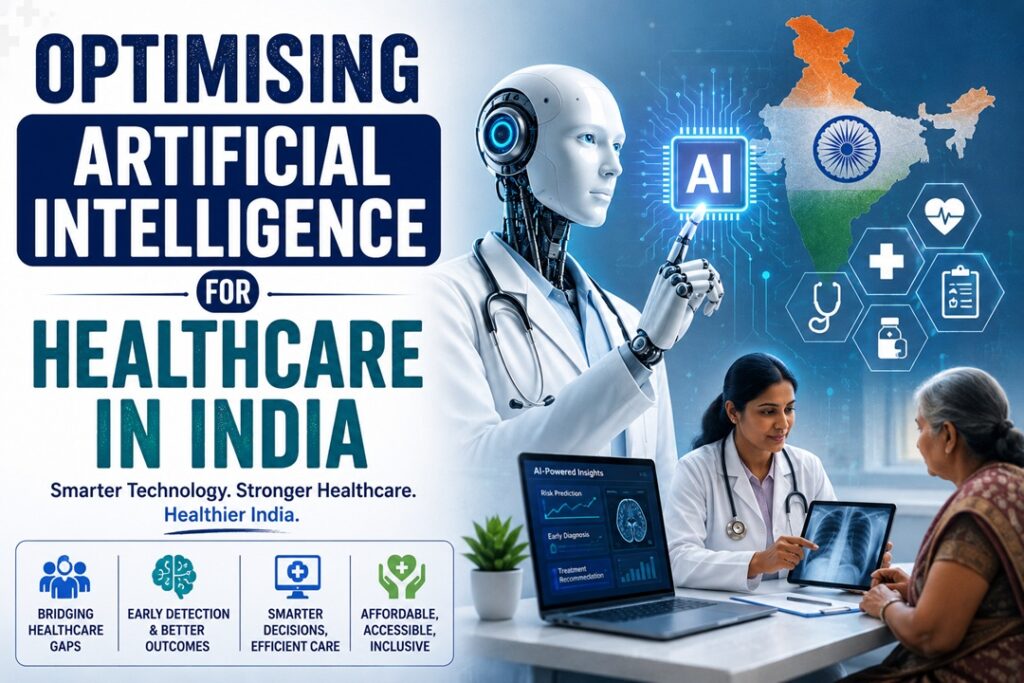
Optimising Artificial Intelligence for Healthcare in India
Context
A recent healthcare policy analysis examined how Artificial Intelligence (AI) can be integrated into clinical and administrative workflows to address capacity constraints, improve healthcare delivery, reduce the burden on medical professionals, and expand access to quality care across underserved regions.
What Does AI-Enabled Healthcare Mean?
- AI in healthcare – It involves the use of machine learning, natural language processing and computer vision to improve diagnosis, reduce administrative workload, optimise hospital operations and extend specialist services to underserved areas.
- Assistive, Not Replacement-Based – Clinical AI primarily functions as a decision-support mechanism, complementing healthcare professionals rather than replacing them.
- System Efficiency – Its wider objective is to make existing healthcare infrastructure more responsive, accessible, preventive and patient-centric.
Evidence of AI and Digital Health Expansion
- International Regulatory Adoption: By January 2025, the U.S. FDA had authorised more than 1,000 AI-enabled medical devices, particularly in radiology, oncology and cardiology.
- Reduced Clinical Paperwork: AI-based ambient clinical scribing in the UK’s NHS reportedly created up to 25% more direct consultation time for doctors.
- ABDM Digital Footprint: More than 100 crore health records had been linked with Ayushman Bharat Health Accounts (ABHA) by May 2026.
- Faster Hospital Registration: ABDM’s Scan and Share facility reduced outpatient registration waiting periods from around 60 minutes to 2–5 minutes at participating hospitals.
- Lower Administrative Expenses: AI adoption across healthcare revenue-cycle functions could reduce the cost of collection by 30–60%.
Major Use Cases of AI in Medical Services
- Smart Diagnosis and Emergency Triage: AI can analyse CT scans, MRI images and X-rays to identify critical conditions such as intracranial bleeding and early-stage tumours.
- Automated Clinical Documentation: Natural language processing systems can convert consultations into structured medical notes, reducing paperwork and administrative fatigue.
- Specialist Access Beyond Major Cities: AI-assisted telemedicine can help doctors in Tier-2 and Tier-3 locations access specialised clinical support.
- Early Warning Systems: Continuous analysis of electronic health records and ICU monitoring data can identify signs of septic shock, cardiac arrest and clinical deterioration.
- Remote Chronic Care: AI-enabled monitoring can support management of diabetes, hypertension and cardiovascular diseases before they lead to emergency hospitalisation.
Obstacles to Responsible AI Adoption
- Data and Algorithmic Bias: Models trained predominantly on Western datasets may not adequately reflect India’s diverse demographic, genetic, socioeconomic and disease profiles.
- Limited Explainability: The “black box” nature of advanced AI systems can make clinicians hesitant to rely on outputs that cannot be easily interpreted.
- Privacy and Cybersecurity Concerns: Processing sensitive health information increases risks of data breaches, unauthorised access and privacy violations.
- Declining Model Accuracy: AI performance may deteriorate in real-world settings because of differences in equipment, imaging protocols and operating environments.
- Uncertain Accountability: Legal ambiguity persists when an AI-supported recommendation contributes to a wrong diagnosis or adverse patient outcome.
Policy Priorities for Responsible Deployment
- Local Clinical Validation: Require multicentric and population-specific validation of AI systems before large-scale deployment.
- Human Oversight: Establish human-in-the-loop frameworks ensuring that AI remains advisory and licensed professionals retain final clinical responsibility.
- ABDM Integration: Use the ABDM ecosystem to facilitate standardised, interoperable and appropriately anonymised health data for validated AI applications.
- Ethical and Legal Frameworks: Establish rules covering medical software liability, patient consent, data protection, algorithmic transparency and clinical accountability.
- Target High-Friction Areas: Prioritise AI for emergency triage, rural screening, diagnostic backlogs and hospital administrative bottlenecks.
Conclusion
AI can strengthen India’s healthcare system by expanding access to medical expertise, improving diagnostic efficiency and reducing administrative pressure on healthcare professionals. However, its adoption must be accompanied by clinical validation, representative datasets, privacy safeguards and human oversight. The success of healthcare AI should ultimately be measured by improved patient outcomes, reduced clinician workload and wider access to quality healthcare.
Source : The Hindu