
National Animal Disease Control Programme: Advancing Livestock Health and Rural Prosperity
Context
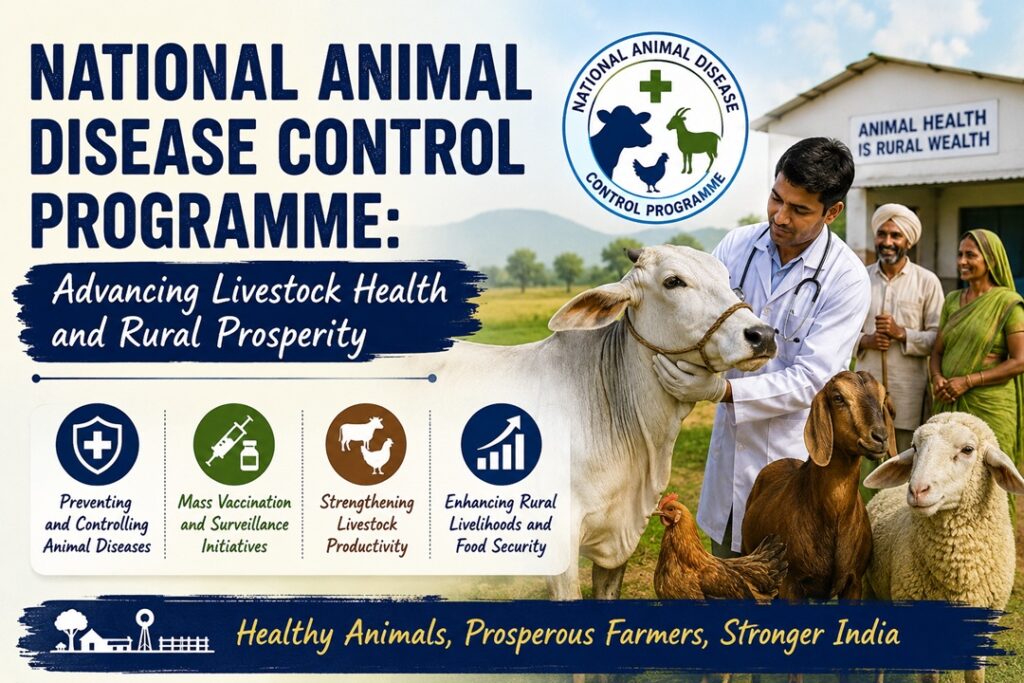
The National Animal Disease Control Programme (NADCP) has significantly strengthened livestock disease prevention through mass vaccination, surveillance and digital monitoring, contributing to healthier animals and improved productivity.
Why is livestock health important for India?
- Rural economic foundation – Livestock supports rural incomes, nutrition, employment and livelihood security for millions of farming households.
- Large livestock base – According to the 20th Livestock Census (2019), India had 535.78 million livestock, including 302.79 million bovines.
- Disease-related losses – Diseases such as Foot and Mouth Disease (FMD) and Brucellosis reduce milk output, impair reproduction, lower animal productivity and can affect livestock trade.
How does NADCP work?
- Programme launch – The Government introduced the National Animal Disease Control Programme (NADCP) in September 2019.
- Core purpose – It seeks to control and progressively eliminate FMD and Brucellosis through vaccination, surveillance, digital tracking and improved veterinary infrastructure.
- One Health linkage – NADCP has become a major livestock-health intervention while supporting the broader One Health and pandemic-preparedness approach.
Key programme interventions
- FMD vaccination – Eligible susceptible livestock are vaccinated twice annually, at six-month intervals.
- Brucellosis vaccination – Female bovine calves aged 4–8 months receive a one-time lifetime vaccination.
- Disease monitoring – Sero-surveillance and sero-monitoring are used to track disease prevalence and immunity.
- Cold-chain strengthening – Vaccine procurement and storage infrastructure are being enhanced.
- Outbreak management – Disease investigations, virus isolation and typing are undertaken.
- Animal movement control – Quarantine facilities and check-posts help regulate livestock movement.
- Digital identification – Animals are ear-tagged and registered on the Bharat Pashudhan Portal.
- Capacity building – Farmers and field personnel are provided awareness and training.
- Vaccinator support – Vaccinators receive remuneration, with a minimum of ₹3 per vaccination dose.
- Migratory livestock coverage – Since 2024, FMD vaccination has also covered pastoral sheep and goats in Haryana, Himachal Pradesh, Uttarakhand, Jammu & Kashmir and Ladakh to reduce disease transmission along migratory routes.
What progress has been achieved?
FMD prevention
- Large-scale vaccination – The programme has administered 147.16 crore cumulative FMD vaccine doses, benefiting 8.04 crore farmers.
- Strong herd immunity – Post-vaccination sero-monitoring recorded average protective immunity of:
- 78.1% for FMD serotype O
- 71.7% for serotype A
- 77.6% for serotype Asia1
- Fewer outbreaks – Reported FMD outbreaks declined from 132 in 2019 to 40 in 2025.
- Asia1 suppression – No FMD outbreak caused by serotype Asia1 has been reported for the last three years.
- Lower virus circulation – NSP antibody prevalence fell from 20.8% in 2019 to 8.1% in 2025, indicating reduced viral circulation and exposure.
Brucellosis management
- Nature of disease – Brucellosis is a bacterial reproductive disease, primarily caused by Brucella abortus in bovines.
- Economic impact – It can result in infertility, reproductive losses and reduced milk and meat production.
- Vaccination-based control – Since bovine brucellosis has no curative treatment, preventive vaccination remains crucial.
- Coverage strategy – Female bovine calves aged 4–8 months receive a one-time vaccination.
- Improved immune response – In 2025, post-vaccination monitoring recorded seroconversion rates of:
- 75.63% among cattle calves
- 67.17% among buffalo calves
- Declining outbreaks – Reported Brucellosis outbreaks decreased from 22 in 2019 to 15 in 2025.
How is technology improving veterinary services?
- Digital livestock database – The Bharat Pashudhan Portal assigns every registered animal a unique 12-digit Tag ID and connects animal identification with vaccination records.
- Growing registration – By July 2026, more than 39 crore livestock had been registered on the portal.
- Benefits – The platform supports real-time monitoring, vaccination traceability, animal identification and evidence-based policy planning.
- Mobile veterinary care – 4,019 Mobile Veterinary Units (MVUs) operate across 29 States and Union Territories.
- Doorstep services – Through the 1962 toll-free service, MVUs have reached 136 lakh farmers and treated 276 lakh animals.
- Rural breeding support – 39,810 Multi-Purpose Artificial Insemination Technicians in Rural India (MAITRIs) have been trained with financial assistance.
What has been the impact on livestock productivity?
- Indigenous and non-descript cattle – Productivity increased from 927 kg per animal annually in 2014–15 to 1,343.2 kg in 2024–25, a 44.89% rise.
- Buffalo productivity – Output increased from 1,880 kg to 2,365.2 kg per animal annually, registering a 25.80% increase.
- Overall bovine productivity – Average productivity rose from 1,640 kg to 2,250 kg per animal annually, an increase of 36.63%.
- Milk production – National milk production expanded from 146.31 million tonnes in 2014–15 to 247.87 million tonnes in 2024–25, a 69.4% increase.
- Future target – The Government aims to increase average milk productivity to 3,000 kg per animal annually by 2030.
What institutional mechanisms support NADCP?
- Research support – ICAR institutions contribute to vaccine research, quality assessment, disease surveillance, sero-surveillance, disease modelling and state-wise sampling.
- State assistance – States and Union Territories receive support for vaccines, vaccination equipment and cold-chain infrastructure.
- Integrated disease-control framework – Under the revised Livestock Health and Disease Control Programme (LHDCP), NADCP, the Livestock Health and Disease Control (LH&DC) component and Pashu Aushadhi operate under a common umbrella.
- Private-sector participation – The Animal Husbandry Infrastructure Development Fund encourages investment in veterinary vaccine and drug manufacturing.
How does NADCP contribute to One Health?
- Integrated health approach – One Health recognises the close links between human, animal and environmental health.
- Zoonotic-risk reduction – Improved animal surveillance can help identify zoonotic threats, support antimicrobial stewardship and strengthen preparedness against emerging infections.
- National One Health Mission – Approved by the Prime Minister’s Science, Technology and Innovation Advisory Council (PM-STIAC) in its 21st meeting on 7 July 2022, the mission seeks greater coordination of One Health initiatives across ministries.
- Pandemic preparedness – The 2024 Pandemic Fund Project on “Animal Health Security Strengthening in India for Pandemic Preparedness and Response”, supported by the G20 Pandemic Fund with US$25 million, is being implemented with the Asian Development Bank (ADB), FAO and World Bank.
- The project strengthens genomic and environmental surveillance, laboratory capabilities and cross-border cooperation.
- Treatment protocols – Standard Veterinary Treatment Guidelines (SVTG) encourage scientific treatment, rational medicine use and antimicrobial stewardship.
- Crisis response – The Crisis Management Plan (CMP) for Animal Diseases provides a framework for rapid outbreak response and recovery.
What additional measures are required?
- India’s experience demonstrates that coordinated vaccination, surveillance and digital traceability can substantially reduce livestock disease.
- However, sustained action is necessary to move progressively towards internationally recognised FMD-free status.
- Key priorities include:
- Expanding laboratory accreditation and genomic surveillance.
- Deploying AI-based disease intelligence and real-time dashboards.
- Building climate-resilient disease surveillance systems.
- Strengthening livestock biosecurity and movement regulation.
- Expanding farmer awareness and community participation.
- Deepening coordination through the One Health framework.
- Increasing investment in vaccine research, cold-chain systems and last-mile veterinary care.
What is the broader significance?
- Healthier animals can translate into higher productivity, stronger rural incomes and improved food and nutritional security.
- Effective disease management can also enhance India’s livestock trade potential while lowering zoonotic-disease risks.
- By combining vaccination, surveillance, digital traceability, veterinary infrastructure and One Health principles, NADCP is helping build a more resilient, productive and globally competitive livestock sector.
- These efforts can contribute to the broader objective of achieving Viksit Bharat 2047.
Source : PIB