
Pradhan Mantri Surya Sarovar Yojana: Expanding Floating Solar Power in India
Context
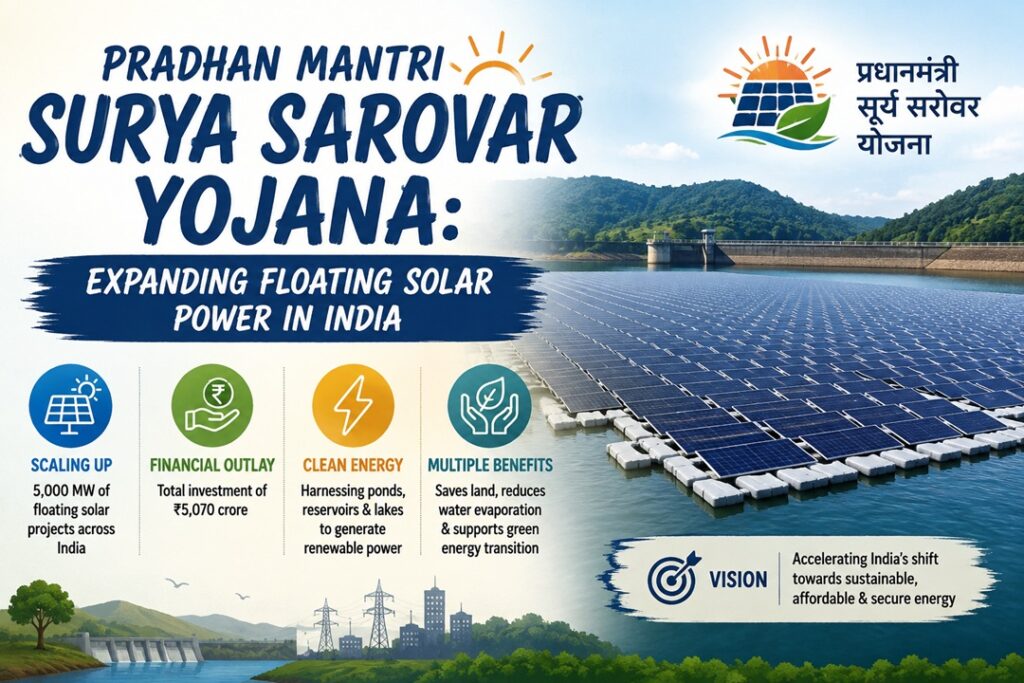
The Union Cabinet has approved the Pradhan Mantri Surya Sarovar Yojana (PM-SSY) with an outlay of ₹5,070 crore to develop 5,000 MW of Floating Solar Photovoltaic (FSPV) capacity, supported by 10,000 MWh of battery energy storage systems across reservoirs and inland water bodies in India.
Understanding Floating Solar Technology
- Floating photovoltaic systems – Floating solar involves installing solar panels on buoyant platforms placed over reservoirs, dams, lakes and other inland water bodies.
- Electricity generation and transmission – Power generated by the panels is transmitted to the shore through underwater cables. The model minimises land requirements and can also reduce water evaporation from exposed surfaces.
India’s Floating Solar Potential: Key Numbers
- Large technical potential – The National Institute of Solar Energy (NISE) estimates India’s floating solar potential at around 102.18 GWp, assuming utilisation of only 20% of reservoir surface areas.
- Limited installed capacity – Operational floating solar capacity is currently around 700 MW, leaving considerable scope for expansion.
- Rapid solar growth – India’s installed solar capacity has risen from around 3 GW in 2016 to more than 160 GW by mid-2026.
- Major installations – Important projects include NTPC’s 100 MW Ramagundam plant in Telangana, the 92 MW Kayamkulam project in Kerala and the Omkareshwar Floating Solar Park in Madhya Pradesh, where 278 MW of the planned 600 MW capacity is operational.
Why Floating Solar Matters for India
- Reduced land dependence – It limits diversion of agricultural and forest land and reduces land acquisition-related conflicts.
- Improved panel performance – Water-induced cooling can enhance solar module efficiency, with floating installations potentially producing 5%–15% more energy than comparable ground-mounted systems.
- Lower evaporation losses – Panel coverage can reduce direct solar exposure to water, helping conserve water stored for irrigation and drinking purposes.
- Synergy with hydropower – Floating solar can use existing transmission networks, switchyards and grid infrastructure associated with hydropower reservoirs.
- Potential water-quality benefits – Reduced sunlight penetration may suppress excessive algal growth and help control eutrophication in suitable water bodies.
Constraints in Scaling Up Floating Solar
- Higher project expenditure – Floating systems may cost 15%–25% more than conventional ground-mounted solar because of specialised floaters, anchoring systems and underwater cables.
- Water-level and weather stresses – Large seasonal variations in reservoir levels, strong winds and waves can place considerable stress on mooring and structural systems.
- Impact on aquatic ecosystems – Extensive surface coverage may influence dissolved oxygen, fish habitats, aquatic vegetation and bird activity.
- Moisture-related deterioration – Persistent humidity and water exposure can accelerate corrosion and electrical degradation.
- Complex approvals – Projects often require coordination among irrigation authorities, dam-safety agencies, water-resource departments and electricity-transmission utilities.
PM-SSY: Major Components
- Capacity expansion – The scheme provides ₹5,070 crore for developing 5,000 MW of floating solar projects between FY 2026–27 and FY 2030–31.
- Integrated energy storage – Projects will include at least two hours of co-located battery storage, amounting to a total storage capacity of 10,000 MWh, enabling power supply during peak-demand periods.
- Financial support – Central Financial Assistance of ₹1 crore per MW will be provided after successful commissioning, along with assistance of up to ₹50 lakh per project for bathymetric, hydrographic and environmental feasibility studies.
Policy Priorities for Effective Implementation
- Strengthen site assessment – Conduct detailed bathymetric surveys, underwater mapping and environmental assessments before project allocation.
- Build a domestic supply chain – Encourage Indian production of durable HDPE floaters, anchoring systems and other water-resistant components.
- Create integrated clearances – A single-window mechanism involving power and water-resource authorities can reduce delays in reservoir allocation and project approvals.
- Develop hydro-solar hybrids – Synchronising floating solar generation with hydropower operations can help balance daytime solar availability with evening electricity demand.
- Protect aquatic environments – Floating solar deployment should maintain appropriate limits on reservoir coverage and safeguard fisheries, biodiversity and local livelihoods.
Conclusion
The Pradhan Mantri Surya Sarovar Yojana can help India expand renewable electricity generation while limiting additional pressure on land resources. Its combination of floating solar capacity and mandatory battery storage can improve the reliability and flexibility of renewable power. However, long-term success will depend on robust engineering standards, ecological safeguards, domestic manufacturing and coordinated regulation across water, power and environmental authorities.
Source : The Indian Express