
UDISE+ 2025–26: India’s School Education Landscape, Gaps and the Road Ahead
Context
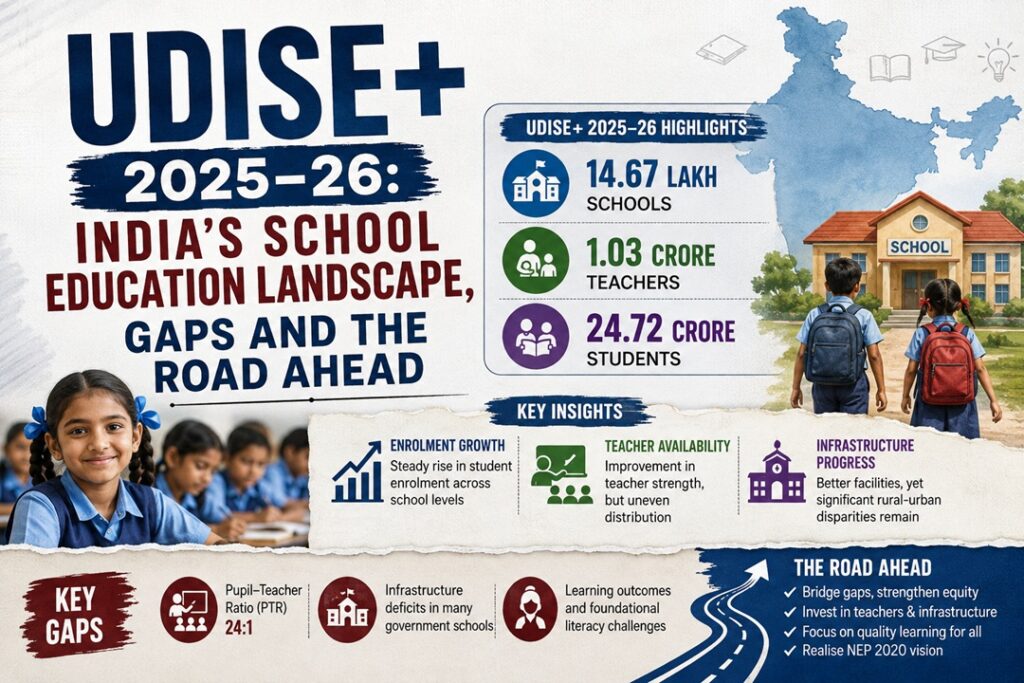
The Unified District Information System for Education Plus (UDISE+) 2025–26 report presents a comprehensive picture of India’s school education system, covering nearly 1.47 million schools, 240 million students and 10.2 million teachers.
How has India’s school education system evolved?
- Significant expansion – India has steadily expanded access to schooling, improved enrolment and retention, reduced dropout levels and strengthened basic educational infrastructure.
- UDISE+ assessment – The 2025–26 dataset captures these developments across nearly 1.47 million schools, 240 million students and 10.2 million teachers.
Education remains a key driver of social mobility, economic opportunity and India’s demographic potential.
- UDISE+ data point to gradual improvements in enrolment, retention, infrastructure and teacher availability.
- Gender participation – The Gender Parity Index (GPI) shows that girls’ participation is ahead of boys in most States and Union Territories, reflecting sustained efforts towards gender-inclusive education.
- Basic amenities – Availability of electricity and drinking water has expanded considerably, strengthening the foundational conditions required for effective schooling.
- These gains indicate that India has made substantial progress in expanding the basic reach of school education.
Where do major educational gaps persist?
- Inter-State disparities – Educational outcomes continue to differ sharply across States and social groups.
- Variations in Gross Enrolment Ratio (GER), dropout rates, Pupil-Teacher Ratio (PTR), school size and infrastructure reveal uneven educational opportunities.
- For example, Meghalaya reports a very high Foundational GER, while Bihar records a considerably lower level.
- At the secondary stage, Chandigarh records a GER above 100, whereas Bihar remains among the lowest.
- Such differences highlight unequal access, retention and progression across educational stages.
- Persistent social gaps – The enrolment share of different social groups does not always correspond with their demographic proportions.
- Scheduled Castes (SCs), Scheduled Tribes (STs), minorities and economically vulnerable households may face overlapping barriers to school participation and completion.
- Location-based constraints – Children in tribal, hilly, border and geographically remote regions often travel long distances to access schools.
- Transport shortages and difficult terrain can further restrict regular attendance.
- Regions of Uttarakhand, Odisha, Jammu and Kashmir and Maharashtra demonstrate some of these continuing challenges.
- Retention and transition concerns – While entry into primary education has improved, retaining students and ensuring their transition to higher classes remains difficult.
- Dropout levels differ significantly across States and educational stages.
- Bihar reports high dropout levels at preparatory and middle stages, while Ladakh records particularly high secondary-stage dropout.
- Poverty, household responsibilities, inadequate transport, social pressures, early marriage, employment needs and weak perceptions of educational returns can contribute to students leaving school.
- Therefore, educational policy must move beyond enrolment and focus equally on retention, transition and completion.
- Uneven teacher distribution – Teacher availability and deployment remain significant concerns.
- PTR differs substantially between States and educational stages.
- Jharkhand records a particularly high secondary PTR, placing additional pressure on teachers.
- High PTRs can reduce personalised attention, classroom engagement and the effectiveness of teaching.
- Rural and remote schools may face additional challenges when teachers manage multiple grades, subjects and non-teaching duties.
- The priority should therefore be not only increasing teacher numbers but also ensuring balanced deployment.
- Difficult-area incentives, rational transfers, local recruitment and stronger administrative support can help address teacher shortages.
- Infrastructure deficiencies – Although school infrastructure has expanded, gaps remain in classrooms, laboratories, libraries, sanitation, digital facilities and other learning resources, particularly in disadvantaged regions.
- Technology access gap – Computer availability, internet connectivity and digital learning resources remain uneven among schools and households.
- Digital education can widen opportunities only when connectivity, devices, content and digital skills are accessible to disadvantaged communities.
- Inclusion of children with disabilities – Inclusive education requires more than admission.
- Accessible classrooms, ramps, toilets, assistive technologies, suitable learning materials and trained teachers are essential to ensure that children with disabilities can participate and learn with dignity.
What policy measures can close these gaps?
- Prioritised educational spending – Public investment should focus more strongly on educationally deprived districts, tribal regions, aspirational districts and remote locations.
- Funding formulas should account for differing levels of need rather than assuming that equal spending produces equal outcomes.
- Balanced teacher placement – Difficult-area allowances, accommodation, professional development, technological support and improved working conditions can make remote postings more sustainable.
- Universal and accessible facilities – Schools should progressively provide safe classrooms, sanitation, drinking water, electricity, digital connectivity and disability-friendly infrastructure.
- Infrastructure planning should incorporate accessibility and inclusion from the outset.
- Strengthening retention mechanisms – Scholarships, transport support, nutrition programmes, counselling and residential schooling where appropriate can reduce the financial and social pressures contributing to school dropout.
- Bridging the digital gap – Digital education should strengthen classroom learning rather than substitute for it.
- Investments in connectivity, devices, digital content and teacher training should prioritise underserved communities.
- Measuring educational outcomes – Enrolment alone cannot capture the quality of education.
- Attendance, learning outcomes, transition rates, completion, inclusion and student well-being should become equally important indicators of educational performance.
- Implementing NEP 2020 priorities – The National Education Policy 2020 provides a framework centred on foundational learning, equity, inclusion and universal access.
- UDISE+ findings can help identify disadvantaged regions and groups and enable more targeted interventions.
- Greater convergence among education, nutrition, healthcare, transport and social welfare programmes can address the multiple disadvantages affecting vulnerable children.
What should India’s next education phase prioritise?
- India’s educational transformation must now move from expansion to equity, enrolment to learning, and access to meaningful inclusion.
- Targeted investment, fair teacher deployment, inclusive infrastructure, stronger social protection and wider digital access can help bridge persistent regional and social inequalities.
- The success of educational reform should ultimately be measured by whether a child’s gender, disability, social background or geographical location ceases to determine the quality of schooling available.
- A system that combines quality, equity and accessibility can strengthen India’s human capital, advance social mobility and contribute to long-term economic development.
Source : The Hindu