
Unified Payments Interface (UPI): India’s Digital Payment Revolution Goes Global
Context
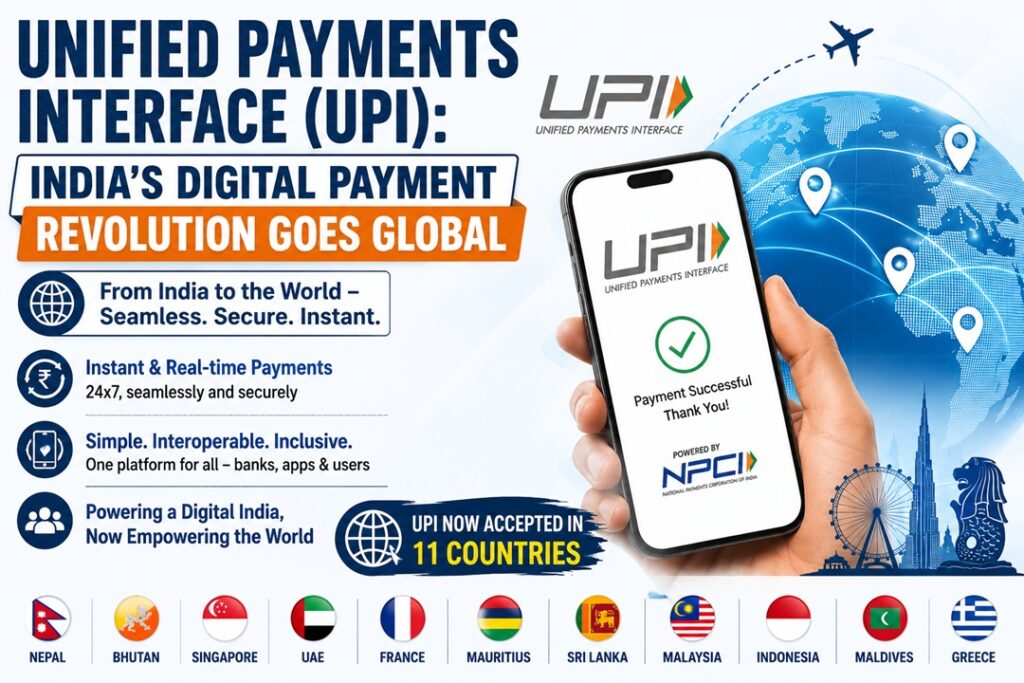
The Unified Payments Interface (UPI) has expanded its international presence to 11 countries, with Greece and the Maldives becoming the latest destinations to adopt or integrate India’s real-time payment system.
What is UPI and how does it work?
- UPI: It is an instant digital payment framework developed by the National Payments Corporation of India (NPCI), under the regulatory oversight of the RBI.
- Built on the Immediate Payment Service (IMPS) infrastructure, UPI enables instant transfer of funds between bank accounts.
- Core objective: To promote a cash-light economy by making digital transactions simple, affordable, secure and accessible.
- Major characteristics:
- Enables real-time payments through a single mobile application.
- Links multiple bank accounts and integrates banking, fund transfers and merchant payments.
- Provides 24×7 payment availability.
- Uses secure authentication mechanisms and encryption for safer transactions.
IMPS: The foundation behind instant bank transfers
Immediate Payment Service (IMPS) is an instant electronic funds-transfer mechanism operated by NPCI.
Salient aspects of IMPS
- Instant settlement: Money can move between bank accounts within seconds.
- Always available: Operates throughout the year, including weekends and public holidays.
- Multiple access points: Available through mobile banking, internet banking, ATMs, SMS and bank branches.
- Transfer options: Customers can use mobile number and MMID or account number and IFSC.
- Transaction ceiling: The standard per-transaction limit is generally up to ₹5 lakh, subject to the applicable bank and channel rules.
UPI’s journey: From pilot project to global platform
2016 – Beginning of a new payment era
- Initial launch: UPI was introduced in April 2016 with 21 banks, followed by its public rollout in August.
- BHIM: The BHIM app was launched in December 2016, facilitating direct bank-to-bank mobile payments and accelerating adoption.
2017 – QR payments gain momentum
- Dynamic QR: UPI introduced dynamic QR-based merchant payments, automatically populating details such as the beneficiary and transaction amount.
2018 – Broader functionality
- New payment tools: Features such as Invoice in Inbox, Signed Intent & QR and Mandates improved ease and security.
- Recurring transactions: Mandates enabled recurring payments, while overdraft account linking expanded UPI’s functionality.
2019 – Rapid mainstream adoption
- IPO payments: SEBI enabled UPI for retail investors applying for IPOs.
- Transaction milestone: UPI crossed 1 billion monthly transactions in October 2019.
2020–2022 – Expansion and financial inclusion
- UPI AutoPay: Enabled electronic mandates for subscriptions, utility bills, SIPs and EMIs.
- UPI 123PAY: Extended digital payment access to feature-phone users through options such as IVR and missed calls.
- UPI Lite: Facilitated quick, low-value payments without requiring a UPI PIN for every transaction.
- Credit card linkage: Expanded the range of payment instruments usable through UPI.
- Scale-up: UPI processed more than US$1 trillion in FY 2021–22, crossed 5 billion monthly transactions in March 2022, and expanded cross-border operations to Bhutan.
2023 – Credit and market expansion
- Credit line integration: Users were allowed to link pre-sanctioned bank credit lines as funding sources.
- Growing dominance: UPI accounted for around 70% of India’s digital payment transactions in FY 2023–24.
2024 – More flexible payment architecture
- UPI Circle: Introduced a mechanism allowing primary users to authorise secondary users within specified limits.
- Higher transaction ceilings: The RBI increased the UPI limit for tax payments to ₹5 lakh and extended higher limits to sectors including IPOs, capital markets, loans, insurance, healthcare and education.
- UPI 123PAY: The transaction limit was raised to ₹10,000.
- UPI Lite: The wallet limit increased to ₹5,000, with a ₹1,000 per-transaction ceiling.
2025 – Easier authentication
- On-device authentication: Smartphone fingerprint or facial authentication enabled easier payment authorisation.
- Aadhaar-based face authentication: Helped simplify PIN onboarding, particularly for first-time users and people with limited access to cards.
Present phase – A mature digital payment ecosystem
- UPI has recorded extraordinary growth in both transaction volume and value, becoming an important component of India’s digital financial infrastructure.
How far has UPI travelled globally?
- International standing: UPI is among the leading real-time payment platforms worldwide.
- Global contribution: It accounted for approximately 49% of global real-time payment transactions in 2024.
- International recognition: The IMF highlighted interoperable digital payment systems, including India’s UPI model, in its June 2025 report.
- Existing international presence: UPI is operational or integrated across countries including Bhutan, Nepal, Singapore, the UAE, France, Sri Lanka, Mauritius and Qatar.
- Recent developments in 2026:
- Cambodia: UPI payments became available through ACLEDA Bank.
- Greece: Cross-border remittance services were enabled through Eurobank.
- Maldives: Integration with the Favara system facilitates instant digital transfers.
- Overall reach: UPI now has a presence in 11 countries, strengthening India’s international digital-payment footprint.
Why does UPI’s overseas expansion matter?
- Lower-cost remittances: UPI can make international money transfers quicker and potentially cheaper than conventional correspondent-banking channels.
- Greater convenience for travellers: Indian visitors can use familiar applications such as PhonePe and Google Pay for QR-based payments where UPI is supported.
- Easier international commerce: Businesses can receive and make payments more efficiently, helping reduce transaction friction in cross-border trade.
- Strengthening India’s fintech influence: Global adoption of UPI demonstrates India’s ability to develop scalable and interoperable digital public infrastructure.
- Closer economic partnerships: Payment connectivity can deepen financial and commercial relationships between India and partner countries.
- Reference model for emerging economies: UPI offers other countries an example of how public digital infrastructure can support secure, accessible and low-cost payments.
What is the road ahead for UPI?
- UPI has fundamentally changed India’s payment ecosystem by combining speed, interoperability, convenience and security.
- Continued innovation and international linkages can further expand its role in cross-border payments and remittances.
- With its growing overseas footprint, UPI is emerging as a significant pillar of India’s Digital Public Infrastructure (DPI) and an instrument of the country’s global fintech outreach.
Source : PIB