
Gorkha Political Demand: Exploring a Permanent Constitutional Settlement
Context
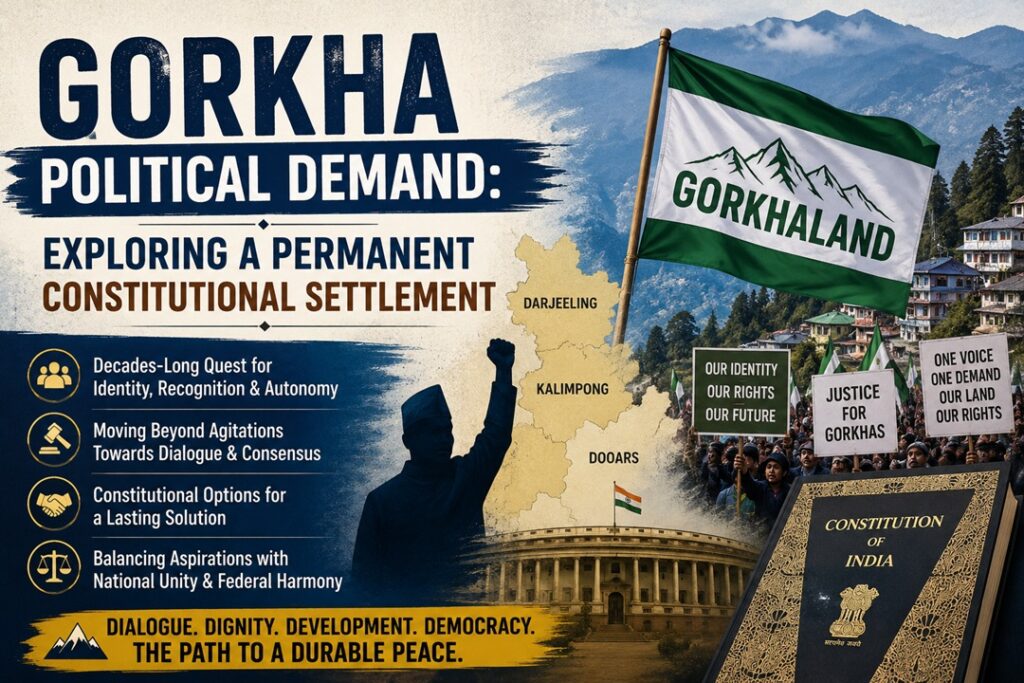
Union Home Minister held a stakeholder consultation in Siliguri and announced a high-level committee under interlocutor and former Deputy National Security Advisor Pankaj Kumar Singh to work towards a long-term political settlement of the Gorkha issue.
Understanding the Gorkha Political Question
- The Gorkha issue stems from a decades-old demand for political autonomy, protection of ethnic and linguistic identity, and a separate administrative arrangement, historically articulated through the demand for Gorkhaland in the hill areas of northern West Bengal.
- A Permanent Political Solution (PPS) seeks to create a durable constitutional and administrative framework that addresses the aspirations of the hill population while safeguarding West Bengal’s territorial integrity and India’s strategic interests.
Evolution of the Administrative Arrangements
- Early Political Mobilisation: Demands for greater autonomy from Bengal emerged in the early 20th century and intensified during the 1980s under the leadership of the Gorkha National Liberation Front (GNLF).
- Darjeeling Gorkha Hill Council (DGHC), 1988: Created after a tripartite agreement to provide limited autonomy to the hills. However, inadequate financial and legislative authority weakened its effectiveness.
- Gorkhaland Territorial Administration (GTA), 2011: Established through an agreement involving the Centre, West Bengal Government and Gorkha Janmukti Morcha (GJM). Its creation did not eliminate the separate-state demand, with major unrest returning in 2017.
- Central Interlocutor, 2025: The Centre appointed Pankaj Kumar Singh as interlocutor in October 2025 to facilitate structured negotiations among stakeholders.
Major Factors Fueling the Demand
- Cultural and Linguistic Distinctiveness: A large section of the hill population identifies with Nepali/Gorkhali language, traditions and cultural practices that differ from those prevalent in the plains.
- Limited Powers of Earlier Councils: The DGHC and GTA faced concerns relating to delayed fund transfers, bureaucratic intervention and inadequate authority over subjects such as land and revenue.
- Developmental Gaps: Issues involving tea-garden livelihoods, employment, healthcare, education, connectivity and public infrastructure have contributed to persistent dissatisfaction.
- Constitutional Safeguards: Demands include Scheduled Tribe (ST) recognition for 11 Gorkha communities and stronger constitutional protection through mechanisms such as Article 244A or the Sixth Schedule.
National Security and Border Considerations
- Siliguri Corridor: The Darjeeling region overlooks the strategically important Siliguri Corridor, popularly known as the “Chicken’s Neck”, which links mainland India with the Northeast.
- Sensitive Neighbourhood: The area lies close to the borders of Nepal and Bhutan and is also geographically proximate to Bangladesh, increasing the strategic importance of political stability.
- Connectivity and Security: Prolonged agitations, disruptions along NH-10, and blockades can affect civilian movement, economic activity and logistical access towards Sikkim and the Northeast.
Constitutional and Administrative Models That Could Be Examined
- Union Territory Framework: The Darjeeling hills and potentially adjoining Terai-Dooars areas could be considered for a centrally administered Union Territory under Article 3.
- Autonomous State under Article 244A: A constitutional autonomous-state arrangement could provide greater legislative and executive powers while retaining the region within West Bengal.
- Sixth Schedule Arrangement: The existing GTA could potentially be transformed into a constitutionally protected autonomous council with enhanced authority over land, forests, taxation and local administration.
- Empowered Statutory Institution: Another possibility is a stronger statutory mechanism with greater financial autonomy, administrative authority and structured coordination with the Union Government.
Obstacles in Finding a Durable Settlement
- Resistance to Territorial Division: Political groups and sections of society in the plains of West Bengal oppose any proposal involving territorial bifurcation.
- Complex Social Composition: The Terai and Dooars comprise Gorkhas, Adivasis, Rajbanshis, Bengalis and other communities, making territorial reorganisation particularly sensitive.
- Fragmentation Within Hill Politics: Differences among GJM, GNLF, Hamro Party and other political organisations make it difficult to develop a single negotiating position.
- Financial Sustainability: The regional economy depends significantly on tea, tourism and related activities, creating questions about the long-term fiscal sustainability of a new administrative structure.
Measures Needed for a Lasting Settlement
- Inclusive Stakeholder Dialogue: The Pankaj Kumar Singh Committee should consult hill political organisations, tribal and ethnic groups, plains communities, civil society and the West Bengal Government.
- Real Transfer of Powers: Any new framework should provide meaningful legislative, financial and administrative authority, rather than simply renaming an existing institution.
- Safeguards for Non-Gorkha Communities: Institutional mechanisms should protect the interests of Adivasis and other communities residing in the Terai and Dooars.
- ST Recognition: The process concerning the 11 left-out Gorkha communities should be addressed through appropriate constitutional and legal procedures.
- Development Alongside Political Reform: A political settlement should be accompanied by investment in roads, disaster-resilient infrastructure, tea-sector livelihoods, education, healthcare and alternative connectivity.
Conclusion
The experience of the DGHC and GTA shows that limited administrative autonomy without adequate devolution may not resolve deep political grievances. The present dialogue provides an opportunity to develop a comprehensive settlement based on constitutional safeguards, genuine decentralisation, inclusive development and national security considerations. A negotiated and participatory solution can help promote long-term peace and stability in the hills and adjoining areas of northern West Bengal.
Source : The Hindu