
Public Examination Reform 2.0: Strengthening the Integrity of India’s Examination System
Context
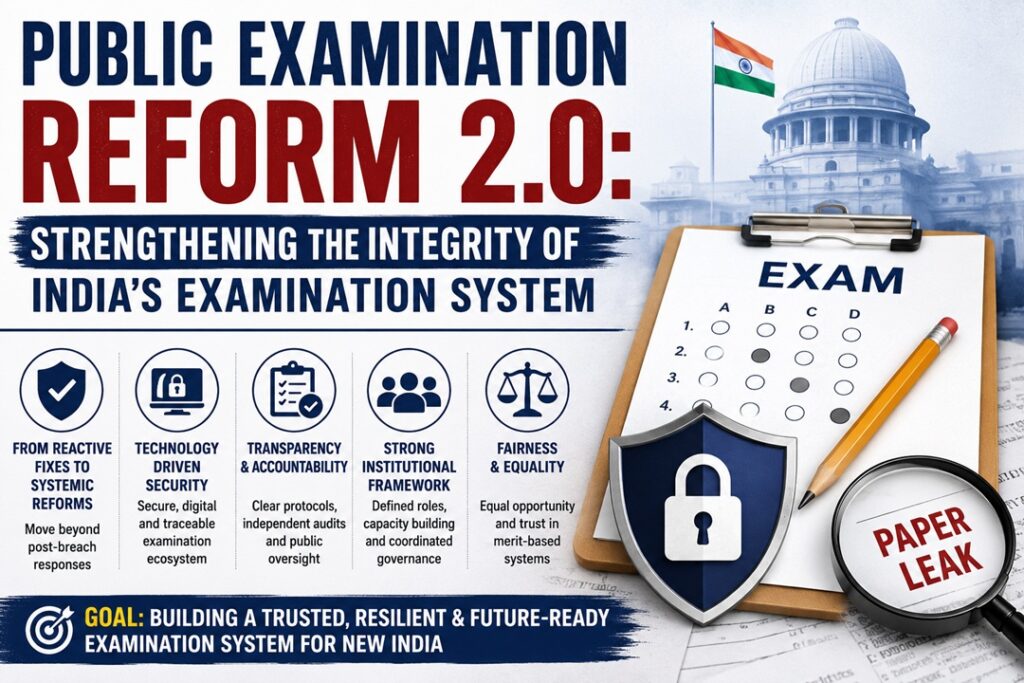
Education reform experts have called for Public Examination Reform 2.0 (PER 2.0) to transform India’s examination system from a reactive approach following paper leaks and irregularities into a proactive, system-wide security framework for major national and State-level examinations.
Public Examination Reform 2.0 (PER 2.0)
Understanding Public Examination Reform 2.0:
What does PER 2.0 propose?
- Public Examination Reform 2.0 (PER 2.0) envisages a comprehensive, lifecycle-based integrity framework for high-stakes entrance and recruitment examinations.
- While PER 1.0 (2006–2015) primarily strengthened candidate-facing transparency, PER 2.0 focuses on institutional resilience and internal controls.
- It seeks standardized and independently auditable Standard Operating Procedures (SOPs), complete chain-of-custody monitoring and clear institutional responsibility from question-paper creation to final result declaration.
Why is a Second-Generation Reform Necessary?
- Weaknesses in Question Development: Recent examination controversies indicate that vulnerabilities can emerge during question preparation, moderation and handling by subject experts, rather than only during physical transportation.
- Physical Security Alone is Insufficient: Police escorts and secured transportation cannot prevent breaches if digital systems, database access and internal workflows remain inadequately monitored.
- Errors and Translation Problems: Incorrect questions, missing options and translation-related defects can undermine examination credibility and necessitate re-tests.
- Poor Follow-Through on Earlier Recommendations: Several committees and expert groups have proposed reforms, but the absence of enforceable and independently verifiable Action Taken Reports has weakened implementation.
- Preserving Merit and Public Confidence: Irregularities, abnormal score patterns and perceived manipulation can undermine the credibility of merit-based selection and cause significant distress among aspirants.
Major Components of PER 2.0
- Secure Question Preparation and Translation: Introduce rigorous background verification, conflict-of-interest declarations, periodic rotation of question setters and secure translation systems to reduce unnecessary human intervention.
- Complete Digital and Physical Tracking: Adopt role-based permissions, biometric authentication, digital watermarking, continuous audit logs and tamper-evident tracking throughout every stage of question-paper handling.
- Data-Driven Centre Allocation and Monitoring: Use algorithmic randomisation for examination centres, objective assessment of third-party facilities and integrated CCTV systems to reduce opportunities for malpractice and collusion.
- Independent Investigation and Institutional Responsibility: Conduct post-examination forensic and statistical analysis, identify abnormal score patterns, undertake external cybersecurity audits and establish protected whistleblower mechanisms.
- Public Integrity Reporting: Examination authorities should periodically disclose examination-security and integrity reports to improve transparency and accountability.
Key Obstacles in Strengthening Examination Security
- Large-Scale and Multilingual Operations: Conducting examinations simultaneously for millions of candidates across multiple languages and geographically dispersed centres creates substantial administrative and monitoring challenges.
- Dependence on External Service Providers: Reliance on private examination centres, technology vendors and temporary personnel can create additional points of vulnerability.
- High-Stakes Coaching Ecosystem: Large financial incentives can encourage collusion between intermediaries, coaching networks and examination personnel seeking unauthorised access to examination material.
- Cyber Threats and Synthetic Manipulation: Greater digitisation exposes examination systems to hacking, remote tampering and sophisticated AI-assisted fabrication of documents or examination records.
- Centre-State Coordination Challenges: Differences in institutional capacity, regulations and examination procedures across central and State bodies can make nationwide standardisation difficult.
Steps Towards a More Robust Examination Framework
- Release a National Examination Integrity White Paper: Map operational weaknesses, review implementation gaps in previous committee recommendations and identify successful practices among examination authorities.
- Create a Common Examination Integrity Code: Establish legally enforceable SOPs and security standards for bodies such as the National Testing Agency (NTA), UPSC, State Public Service Commissions and recruitment agencies.
- Adopt a Secure-by-Design Model: Build transparency, traceability and resilience into examination architecture from the beginning instead of introducing emergency safeguards after every breach.
- Implement Pending Expert Recommendations: Put measures such as encryption, question-bank randomisation, stronger access controls and biometric verification into operation within clearly defined timelines.
- Strengthen Legal Deterrence: Establish fast-track mechanisms for examination-related offences, protect whistleblowers and ensure effective implementation of the Public Examinations (Prevention of Unfair Means) Act, 2024.
Conclusion
Public Examination Reform 2.0 should move India beyond isolated responses to individual paper leaks and examination controversies. By securing the entire examination lifecycle—from question-setting and translation to logistics, evaluation and post-exam forensic auditing—India can reduce both insider and external vulnerabilities. A secure-by-design examination ecosystem is essential for restoring public confidence, protecting merit and safeguarding the aspirations of millions of students and job aspirants.
Source : The Hindu