
e-Shram Portal: Expanding Social Security Coverage for India’s Unorganised Workforce
Context
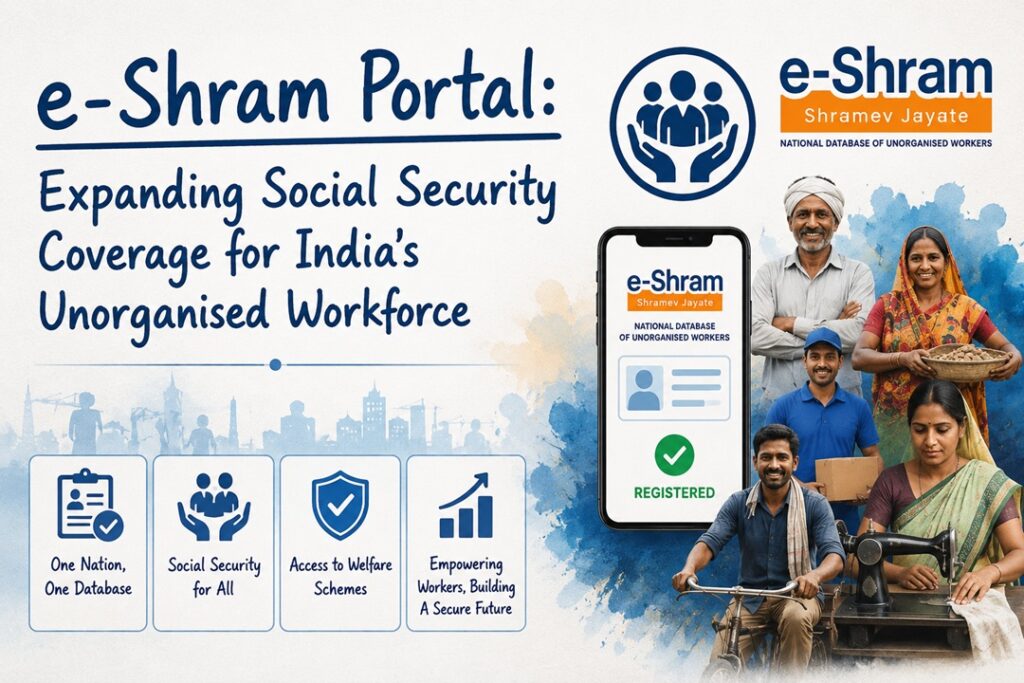
The e-Shram Portal has completed five years since its launch, highlighting its growing role in creating a unified database and improving access to social security for workers in India’s unorganised sector.
Understanding the e-Shram Portal
- e-Shram Portal – It is India’s first national centralised database of unorganised workers, launched by the Ministry of Labour and Employment in August 2021.
- Meaning of Unorganised Worker – The category includes home-based, self-employed and wage workers in the unorganised sector. It also covers workers in the organised sector who are not members of ESIC/EPFO and are not government employees.
- Technology Backbone – The National Informatics Centre (NIC) developed the platform and established the country’s first Aadhaar-seeded National Database of Unorganised Workers (NDUW).
- Coverage – The portal caters to construction labourers, migrant workers, gig and platform workers, street vendors, domestic workers, agricultural labourers and other workers outside formal employment.
Core Functions of e-Shram
- National Worker Database – Builds an Aadhaar-seeded repository of workers who largely remain outside the formal social-security system.
- Universal Account Number – Each registered worker receives a unique 12-digit UAN, which remains valid throughout the country.
- Integrated Service Gateway – Links workers with welfare schemes, social-security programmes, employment opportunities, skill development and pension facilities.
- Inter-State Portability – Supports continuity of welfare access for workers who migrate between States.
- Emergency Support – The database can help governments identify and assist vulnerable workers during crises and national emergencies.
From Worker Database to Integrated Welfare Platform
Major Developments in e-Shram
- One-Stop Service Model – In October 2024, e-Shram evolved into a One-Stop Solution, bringing together social security, employment, skilling and pension-related services while improving scheme convergence.
- Better Welfare Delivery – The expanded platform seeks to improve accessibility and portability of benefits for unorganised workers, reflecting the Union Budget 2024-25 emphasis on strengthening social-security coverage.
- Scheme Integration – Around 15 social-security and welfare schemes are brought within the platform ecosystem, including:
- Pradhan Mantri Shram Yogi Maan-Dhan Yojana (PM-SYM)
- Pradhan Mantri Suraksha Bima Yojana (PMSBY)
- Pradhan Mantri Jeevan Jyoti Bima Yojana (PMJJBY)
- National Social Assistance Programme (NSAP)
- One Nation One Ration Card (ONORC)
- Pradhan Mantri Awaas Yojana–Gramin (PMAY-G), among others.
Improving Insurance Coverage
- Simplified Registration – Eligible workers can enrol in PMSBY and PMJJBY through the e-Shram platform.
- PMSBY Protection – Provides ₹2 lakh in case of accidental death or total permanent disability and ₹1 lakh for partial disability.
- PMJJBY Benefit – Provides ₹2 lakh life insurance cover for death due to any cause, subject to scheme conditions.
Employment and Skill Connections
- Job Opportunities – e-Shram is linked with the National Career Service (NCS) to facilitate access to employment opportunities.
- Skill Development – Workers can access the Skill India Digital Hub for skilling and apprenticeship opportunities.
- Scheme Identification – Integration with myScheme helps workers discover government programmes for which they may be eligible.
Pension and Social-Security Linkages
- Pension Enrolment – Eligible workers can register for Pradhan Mantri Shram Yogi Maan-Dhan (PM-SYM) through the portal.
- Retirement Support – The scheme provides an assured pension of ₹3,000 per month after the age of 60, subject to eligibility and contribution requirements.
Wider Inclusion Through Technology
- Multilingual Access – In 2025, integration with BHASHINI enabled multilingual functionality across 22 languages, improving accessibility for workers from different linguistic backgrounds.
- Migrant Families – Collection of family-related information can support better welfare planning for migrant households.
- Construction Workforce – Data can be shared with States and Union Territories to facilitate registration with Building and Other Construction Workers (BOCW) Welfare Boards.
- Gig Economy Workers – The platform supports identification and registration of gig and platform workers within the national unorganised-worker database.
- Growing Coverage – Around 1.15 million platform workers have been registered, providing a foundation for designing targeted social-security interventions.
Key Challenges Hindering e-Shram’s Effectiveness
- Awareness and Digital Access Gap – A considerable section of unorganised workers, particularly women and rural workers, may remain unaware of the portal and its services.
- Digital Literacy Constraints – Limited familiarity with digital platforms can make independent registration difficult.
- Usability Issues – Despite multilingual support, some workers may continue to face difficulties in navigating the interface.
- Aadhaar-Related Exclusion – Errors in addresses or outdated Aadhaar-linked mobile numbers can create difficulties, particularly for mobile and migrant workers.
- Limited Automatic Benefits – Registration mainly establishes worker identity; it does not automatically confer every social-security benefit.
- Data Updating Concerns – Changes in occupation, employment, migration status and location may not always be reflected promptly.
- Institutional Gaps – Coordination between central, State and local agencies, along with inadequate field-level capacity, can weaken outreach.
- Migrant Worker Mobility – Frequent movement across States makes it challenging to maintain accurate information about a worker’s location, occupation and employment status.
Reforms Needed to Strengthen e-Shram
- Expand Assisted Registration – Strengthen registration through Common Service Centres (CSCs), Panchayats and Self-Help Groups (SHGs), especially in underserved areas.
- Target Vulnerable Groups – Conduct focused awareness drives for women, rural workers, migrants and other hard-to-reach groups.
- Make the Platform More Inclusive – Simplify navigation and introduce stronger voice-based and low-literacy-friendly features.
- Reduce Aadhaar-Linked Exclusion – Provide flexible authentication and easy correction mechanisms for mobile, address and Aadhaar-related discrepancies.
- Create a Continuously Updated Database – Enable periodic verification and updating of employment, occupation, location and migration details.
- Move Towards Automatic Entitlement – Integrate e-Shram more deeply with welfare schemes so that eligible workers can be identified and connected with benefits with minimal duplication.
- Strengthen Benefit Portability – Develop a truly portable social-security identity that functions seamlessly across States.
- Improve Institutional Coordination – Build stronger coordination among Union, State and local authorities and provide regular capacity-building for officials and field workers.
- Protect Worker Data – Strengthen privacy safeguards, consent mechanisms, cybersecurity, deduplication and verification systems to ensure trustworthy records.
The Way Forward
- e-Shram has created an important digital foundation for extending social security to India’s large unorganised workforce.
- The next stage should involve shifting from a primarily registration-oriented database to a dynamic social-security delivery platform.
- Greater interoperability with welfare schemes, continuous data updating and nationwide portability can help workers receive benefits more efficiently.
- Ultimately, the success of e-Shram should be measured not merely by the number of registrations, but by its ability to convert worker identification into timely, portable and meaningful social-security protection.
Source : PIB