
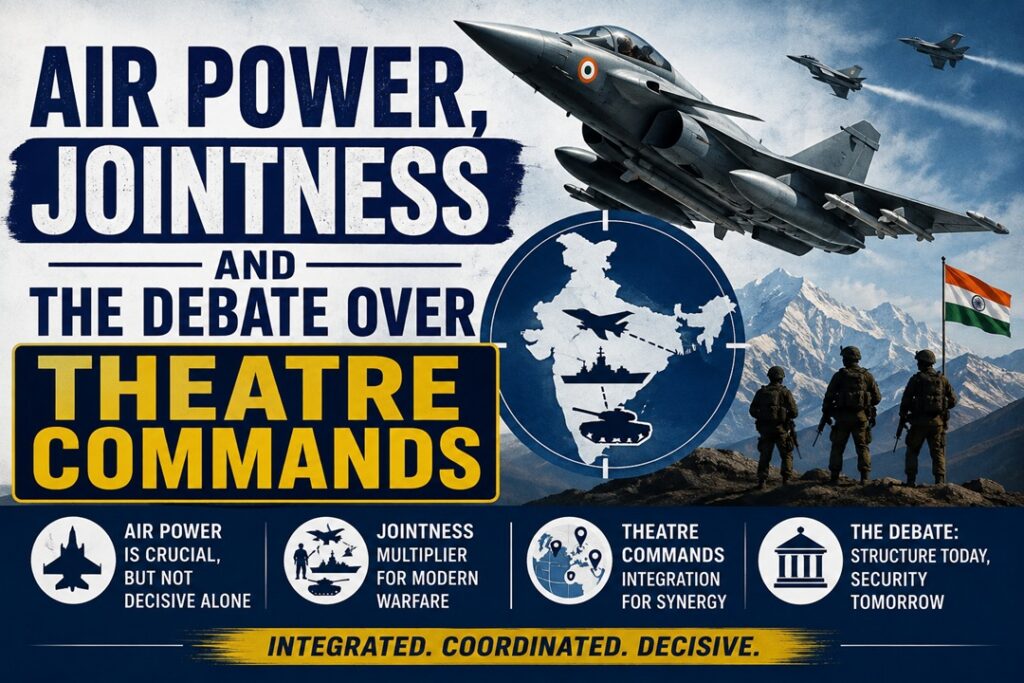
Air Power, Jointness and the Debate Over Theatre Commands
Context
Recent conflicts in Ukraine and West Asia demonstrate that air superiority by itself may not deliver decisive military outcomes without integrated joint operations. This has renewed India’s debate over theatre commands, centralized air control and the optimal employment of the Indian Air Force (IAF), particularly along the China-facing LAC.
Understanding Air Power and Theatre Commands
What do these concepts mean?
- Air Power – It refers to the ability to employ military force through air and space to generate strategic, operational and tactical effects. However, contemporary multi-domain warfare shows that air power has significant limitations when employed independently.
- Theatreisation – It seeks to restructure separate Army, Navy and Air Force commands into integrated, geographically defined Joint Theatre Commands (JTCs) under unified operational leadership, enabling coordinated use of land, maritime, air, cyber and space capabilities.
Important Indicators of Modern Air Warfare
- Unequal Cost Exchange: One-way attack drones such as Shahed-type systems may cost around $20,000–$50,000, while sophisticated air-defence interceptors can cost roughly $1 million–$3 million each.
- China-Facing Force Imbalance: India has approximately 460–520 combat aircraft available along its northern frontiers, while the PLAAF possesses an estimated 65+ combat squadrons.
- IAF Fighter Shortfall: Against the sanctioned requirement of 42 fighter squadrons, the IAF has around 30–31 active fighter squadrons.
- Ukraine’s Air-Denial Experience: Dense and layered surface-to-air missile networks prevented Russia from obtaining uncontested air superiority despite its larger air-power inventory.
Major Constraints on Air-Centric Warfare
- Persistent Air Defence Threat: Sophisticated, networked air-defence systems can restrict even a numerically superior air force from achieving complete control of the skies.
- Air Superiority May Not Ensure Strategic Victory: Air campaigns can destroy visible and accessible targets, but hardened underground facilities, dispersed forces and concealed infrastructure may continue to function.
- Favourable Economics for Drone-Based Warfare: Large numbers of inexpensive drones can force an opponent to consume costly and limited interceptor inventories.
Why the IAF Remains Cautious About Theatreisation
- Need for Operational Mobility: The IAF maintains that air power is inherently flexible and that scarce fighter assets should be rapidly shifted between fronts according to operational requirements.
- Risk of Fragmenting Limited Resources: With only around 30 fighter squadrons, permanently distributing aircraft among geographical theatres could reduce the concentration of combat power.
- Experience with Centralized Employment: Operations such as Balakot in 2019 and Operation Sindoor in 2025 demonstrated the utility of centralized air-force planning and execution.
- Joint Coordination Alternative: The IAF has favoured Joint Coordination Centres (JCCs) to facilitate inter-service cooperation during crises.
Why the China Challenge Requires Greater Jointness
- Greater Strategic Resilience: China possesses substantial industrial and military depth, enabling it to absorb losses and sustain prolonged military operations.
- Difficult Himalayan Operating Environment: Airfields in Ladakh and the Northeast face runway, altitude, weather and logistical constraints.
- Decision-Making Delays: Consensus-oriented coordination mechanisms could slow responses when multiple fronts become active simultaneously.
- Need for Seamless Air-Land Integration: Army formations along the LAC require rapid and synchronized air support.
- Inter-Service Institutional Barriers: Differences in promotion structures, seniority, command authority and organizational cultures can complicate military integration.
Reforming India’s Joint Warfare Architecture
- Provide Clear Political Direction: The political leadership and Chief of Defence Staff should establish a coherent framework for integrated theatre commands.
- Deepen Joint Training and Career Progression: Tri-service appointments, joint staff courses and inter-service exposure should become important components of professional military advancement.
- Create Flexible Air-Asset Allocation: Theatre commanders should have access to assigned air capabilities while the Air Chief retains the ability to redistribute strategic assets during major contingencies.
- Expand Affordable Counter-Drone Capabilities: India should develop layered and economical counter-UAS systems, including electronic, kinetic and directed-energy solutions.
- Integrate C4ISR Architecture: A unified command, control, communications, computers, intelligence, surveillance and reconnaissance network should connect Army sensors, naval assets and IAF platforms.
Conclusion
The changing nature of warfare in Ukraine, West Asia and along India’s northern frontier demonstrates that air power is most effective when embedded within a broader joint-force strategy. The IAF’s concern about losing flexibility is understandable, particularly given its existing fighter-squadron shortage. However, excessive dependence on consultative coordination can create vulnerabilities during simultaneous or high-intensity contingencies. India therefore needs a theatre-command architecture that combines unity of command with flexible allocation of scarce air assets, enabling faster decision-making, stronger inter-service coordination and greater operational effectiveness against a technologically capable adversary such as China.
Source : The Hindu