
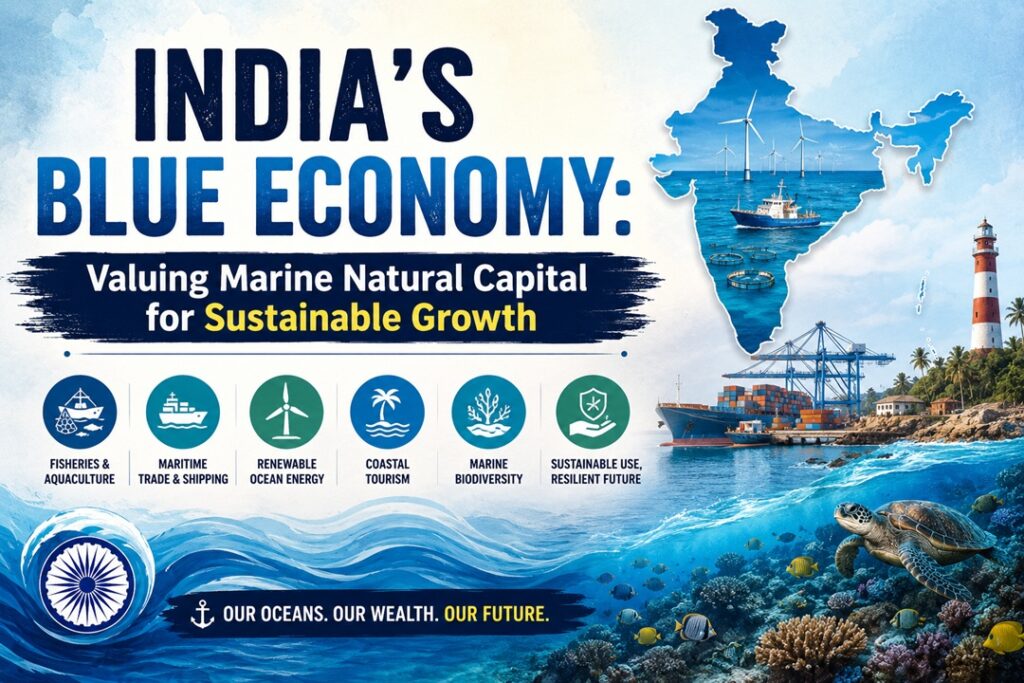
India’s Blue Economy: Valuing Marine Natural Capital for Sustainable Growth
Context
India’s expanding dependence on marine and coastal resources has created significant economic opportunities, but rising ecological stress makes sustainable management of ocean wealth increasingly important.
Understanding the Blue Economy
- Meaning – The blue economy broadly refers to the sustainable utilisation of oceanic and marine resources to promote economic growth, employment and livelihoods while preserving marine ecosystems.
- Major Sectors – In the Indian context, it includes:
- Marine and inland fisheries and aquaculture
- Ports, shipping and maritime logistics
- Coastal and cruise tourism
- Offshore renewable energy
- Marine biotechnology and pharmaceuticals
- Deep-sea mineral exploration
- Coastal infrastructure and associated services
- India’s Maritime Potential – India possesses a coastline of around 11,100 km and an Exclusive Economic Zone (EEZ) of more than 2 million sq km, creating considerable scope for sustainable ocean-based development.
Why Does the Ocean Economy Matter to India?
- Contribution to the Economy – The marine sector contributes approximately 4% to India’s GDP.
- Ports and maritime routes are essential for international commerce, making efficient shipping infrastructure crucial for trade competitiveness.
- Jobs and Livelihoods – Millions of coastal residents rely on fishing, aquaculture, boat construction, port-related activities and tourism.
- India is among the world’s leading fish-producing countries, supporting a large employment base.
- Nutritional Security – Fish and other seafood provide an important source of affordable animal protein and micronutrients.
- Renewable Energy Potential – Offshore wind, tidal power and marine-linked solar projects can contribute to energy diversification.
- Ecosystem Protection – Mangroves and other coastal ecosystems store carbon while reducing the impact of cyclones, storm surges and coastal erosion.
- Strategic Importance – Maritime capabilities are vital for protecting India’s oceanic territory, offshore infrastructure and strategic interests in the Indian Ocean Region.
Fisheries: A Key Pillar of India’s Ocean Economy
- Fisheries form a major component of India’s blue economy and provide direct and indirect livelihoods to nearly 30 million people.
- As per data cited in the MoSPI concept paper:
- India produced around 19.77 million metric tonnes (MMT) of fish in FY2024–25.
- Nearly 77% originated from inland fisheries and 23% from marine fisheries.
- Marine fish output increased to approximately 4.615 million tonnes in 2024–25 from 3.443 million tonnes in 2013–14.
- Fisheries accounted for an estimated ₹1.76 lakh crore, or around 1.09% of India’s GVA, in 2023–24.
- India exports over 350 varieties of marine products to nearly 130 global markets.
- Marine product exports in FY2024–25 stood at approximately 1.7 MMT, valued at ₹62,408.45 crore.
- However, higher production and export earnings do not necessarily indicate that the underlying fish stocks and marine ecosystems remain healthy.
MoSPI’s New Approach to Measuring Marine Wealth
- Putting a Value on Fish Resources – The Ministry of Statistics and Programme Implementation (MoSPI) has undertaken an experimental exercise to estimate the monetary value of India’s marine fish resources.
- Based on UN Standards – The exercise follows the United Nations System of Environmental-Economic Accounting (UN SEEA) framework.
- The approach treats fish stocks as natural assets, allowing policymakers to examine not only the economic returns from fishing but also whether the resource base is being maintained, depleted or regenerated.
- This represents a shift from measuring only economic flows to assessing changes in natural wealth.
Why Should Natural Capital Be Accounted For?
- Limitations of Conventional Accounts – Conventional economic statistics generally capture the value of fish harvested and sold.
- They may not adequately reflect the depletion of the fish stock from which future production will originate.
- A fishery could therefore generate high current revenues while simultaneously experiencing a decline in its underlying natural wealth.
What Can Natural-Capital Accounting Reveal?
It can help address questions such as:
- Is the fish stock growing, stable or declining?
- What is the estimated economic worth of the remaining resource?
- What are the long-term costs of overfishing?
- How could climate change affect marine resources and fishing communities?
- Is expanding fishing capacity economically and ecologically viable?
Thus, the approach encourages policymakers to move from short-term production measurement towards long-term resource sustainability.
Linking Marine Accounting with Climate Risks
Marine ecosystems are being affected by:
- Rising ocean temperatures
- Ocean acidification
- Shifting fish distribution
- Alterations in breeding and migration cycles
- Extreme marine weather events
- Loss and degradation of coastal habitats
These changes can influence both fish-stock availability and the future earnings of fishing-dependent communities.
Natural-capital accounts can help quantify some of these economic implications and incorporate environmental risks into development planning.
Managing Multiple Demands on Marine Space
India’s marine areas are increasingly subject to competing demands from:
- Fisheries
- Ports and shipping
- Coastal and cruise tourism
- Offshore renewable energy
- Coastal infrastructure
- Marine conservation
- Emerging ocean-based industries
An integrated environmental-economic accounting system can provide policymakers with a common evidence base for evaluating these competing uses.
For example, an infrastructure or energy project may generate substantial short-term economic benefits but simultaneously damage fish habitats. Such ecological losses could impose significant costs on fishing communities and reduce future national wealth.
Therefore, natural-capital accounting can strengthen marine spatial planning and sustainable allocation of ocean resources.
How Will India Value Marine Fish Assets?
MoSPI’s concept paper, ‘Methodological Approach for Compilation of Experimental Monetary Asset Accounts of Marine Fish Resources’, proposes an experimental methodology aligned with the SEEA framework.
1. Selecting Accounting Resources
Commercially, economically or ecologically significant marine fish species would first be identified for inclusion in the accounts.
2. Determining Resource Status
The condition of each selected species would be assessed to determine whether it is:
- Regenerating
- Relatively stable
- Being depleted
Given limitations in species-specific stock information, 10-year species-wise landing data may initially be used as a proxy by comparing current landings with historical peaks.
3. Estimating the Resource’s Economic Life
The estimated asset life indicates the period during which the fish resource is expected to generate economic benefits, thereby connecting fisheries science with economic valuation.
4. Computing Resource Rent
Resource rent represents the income attributable to the natural resource after accounting for:
- Labour expenditure
- Operating costs
- Depreciation
- Normal returns on fishing vessels and other produced capital
5. Discounting Future Earnings
Expected future resource rents are projected over the estimated asset life and converted into present value.
For the experimental exercise, MoSPI proposes a 2% real discount rate.
6. Creating Marine Fish Asset Accounts
The resulting accounts would combine:
- Physical information on the condition of fish resources; and
- Monetary estimates of their economic value.
This can help track whether marine natural capital is being preserved, regenerated or depleted.
Global Context of Aquatic Natural-Capital Accounting
Only a relatively small number of countries have experimented with monetary accounting for aquatic resources.
Countries including Australia, the Netherlands, Norway, Canada, the United Kingdom, France, the United States and New Zealand have undertaken various forms of natural-capital or fisheries-related accounting.
However, aquatic resources are particularly difficult to value because fish are:
- Living organisms
- Mobile across ecosystems and jurisdictions
- Naturally reproducing
- Highly sensitive to ecological and climatic changes
India’s experiment can therefore contribute to the broader development of marine natural-capital accounting methodologies.
Key Obstacles in Valuing Marine Natural Assets
Complexity of Biological Resources
Fish populations fluctuate because of ecological conditions, climate variability, fishing pressure and natural reproduction, making them harder to value than static assets such as minerals.
Gaps in Fisheries Data
India requires more comprehensive and continuous information on:
- Biomass
- Stock condition
- Catch composition
- Recruitment
- Mortality
- Ecosystem health
Reliance on landing data as a proxy can therefore create significant uncertainty.
Limits of Monetary Valuation
Not every ecological benefit can be meaningfully expressed in monetary terms.
Marine ecosystems also provide:
- Biodiversity
- Cultural benefits
- Ecological functions
- Carbon sequestration
- Climate-regulation services
These may not be fully reflected in market-based valuations.
Climate-Related Uncertainty
Future fish availability depends on uncertain changes in:
- Ocean temperature
- Currents
- Habitat conditions
- Species distribution
Consequently, estimates of future resource rents can carry considerable uncertainty.
Possibility of Misreading Valuation Results
A high monetary value for a fish stock should not automatically be interpreted as an invitation to increase exploitation.
Valuation must support, rather than replace, scientific catch limits and ecological sustainability criteria.
Institutional Coordination
Marine resources fall under multiple domains, including fisheries, environment, shipping, ports, coastal regulation and disaster management.
Effective accounting therefore requires stronger inter-agency coordination and data sharing.
Existing Measures for Advancing India’s Blue Economy
- Pradhan Mantri Matsya Sampada Yojana (PMMSY) – Supports fisheries development, infrastructure and value-chain enhancement.
- Deep Ocean Mission – Promotes deep-sea exploration, marine science and resource-related capabilities.
- Sagarmala Programme – Focuses on port-led development and maritime connectivity.
- Blue Revolution initiatives – Promote fisheries and aquaculture development.
- National Coastal Mission – Supports conservation and sustainable management of coastal ecosystems.
- EnviStats India – Provides environmental-economic accounts covering resources such as land, water, forests and minerals.
- Marine fish asset accounts can complement these programmes by providing a stronger statistical basis for sustainable marine-resource governance.
Priority Areas for the Future
Upgrade Fisheries Information Systems
India should improve regular collection of:
- Species-level biomass
- Stock status
- Catch and fishing effort
- Mortality and recruitment
- Marine ecosystem indicators
Combine Statistics with Scientific Assessments
Landing statistics should increasingly be complemented by scientifically robust biomass estimates and stock-assessment models.
Integrate Climate Projections
Marine asset accounts should incorporate alternative climate scenarios to estimate potential effects on:
- Fish stocks
- Fishing incomes
- Coastal livelihoods
- Future economic returns
Use Accounting for Marine Spatial Planning
Natural-capital information can help balance the needs of:
- Fisheries
- Conservation
- Ports
- Tourism
- Offshore renewable energy
Safeguard Small-Scale Fishers
Economic valuation should contribute to sustainable catch limits, livelihood diversification, insurance, alternative employment and social protection for vulnerable fishing communities.
Apply the Precautionary Principle
Monetary valuation should never become a tool for legitimising overexploitation. Ecological thresholds, carrying capacity and scientifically determined catch limits must remain central to fisheries management.
Build an Integrated Blue-Economy Statistical System
Over time, India could develop comprehensive accounts covering:
- Fisheries
- Coastal ecosystems
- Maritime transport
- Tourism
- Offshore energy
- Other ocean-based industries
Such a framework should also avoid double counting of economic and environmental values.
The Road Ahead
- India’s initiative to introduce natural-capital and climate-risk accounting for marine fish resources marks an important shift in economic policymaking.
- It recognises that oceans are not merely sources of annual income but represent a long-term stock of natural wealth.
- The effectiveness of the initiative will depend on reliable data, scientific stock assessments and the ability to translate accounting outcomes into policy decisions.
- The objective should not be to assign a price to every component of nature, but to ensure that economic expansion does not result in irreversible ecological depletion.
- By integrating economic valuation, marine science, community participation and the precautionary principle, India can build a blue economy that is productive, resilient, inclusive and environmentally sustainable.
Source: The Hindu