
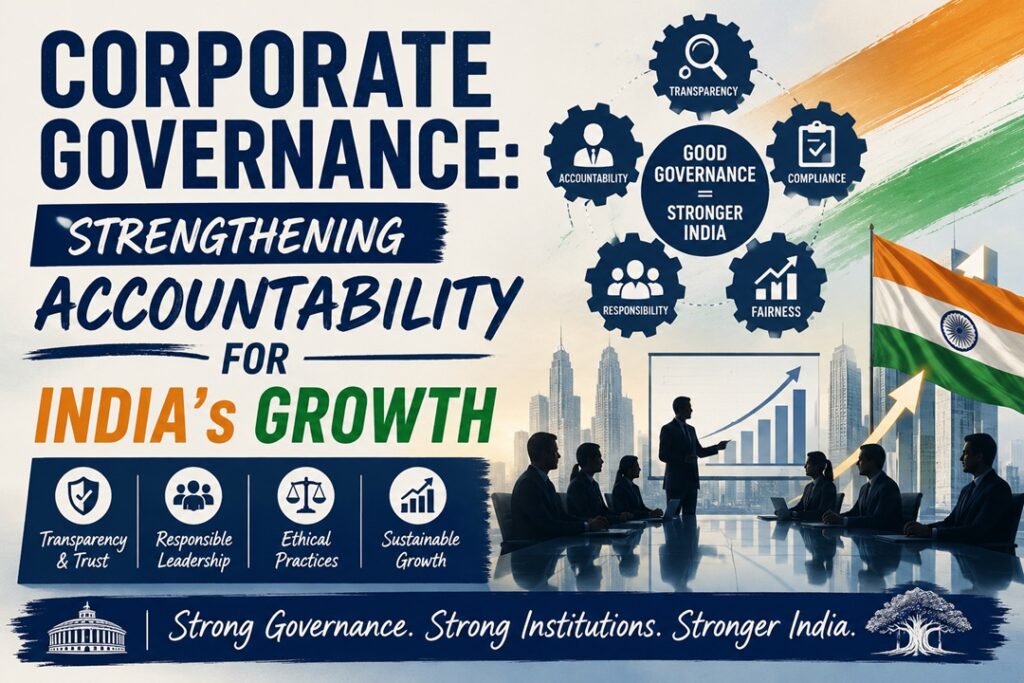
Corporate Governance: Strengthening Accountability for India’s Growth
Context
Union Minister of State for Personnel, Public Grievances and Pensions emphasised that sound corporate governance is a key pillar of India’s development journey during an interaction with a delegation from the Institute of Company Secretaries of India (ICSI).
Understanding Corporate Governance
Corporate governance is the institutional framework through which companies are directed, supervised and held accountable. It consists of rules, processes, institutions and relationships that determine how an organisation is managed while balancing the interests of shareholders, management, employees, investors, creditors, customers, regulators and society.
ICSI and the Expanding Governance Ecosystem
- Professional Strength: The Institute of Company Secretaries of India (ICSI) has more than 80,000 qualified members supporting corporate compliance, board processes and regulatory requirements.
- Future Talent Pool: Around 2.5 lakh students are pursuing professional education covering areas such as corporate legislation, securities regulation and dispute resolution.
- National Recognition: The 26th ICSI National Awards for Excellence in Corporate Governance, scheduled for 2027, will assess areas including corporate disclosures, sustainability practices, CSR outcomes and secretarial audit standards.
- Governance at the Local Level: ICSI is also working towards extending governance principles beyond listed corporations to Panchayats and local government institutions, including through multilingual educational resources.
Major Elements of Effective Corporate Governance
- Openness and Accurate Disclosure: Companies are expected to provide timely and reliable information regarding financial performance, related-party dealings and business risks under SEBI’s LODR framework and the Companies Act, 2013.
- Effective Board Supervision: Independent Directors and specialised committees such as Audit, Nomination and Remuneration, and Stakeholder Relationship Committees help strengthen oversight and reduce conflicts of interest.
- Safeguarding Small Investors: Mechanisms such as e-voting, postal ballots and class-action remedies under Section 245 of the Companies Act help protect minority shareholders.
- Compliance Assurance: Secretarial audits undertaken by practising Company Secretaries examine compliance with statutory provisions, regulatory requirements and Secretarial Standards such as SS-1 and SS-2.
- Sustainability-Oriented Reporting: ESG considerations are increasingly incorporated into corporate decision-making, including through the Business Responsibility and Sustainability Report (BRSR) framework applicable to leading listed entities.
Persistent Weaknesses in Corporate Governance
- Concentration of Promoter Power: Strong promoter influence, particularly in family-controlled companies, can restrict the ability of Independent Directors to question managerial decisions.
- Misuse of Related-Party Dealings: Complex corporate structures may be exploited to move funds, shift profits or favour promoter-linked entities.
- Procedural Rather than Ethical Compliance: Some organisations treat governance as a formal regulatory requirement instead of developing an internal culture of integrity and accountability.
- Audit and Monitoring Deficiencies: Weak coordination between external auditors, internal audit teams and compliance mechanisms can allow financial irregularities and fraud to remain undetected for longer periods.
- Governance Risks in Startups: Rapidly expanding and unlisted startups may give greater priority to growth and fundraising than to internal controls, risk management and structured board oversight.
Reform Priorities
- Enhance the Independence of Boards: Develop stronger performance assessments for Independent Directors and create safeguards for individuals raising concerns about governance failures.
- Widen Secretarial Audit Coverage: Consider extending independent secretarial audits to major unlisted public companies, highly leveraged private firms and public sector enterprises.
- Adopt Technology-Enabled Compliance: Expand the use of AI, digital forensic tools and distributed-ledger technologies to identify suspicious transactions, monitor related-party dealings and automate regulatory compliance through platforms such as MCA21.
- Build Governance into Startup Culture: Develop proportionate governance standards for early-stage and venture-backed companies so that strong internal controls are established before they enter public markets.
- Strengthen Local Institutional Governance: Apply principles of transparent accounting, auditing and administrative accountability to Municipal Corporations and Panchayati Raj Institutions.
Significance for Viksit Bharat@2047
As India moves towards becoming a major global economic power, corporate governance will be critical for building investor confidence, responsible entrepreneurship and sustainable economic growth.
Professional institutions such as ICSI and Company Secretaries can serve as an important bridge between regulatory compliance and ethical business conduct. Strengthening transparency, accountability and fiduciary responsibility across businesses and public institutions can help ensure that India’s economic expansion remains inclusive, sustainable and institutionally sound.
Conclusion
Good corporate governance is not merely about complying with laws; it is about creating organisations built on integrity, transparency, accountability and responsible decision-making. For India’s long-term development, governance standards must evolve alongside economic expansion and extend from large corporations to startups and local institutions.
Source : The Print