
Global Coral Reefs in Crisis: Rising Heat Stress and Shrinking Recovery Time
Context
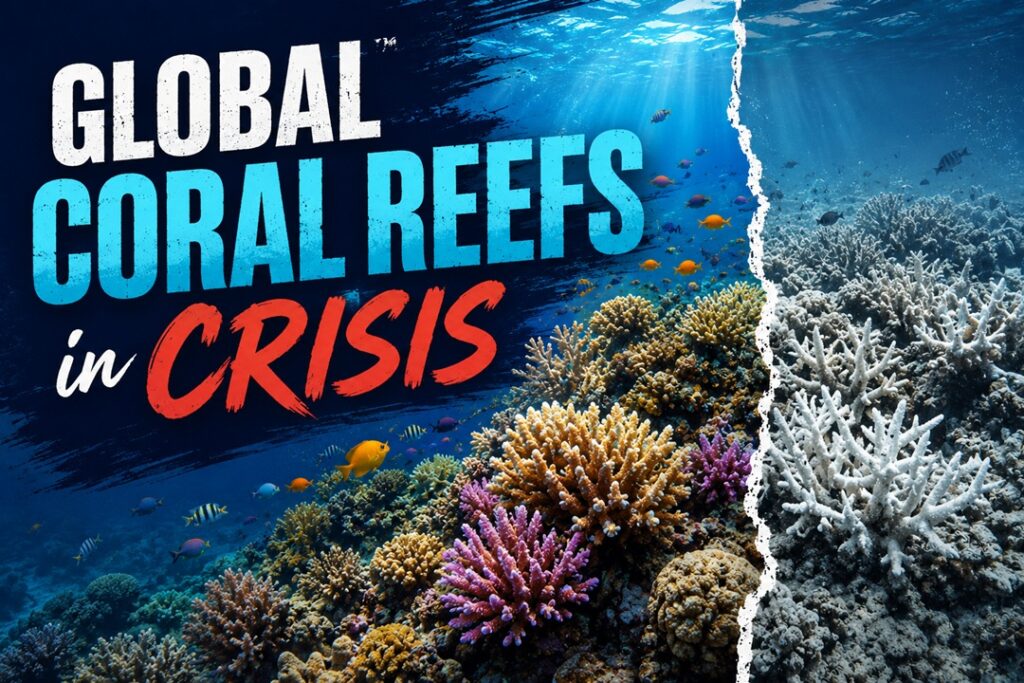
The 7th Status of Coral Reefs of the World report by the Global Coral Reef Monitoring Network (GCRMN) highlights a rapid deterioration in coral reef ecosystems. Global hard coral cover has fallen by about 9.5% compared with the 1980–2009 baseline, while increasingly frequent bleaching events are leaving reefs with insufficient time to recover.
Understanding Coral Bleaching
- Coral bleaching occurs when prolonged thermal or environmental stress causes coral polyps to expel their symbiotic photosynthetic algae, known as zooxanthellae.
- The loss of these algae deprives corals of an important source of energy and pigmentation, turning colonies white and increasing their vulnerability to starvation, disease and mortality.
- Although bleached corals can recover if stress conditions ease, repeated bleaching can cause irreversible ecosystem degradation.
Major Findings from the GCRMN Assessment
- Global hard coral cover has declined by around 9.5% on average, with regional losses ranging from 4% to 14.5% compared with the historical reference period.
- The steepest annual contraction occurred between 2023 and 2024, when hard coral cover fell by 8.9%.
- In 2024, around 87% of monitored reefs encountered unprecedented heat anomalies, while 42.6% experienced temperatures associated with severe coral mortality.
- Major disturbance events that once occurred roughly every decade are now returning within 4–6 years, reducing opportunities for natural regeneration.
- More than one-fourth of global reef areas experienced severe heat stress of over 4°C-weeks on at least four occasions during 2019–2025.
- Four major global bleaching phases have been recorded during 1998–99, 2010–11, 2016–17 and 2023–25, each producing substantial reductions in coral cover.
Regions Facing Acute Reef Degradation
- Caribbean reefs have suffered particularly severe losses, with average hard coral cover falling to nearly 1%.
- The Mesoamerican Barrier Reef has witnessed extensive mortality of reef-building Acropora corals, including over 90% mortality of wild and restored acroporids in Belize.
- The ROPME Sea Area, covering the Persian Gulf and Sea of Oman, lost approximately half of its hard coral cover between 2020 and 2024.
- Parts of the Indo-Pacific and the Great Barrier Reef have experienced repeated bleaching episodes, placing major biodiversity centres such as the Coral Triangle under growing pressure.
Forces Behind the Decline
- Sea surface temperatures across global reef provinces increased by approximately 0.81°C between 1985 and 2025, making marine heatwaves the dominant bleaching trigger.
- Coastal construction, dredging, destructive fishing practices and untreated wastewater add local pressures to already heat-stressed reefs.
- Ocean acidification reduces carbonate availability in seawater, making it harder for corals to build and maintain calcium carbonate skeletons.
- Coral mortality can trigger a shift towards macroalgae, which occupy reef surfaces and restrict the settlement and growth of new coral colonies.
- Fragmentation of coral populations can reduce genetic diversity and reproductive success, weakening the long-term resilience of reef ecosystems.
Conservation Priorities
- Strengthen international climate action to keep global temperature rise as close as possible to 1.5°C, since higher warming levels dramatically increase risks to warm-water coral reefs.
- Expand effectively managed Marine Protected Areas in line with the 30×30 biodiversity conservation target.
- Promote coral restoration through micro-fragmentation, larval propagation, assisted breeding and other approaches aimed at developing heat-tolerant coral populations.
- Reduce sediment, sewage and agricultural runoff entering coastal waters by improving wastewater management and restoring mangrove and seagrass buffers.
- Introduce dynamic ocean-management systems using satellite observations and real-time marine data to regulate fishing, shipping and tourism during extreme heat events.
Conclusion
The latest GCRMN assessment demonstrates that coral reefs are moving from episodic disturbance towards chronic ecological stress. Increasing ocean temperatures, repeated bleaching and shortened recovery intervals are undermining the natural resilience of reef ecosystems. Protecting these habitats will require a combination of ambitious climate mitigation, stronger coastal regulation, well-managed marine protected areas and science-based coral restoration.
Source : Down To Earth