
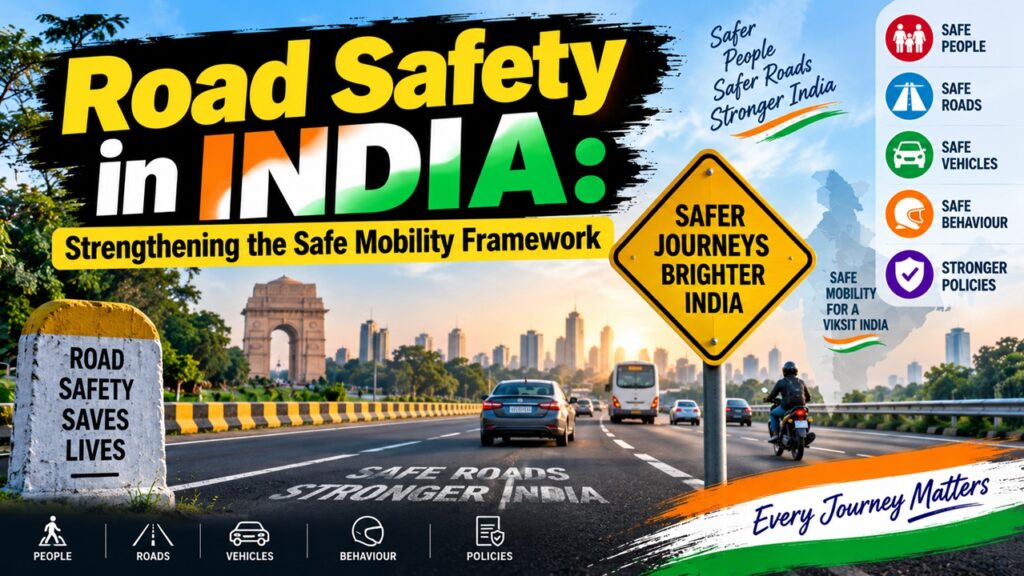
Road Safety in India: Strengthening the Safe Mobility Framework
Context
Seven years after the Motor Vehicles (Amendment) Act, 2019, India continues to face a serious road-safety challenge. With 1.77 lakh road fatalities recorded in 2024, the experience of implementation highlights the need to complement stricter laws with safer road design, stronger enforcement, emergency care and responsible road behaviour.
Motor Vehicles (Amendment) Act, 2019: A New Road-Safety Framework
What the Law Changed
- The Motor Vehicles (Amendment) Act, 2019 amended the Motor Vehicles Act, 1988 to strengthen road safety and improve regulatory enforcement.
- It introduced a broader Safe Systems approach, recognising that road safety depends not only on drivers but also on vehicles, infrastructure, enforcement and emergency medical services.
- Major provisions include higher penalties, electronic enforcement, Good Samaritan safeguards, cashless treatment during the Golden Hour, vehicle recalls and accountability for unsafe road construction.
Road Accident Scenario: Key Trends
- High Fatality Burden – India witnessed 4,87,707 road accidents and 1,77,175 deaths in 2024, translating into nearly 485 fatalities every day.
- Rising Crash Severity – Fatalities per 100 accidents increased from 21.6 in 2005 to 36.3 in 2024, showing that accidents are becoming increasingly lethal.
- National Highway Risk – National Highways constituted around 31% of accidents but accounted for 36.6% of total fatalities.
- Economic Cost – People aged 18–45 years represented 66.1% of road deaths, creating substantial economic and productivity losses.
- Vulnerable Users at Risk – Two-wheeler users accounted for 46.2% of fatalities, while pedestrians contributed another 20.6%.
- Safety Gear Gaps – Failure to wear helmets was associated with 54,122 deaths, while non-use of seatbelts accounted for 14,466 fatalities in 2024.
Major Provisions Under the 2019 Amendment
- Enhanced Penalties and Digital Surveillance – The legislation substantially increased fines for serious traffic violations and enabled electronic monitoring and enforcement under Section 136A.
- Safeguards for Good Samaritans – Section 134A protects individuals who voluntarily assist crash victims from unnecessary legal harassment and liability.
- Golden-Hour Medical Support – Section 162 provides for cashless emergency treatment during the crucial first hour following an accident and strengthens compensation provisions for hit-and-run victims.
- Responsibility for Unsafe Roads – Section 198A provides for penalties against contractors, consultants and concessionaires where defective road construction or maintenance compromises safety.
- Defective Vehicle Recall – Section 110A empowers the government to mandate recalls of vehicles that fail prescribed safety requirements.
Barriers Affecting Road-Safety Outcomes
- Variation Across States – Since transport administration largely involves state authorities, implementation of penalties and enforcement measures remains uneven.
- Weak Child Passenger Protection – Compliance with child helmets, rear-seat restraints and appropriate child restraint systems remains inadequate, particularly in school transportation.
- Unsafe Road Design – Delayed black-spot correction, inadequate pedestrian infrastructure and insufficient cycling facilities continue to expose vulnerable users.
- Limited Trauma-Care Reach – Advanced emergency medical facilities and rapid ambulance services remain disproportionately concentrated in major urban centres.
- Risky Road Behaviour – Overspeeding, distracted driving, improper helmet use and failure to wear rear-seat belts continue despite legal deterrence.
- Limited Crash Investigation – Scientific accident investigation and evidence-based identification of dangerous road locations need wider institutional adoption.
Strategic Priorities for Safer Roads
- Promote Forgiving Infrastructure – Design roads around the reality of human error through safer junctions, pedestrian facilities, median protection and scientifically engineered highways.
- Strengthen Technology-Based Enforcement – Expand automated speed monitoring, intelligent transport systems, cameras and AI-assisted traffic management linked with digital accident databases.
- Improve Child Road Safety – Establish stronger standards for child restraints, two-wheeler protection and school transportation vehicles.
- Build a Nationwide Trauma Network – Expand cashless Golden-Hour treatment facilities along highways and integrate ambulances with GPS-enabled emergency response systems.
- Enforce Engineering Accountability – Make road agencies, consultants and contractors answerable for unsafe designs, inadequate signage, defective construction and poorly managed diversions.
- Encourage Behavioural Change – Combine enforcement with sustained public-awareness campaigns targeting speeding, helmet use, seatbelts, distracted driving and responsible road sharing.
Conclusion
India’s road-safety challenge cannot be addressed through penalties alone. The next phase of implementation must combine safer infrastructure, technology-enabled enforcement, responsible road behaviour and accessible emergency healthcare. A coordinated Safe Systems approach can help reduce preventable fatalities while creating a safer and more efficient mobility ecosystem for India’s growing population.
Source : The Hindu