
BRICS New Delhi Declaration 2026: Advancing Multilateral Reform and Global South Cooperation
Context
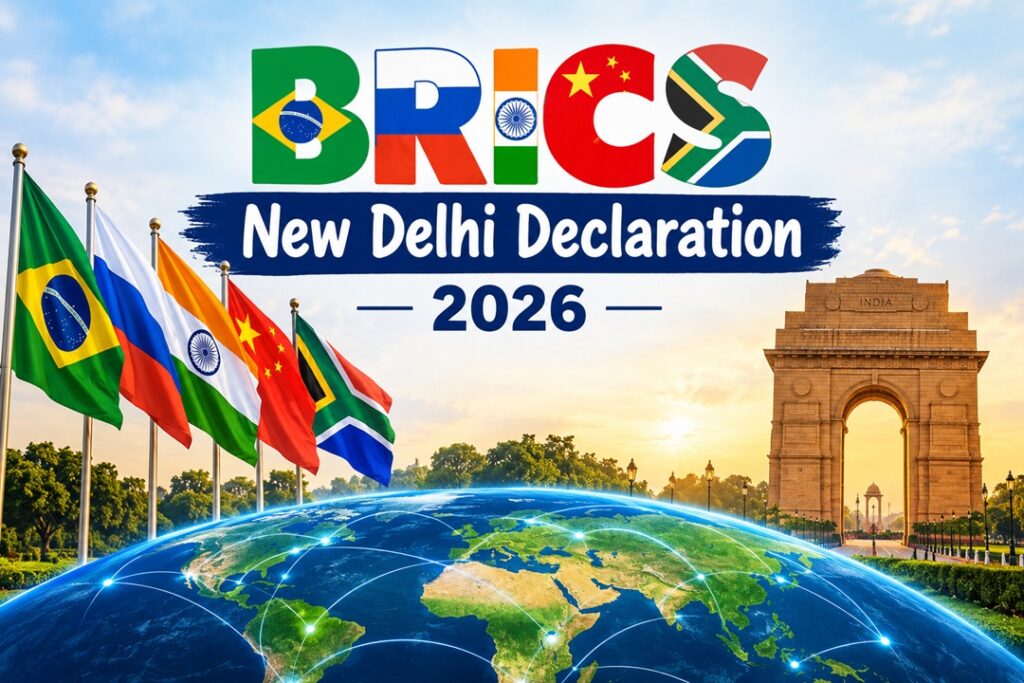
The 18th BRICS Summit, held in New Delhi under India’s chairship, culminated in the BRICS New Delhi Declaration, marking two decades of BRICS cooperation. The 140-point declaration seeks to deepen cooperation among the expanded 11-member grouping while giving greater institutional weight to the Global South.
The summit was organised around the theme “Building for Resilience, Innovation, Cooperation and Sustainability.”
Institutionalising an Expanded BRICS
The New Delhi Summit reflects the consolidation of the enlarged BRICS framework across three broad areas:
- Political and security cooperation
- Economic and financial cooperation
- Cultural and people-to-people exchanges
During India’s presidency, more than 400 ministerial, official and technical meetings were organised across 30 Indian cities, covering areas ranging from finance and technology to health, agriculture, energy and climate change.
Reforming Global Multilateral Institutions
A central theme of the declaration is the need to make international institutions more representative of present-day economic and geopolitical realities.
- BRICS reiterated its support for comprehensive reform of the United Nations, including greater representation of developing countries in the UN Security Council.
- It recognised the aspirations of African countries articulated through the Ezulwini Consensus and Sirte Declaration.
- China and Russia reiterated support for Brazil and India to assume greater roles in the UN system, including the Security Council.
- The declaration also highlighted the need for greater gender and geographical representation in senior positions within international organisations.
These positions reflect the broader BRICS objective of increasing the voice of emerging and developing economies in global decision-making.
Rebalancing Global Economic Governance
The declaration also addresses shortcomings in the existing international financial and trading architecture.
- BRICS called for faster progress on IMF quota reforms, including meaningful realignment under the 17th General Review of Quotas.
- It supported reforms that better reflect the economic weight of Emerging Markets and Developing Economies (EMDEs).
- The grouping called for restoration of a fully operational two-tier WTO dispute settlement mechanism.
- It criticised unilateral protectionist tariffs and non-tariff barriers.
- BRICS also expressed concerns that mechanisms such as the EU’s Carbon Border Adjustment Mechanism (CBAM) could impose disproportionate burdens on developing economies.
- The declaration supported the WTO accession bids of Ethiopia and Iran.
Counter-Terrorism and Regional Security
BRICS reiterated its opposition to terrorism in all forms and called for stronger multilateral cooperation.
The declaration:
- Condemned terrorism and rejected double standards in counter-terrorism efforts.
- Specifically condemned the April 22, 2025 terrorist attack in Jammu and Kashmir, in which 26 people were killed.
- Called for progress towards adopting the Comprehensive Convention on International Terrorism (CCIT).
- Supported coordinated action against UN-designated terrorist organisations.
- Welcomed the Guwahati Declaration on cooperation against narcotics trafficking.
The grouping also addressed several regional conflicts, including Gaza, Lebanon, Sudan and Syria, while emphasising sovereignty, humanitarian access and internationally recognised diplomatic frameworks.
West Asia and Other Regional Conflicts
On Palestine, BRICS reaffirmed support for a sovereign Palestinian state based on the 1967 borders, with East Jerusalem as its capital, within a two-state framework.
It also:
- Opposed forced displacement of Palestinians.
- Called for unhindered humanitarian assistance.
- Supported implementation of relevant ICJ provisional measures.
- Called for protection of humanitarian and UN personnel.
- Welcomed the Lebanon ceasefire and stressed compliance with UN Security Council Resolution 1701.
- Supported African-led efforts to address the conflict in Sudan.
- Called for the withdrawal of foreign forces from Syria.
- Reiterated opposition to the unilateral blockade against Cuba.
Financial and Trade Cooperation
BRICS is simultaneously attempting to build practical mechanisms that reduce transaction costs among its members.
Local-Currency Payments
Rather than pursuing a common BRICS currency, the declaration focuses on improving cross-border payment interoperability and encouraging trade and investment settlements in local currencies.
The BRICS Payment Task Force has been tasked with advancing faster, cheaper and more efficient payment arrangements.
Insurance and Risk Management
The grouping welcomed discussions on a BRICS Insurance Resilience Centre, aimed at strengthening collective reinsurance capacity.
India’s proposal for a BRICS Risk Lab at GIFT City IFSC, Gujarat, also received member support.
MSME Finance
The Jaipur Consensus was endorsed to develop an invoice-discounting mechanism for BRICS countries. Such an arrangement could help export-oriented MSMEs obtain working capital against outstanding invoices.
Agriculture and Food Security
Food and agricultural cooperation received greater institutional attention.
- BRICS endorsed discussions on operationalising a BRICS Grain Exchange and potentially extending it to other agricultural commodities.
- BRICS AGRIN was established as a farmer-oriented platform dealing with agro-inputs, genetic resources and information.
- The grouping also launched the Global Forum on Farmers’ Rights in Seed Systems.
These initiatives seek to connect agricultural productivity with food security, seed sovereignty and farmer-oriented cooperation.
Energy, Critical Minerals and Green Transition
The declaration adopts a relatively broad approach towards energy transitions.
- It reaffirmed Common But Differentiated Responsibilities and Respective Capabilities (CBDR-RC).
- It recognised that developing countries may continue to require fossil fuels alongside renewable energy during their transition.
- A BRICS Digital Centre of Excellence for Smart Grids and Energy Storage was initiated.
- BRICS called for resilient and diversified critical-mineral supply chains, while emphasising the sovereign rights of resource-rich countries over their domestic resources.
This approach links energy security with technological cooperation and the strategic importance of critical minerals.
Digital Public Infrastructure and Artificial Intelligence
Technology emerged as an important area of cooperation.
BRICS supported the creation of a Digital Public Infrastructure Repository to facilitate the sharing and scaling of open-source digital public goods among member countries.
The declaration also:
- Recognised outcomes of India’s AI Impact Summit and the World AI Conference in Shanghai.
- Committed members to implementing the BRICS Leaders’ Statement on Global Governance of Artificial Intelligence.
- Promoted greater cooperation in emerging technologies and digital systems.
For India, this creates an avenue to internationalise its experience with Digital Public Infrastructure (DPI) while contributing to discussions on responsible AI governance.
Space Cooperation
BRICS also expanded its technological cooperation into outer space.
- Amendments were finalised to accommodate additional member space agencies in the BRICS Remote Sensing Satellite Constellation.
- Terms of Reference were drafted for a BRICS Space Council.
- The grouping commemorated the 65th anniversary of Yuri Gagarin’s first human spaceflight.
Remote sensing cooperation could support applications in agriculture, disaster management, climate monitoring and environmental protection.
Health, Labour and Social Protection
The declaration extends BRICS cooperation beyond conventional economic and diplomatic issues.
Health
- The BRICS Mission for Healthy Lifestyle 2026–2029 was endorsed.
- A network of Centres of Excellence on mental well-being was established.
- NIMHANS, Bengaluru, was designated as the coordinating nodal centre.
- Members proposed an expert working group on Traditional, Complementary and Integrative Medicine.
- A sub-working group was created to operationalise an Integrated Early Warning System for Mass Infectious Diseases.
Workers and Emerging Employment
The declaration adopted BRICS CONNECT, focusing on employability, capacity building and emerging skills.
It aims to:
- Anticipate labour-market changes caused by green and digital transitions.
- Address new skill requirements.
- Develop mechanisms for social-security portability for cross-border and platform/gig workers.
Climate and Environmental Cooperation
BRICS reaffirmed its commitment to the Paris Agreement and stressed the responsibility of developed countries to provide climate finance and technology for adaptation.
Other initiatives include:
- Welcoming the Tropical Forest Forever Facility (TFFF) for long-term, results-based tropical forest financing.
- Supporting India-led cooperation through the International Big Cats Alliance (IBCA).
- Endorsing BRICS Principles for Integrated Landscape-Based Greening and Land Restoration.
- Promoting integrated protection of forests, wetlands, mangroves, peatlands, grasslands and arid landscapes.
This broadens BRICS environmental cooperation from climate negotiations to practical landscape restoration and biodiversity protection.
Way Forward
For BRICS to translate the declaration into measurable outcomes, emphasis would need to be placed on implementation rather than only institutional expansion. Practical progress in local-currency payments, DPI interoperability, critical-mineral supply chains, health preparedness, agricultural cooperation and climate finance can strengthen the grouping’s relevance.
At the same time, maintaining consensus among an enlarged membership will require balancing diverse national interests while keeping cooperation focused on areas of shared developmental interest.
Conclusion
The BRICS New Delhi Declaration combines demands for greater representation in global institutions with practical cooperation in finance, technology, health, agriculture, energy and climate action. Its long-term significance will depend on how effectively the expanded grouping converts these commitments into functioning institutions, common platforms and tangible benefits for developing economies.
Source : PIB