
India’s Space Sector Reforms: Balancing ISRO and Private Participation
Context
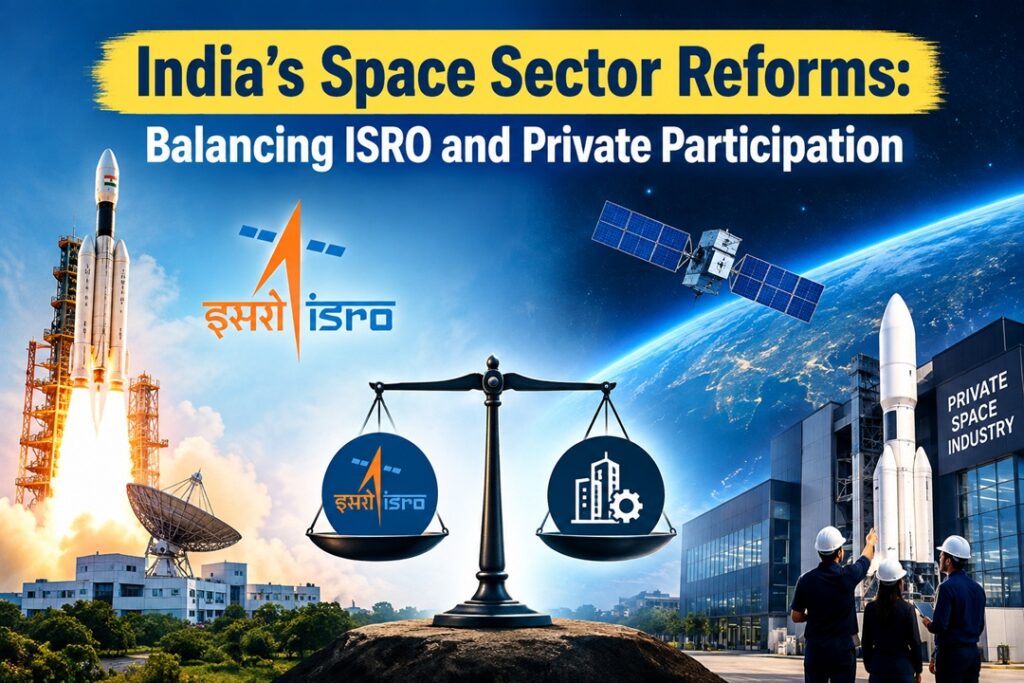
Recent concerns over transferring launch-vehicle manufacturing and spaceport operations to private entities have raised questions about preserving ISRO’s expertise while expanding India’s private space ecosystem. The Indian Space Policy, 2023 seeks to achieve this balance by allowing industry to commercialise mature technologies while ISRO focuses on advanced research and strategic missions.
The policy marks a shift from an ISRO-centric model to an ecosystem-based approach, involving ISRO, IN-SPACe, NSIL, private companies, startups and academia.
Changing Role of ISRO
Under the Indian Space Policy, 2023, ISRO is expected to increasingly concentrate on:
- Advanced research and development in space technologies.
- Development of new applications and systems.
- Scientific and exploratory missions.
- Demonstration of emerging capabilities.
- Human-spaceflight programmes.
- Transfer of mature technologies to industry.
This means ISRO is not being made redundant. Instead, it is expected to move away from routine production of established systems and focus more on next-generation technologies and strategic capabilities.
Role of Key Institutions
IN-SPACe serves as the independent nodal institution for promoting and authorising private space activities. It facilitates access to government infrastructure, supports technology transfer and industry-academia collaboration, and ensures that private activities comply with security and international obligations.
NewSpace India Limited (NSIL) is the commercial arm under the Department of Space. It focuses on commercialising publicly developed space technologies and providing space-based services to domestic and international markets.
Private entities can undertake a wide range of activities, including satellite development, launch services, ground infrastructure, communication, remote sensing and navigation services.
Thus, the emerging model divides responsibilities between public technological leadership and private-sector scale and commercialisation.
Major Technologies and Facilities Under Commercialisation
Small Satellite Launch Vehicle (SSLV)
The SSLV was designed for relatively low-cost and rapid satellite launches and is well suited for industrial production.
Following its operationalisation, Hindustan Aeronautics Limited (HAL) secured the opportunity for technology transfer and production. During the transition, ISRO will provide technical assistance before greater autonomy is transferred to industry.
This reflects the emerging model:
ISRO develops and demonstrates technology → Industry manufactures and commercialises it.
Polar Satellite Launch Vehicle (PSLV)
The PSLV, one of India’s established launch systems, is also moving towards industrial production.
A consortium of HAL and Larsen & Toubro has been awarded a contract for PSLV manufacturing. The objective is to enable large-scale industrial production while allowing ISRO to focus on more advanced launch technologies and missions.
Launch Vehicle Mark-3 (LVM3)
India’s heavy-lift LVM3 is also being prepared for greater private-sector participation. A fresh expression of interest was issued after an earlier commercialisation attempt did not lead to an awarded bid.
Greater industrial involvement could increase India’s launch capacity and strengthen its position in the global commercial launch market.
Kulasekarapattinam Spaceport
Commercialisation is also extending to space infrastructure. The proposed transfer of operational management of the Small Satellite Launch Complex at Kulasekarapattinam in Tamil Nadu to a private entity represents a broader shift towards private participation in launch services and infrastructure.
ISRO would continue to provide technical guidance, operational support and training during the transition.
Why Is India Promoting Private Participation?
India possesses significant technological capabilities but has historically captured only a limited share of the global space economy. ISRO’s traditional focus was primarily on national development, scientific exploration and strategic requirements rather than large-scale commercial operations.
Greater private participation can help India achieve:
- Higher levels of private investment.
- Faster manufacturing and greater launch frequency.
- Economies of scale.
- Specialised industrial expertise.
- Greater competition and innovation.
- Development of new space technologies and applications.
- Improved access to international markets.
The growth of Indian space startups in areas such as launch vehicles, satellites, propulsion and Earth observation shows that private companies can complement ISRO rather than simply replace it.
Why Are ISRO Employees Concerned?
1. Possible Loss of Institutional Expertise
Manufacturing is not merely a production activity. Continuous involvement in manufacturing gives engineers practical experience in design, testing, integration and troubleshooting.
If ISRO withdraws completely from production, its hands-on engineering knowledge could gradually decline.
2. Concerns Over Strategic Autonomy
Space infrastructure supports communication, navigation, weather forecasting, disaster management, intelligence and defence.
Therefore, India cannot afford excessive dependence on private entities for capabilities that may become strategically critical during emergencies or geopolitical disruptions.
3. Private Sector Is Still Developing
India’s private space industry has expanded rapidly, but it is still at an evolving stage.
Private companies may require time to develop the financial strength, technical workforce, infrastructure and operational experience needed to independently manage all critical space requirements.
4. Future Scientific and Strategic Missions
ISRO’s role extends far beyond commercial launch services. Major programmes such as Gaganyaan, the proposed Bharatiya Antariksh Station, Chandrayaan-4 and Chandrayaan-5, and future Mars and Venus missions require advanced research, complex systems integration and strong institutional capabilities.
Such missions may not always offer immediate commercial returns but are important for India’s long-term scientific and strategic ambitions.
Commercialisation vs Privatisation
The current debate becomes clearer when commercialisation and privatisation are distinguished.
Privatisation would imply transferring ownership and core responsibilities from the public institution to private entities.
Commercialisation, on the other hand, involves allowing private companies to manufacture mature technologies and undertake routine operational activities while the state continues to retain strategic, scientific and advanced technological responsibilities.
The Indian Space Policy, 2023 primarily seeks the latter.
Therefore, transferring the production of an established launch vehicle does not necessarily weaken India’s space capability, provided ISRO retains sufficient expertise and capacity to develop, test and operate advanced systems.
Way Forward
India should follow a calibrated public-private partnership model:
- Retain strategic capabilities within ISRO: Critical technologies and expertise should remain available in-house.
- Transfer mature technologies progressively: Commercialisation should follow demonstrated private-sector capacity.
- Preserve institutional knowledge: ISRO should retain adequate manufacturing, testing and systems-integration expertise.
- Strengthen IN-SPACe: It should ensure transparent authorisation, safety regulation and fair competition.
- Avoid excessive concentration: The sector should encourage multiple capable private players.
- Reskill existing personnel: Technical manpower should be redeployed towards advanced technologies and emerging missions.
- Ensure strategic oversight: Sensitive technologies and national-security-related activities should remain subject to appropriate government supervision.
- Promote global competitiveness: Indian firms should be supported in becoming competitive providers of space products and services internationally.
Conclusion
India’s space reforms should not be viewed as a choice between ISRO and private industry. ISRO should remain the technological and strategic anchor, while private companies provide scale, investment, innovation and commercial reach.
A public leadership–private participation model can expand India’s space economy while safeguarding technological self-reliance and strategic autonomy.
Source : The Indian Express