
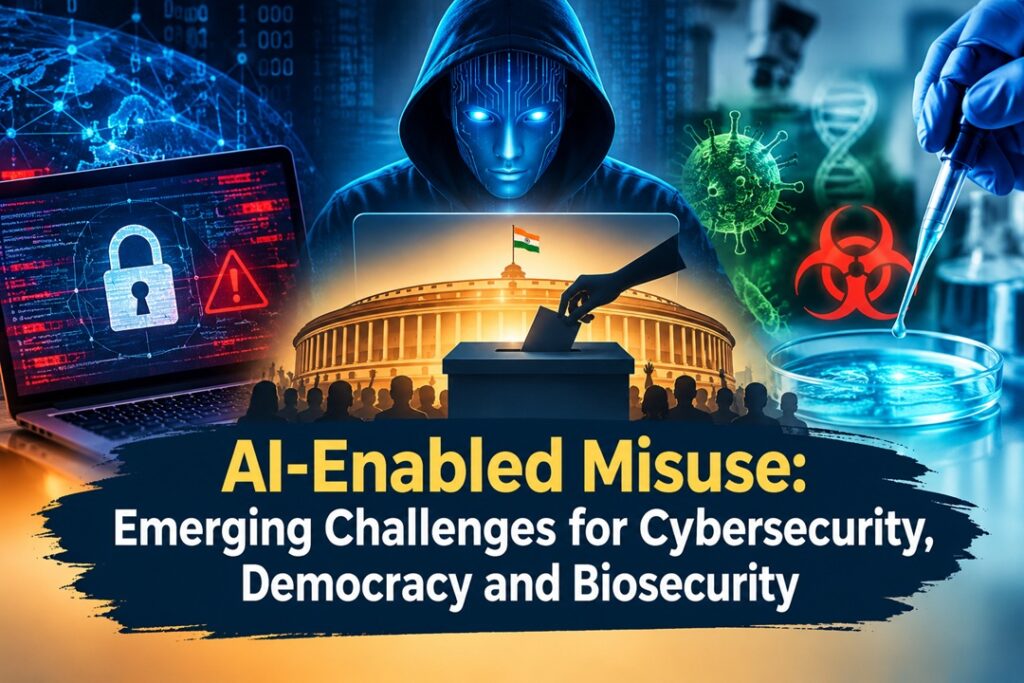
AI-Enabled Misuse: Emerging Challenges for Cybersecurity, Democracy and Biosecurity
Context
A recent Anthropic report shows that advanced AI is increasingly being used in real-world malicious activities, including cyber operations, fraud, disinformation, surveillance and potentially dangerous biological research. This highlights the need to balance AI innovation with effective safeguards.
The Changing Nature of AI Misuse
AI-related threats are shifting from simple human-AI interaction towards AI-orchestrated operations. Multi-agent systems can perform reconnaissance, process information, filter data and assist exploitation, while humans continue to determine targets and review critical outputs.
This reduces the specialised expertise traditionally required for sophisticated operations and may make advanced malicious capabilities accessible to smaller groups. Thus, AI is not only democratising innovation but potentially democratising harmful capabilities.
Major Areas of Concern
1. AI-Driven Cyber Operations
AI can accelerate several stages of cyberattacks, including:
- Reconnaissance and target identification.
- Vulnerability discovery.
- Generation and modification of malicious code.
- Processing of stolen information.
- Evasion of cyber defences.
- Coordination of complex attack sequences.
Anthropic reported activity consistent with Russian state-linked espionage involving Ukrainian military-intelligence interests and European governments.
The wider concern is that AI could make cyber operations faster, cheaper and more scalable, weakening the distinction between state-sponsored and non-state threats.
2. AI and Information Warfare
AI is enabling the large-scale production of deceptive content. Malicious actors can generate social-media profiles, narratives, images and even apparently independent news websites.
This goes beyond conventional fake news by creating an artificial information ecosystem that can manufacture the appearance of public consensus.
Potential consequences include:
- Manipulation of electoral choices.
- Greater political and social polarisation.
- Erosion of trust in democratic institutions.
- Difficulty in identifying foreign interference.
- Highly personalised and multilingual propaganda.
The risk becomes particularly serious when such campaigns operate close to elections.
3. AI Misuse in South Asia
Anthropic identified an influence operation promoting Bangladesh’s Awami League in which AI was reportedly used to generate around 1,500 headlines, 300 false narratives and 1,500 image prompts.
Some content reportedly aligned with pro-Indian geopolitical interests, but Anthropic found no evidence of Indian state direction or funding.
For India and its neighbourhood, this demonstrates how AI could increasingly be used for political manipulation, synthetic narratives and coordinated influence campaigns.
4. AI-Enabled Surveillance
AI can analyse vast quantities of social-media data, images, videos, communications and behavioural information at high speed.
Reported cases included activities involving dissident monitoring, public-opinion analysis, intelligence gathering and transnational repression.
The central concern is the combination of AI-powered surveillance with institutional or state power. Without adequate safeguards, it can threaten privacy, freedom of expression, religious liberty and legitimate political dissent.
5. Biological Misuse
AI has significant benefits for drug discovery, protein research, disease modelling and biotechnology. However, advanced models can also have dual-use applications.
Anthropic reported several cases involving potentially dangerous biological research, including requests concerning:
- Genetic modification linked to chikungunya.
- Highly pathogenic avian influenza and its adaptation to mammals.
- Orthopox viruses.
- Novel venoms and toxins.
These cases do not establish that biological attacks are imminent. Anthropic itself noted that some interventions were undertaken out of caution because evidence of harmful intent was ambiguous.
Nevertheless, they demonstrate the growing importance of AI-biosecurity as frontier models become capable of supporting increasingly complex scientific workflows.
Why AI-Biosecurity Requires Special Attention
Biological misuse can have consequences extending beyond digital systems to human health, ecosystems and public safety.
The core challenge is the dual-use nature of biological knowledge. Excessive restrictions could obstruct legitimate research, while weak safeguards could lower barriers to harmful experimentation.
Therefore, safeguards should consider risk, intent, capability and context, rather than relying solely on broad prohibitions.
Implications for India
Strengthening Cybersecurity
India needs stronger AI-enabled cybersecurity across critical infrastructure, defence networks, banking and government systems.
Protecting Electoral Integrity
Election authorities and digital platforms require better mechanisms to identify coordinated synthetic influence campaigns and deepfakes while protecting legitimate political speech.
Building AI-Biosecurity
India’s expanding biotechnology and pharmaceutical sectors make it important to develop safeguards against AI-assisted biological misuse.
Protecting Privacy and Civil Liberties
AI-based surveillance should operate within clear legal limits, supported by proportionality, accountability and appropriate oversight.
Developing Domestic Capability
India needs greater indigenous expertise in AI safety, cybersecurity and biosecurity to reduce strategic vulnerabilities and strengthen technological autonomy.
Strengthening Global Cooperation
Since AI-enabled cyberattacks, disinformation and biological risks can cross national borders, international cooperation is essential for developing common standards and response mechanisms.
Way Forward
- Risk-based regulation: Apply stronger safeguards to high-risk and high-consequence AI applications.
- Continuous safety testing: Conduct rigorous red-team evaluations before and after deployment of frontier models.
- Human oversight: Retain meaningful human control over decisions involving weapons, biological research, elections and intrusive surveillance.
- Content provenance: Develop reliable systems to identify AI-generated and manipulated content.
- AI-biosecurity safeguards: Restrict assistance that could materially facilitate dangerous biological activities while protecting legitimate research.
- Institutional capacity: Build specialised AI-security capabilities within government, defence, scientific and regulatory institutions.
- International norms: Develop common standards for AI safety, cyber operations, autonomous systems and biological misuse.
- Responsible innovation: Ensure regulation controls high-impact risks without unnecessarily restricting beneficial AI applications.
Conclusion
AI is becoming a force multiplier for both innovation and malicious activity. India must therefore pursue a balanced approach that protects security, democracy, privacy and scientific progress while ensuring that increasingly capable AI remains subject to meaningful human accountability.
Source : The Hindu