
Merchant Discount Rate on UPI: Balancing Sustainability with Digital Inclusion
Context
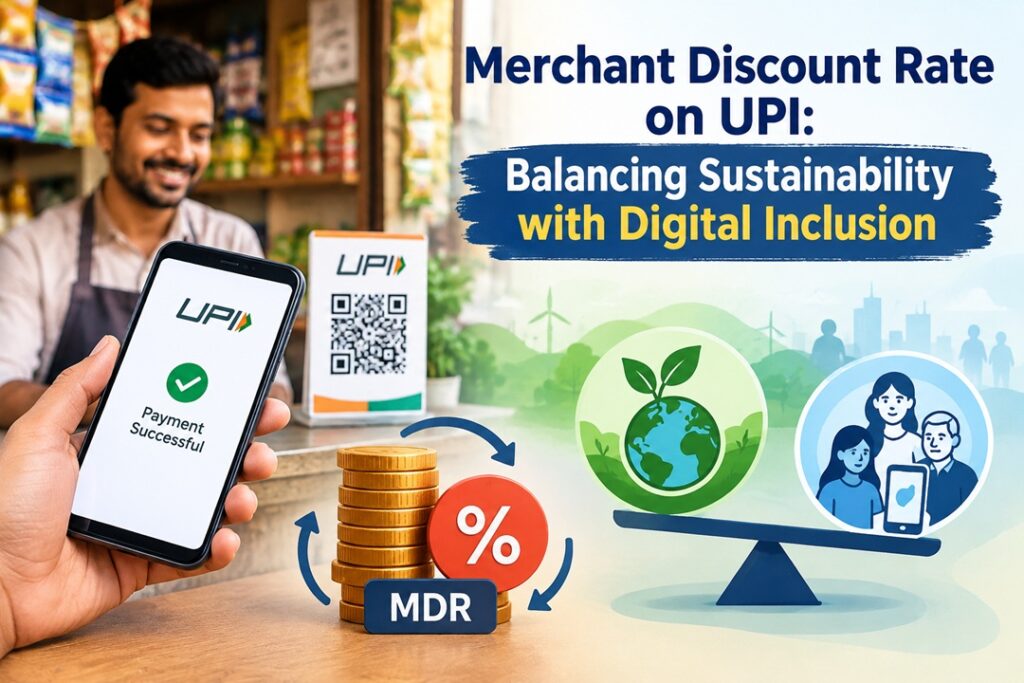
The reintroduction of a structured Merchant Discount Rate (MDR) on selected UPI transactions seeks to make India’s digital payment ecosystem financially sustainable while protecting small merchants and everyday users.
MDR is the fee paid by merchants to banks, fintech intermediaries and payment gateways for processing digital payments and supporting infrastructure such as servers, cybersecurity and fraud detection.
Key Features of the Proposed MDR Framework
The framework adopts a tiered approach rather than imposing a uniform charge:
- P2P transactions: Transfers between individuals remain free, regardless of transaction value.
- Small P2M transactions: Merchant payments up to ₹2,000 remain exempt from MDR.
- Standard P2M transactions: Payments above ₹2,000 attract a baseline MDR of 0.4%, with the fee capped at ₹300 for transactions above ₹75,000.
- Essential and recurring payments: Utilities, fuel, education, telecom and agriculture-related transactions carry a flat ₹5 charge, while AutoPay and UPI mandates remain exempt.
- Financial-market transactions: Mutual fund and securities payments attract an MDR of 0.02%, subject to a ₹300 cap.
Safeguards for Small Merchants and Consumers
A separate Person-to-Person Merchant (P2PM) category seeks to shield micro-vendors. Small shopkeepers and street vendors receiving up to ₹1 lakh per month through QR-based payments into personal accounts remain outside the MDR framework.
They are shifted to the commercial P2M category only when their monthly inward credits exceed ₹1 lakh for three consecutive months.
The framework also seeks to prevent merchants from transferring MDR to consumers. Banks are expected to monitor such practices, while payment platforms are barred from imposing hidden or additional platform charges.
Even after the proposed charge, UPI remains comparatively inexpensive for merchants when compared with card-based payments, where debit-card charges can reach around 0.9% and credit-card charges may range between 1.5% and 2.5%.
Why MDR is Being Considered
UPI has developed into a large-scale digital public infrastructure, but maintaining such an ecosystem involves substantial recurring expenditure. Cloud infrastructure, server capacity, cybersecurity, fraud prevention and customer support impose significant costs on banks and fintech firms.
Under a completely zero-MDR system, payment companies have had to depend heavily on government incentives or alternative revenue streams such as lending, insurance and advertising.
A calibrated MDR could therefore provide a more predictable commercial revenue stream, potentially encouraging private investment in payment technology, security and service quality.
The proposed structure also concentrates charges on relatively higher-value transactions. Although payments above ₹2,000 constitute only around 4% of P2M transaction volume, they account for roughly two-thirds of P2M transaction value. This allows revenue generation to focus more on commercial transactions rather than routine low-value purchases.
Concerns and Potential Behavioural Effects
The policy could nevertheless create friction among small and informal businesses. Merchants facing an additional cost on larger transactions may attempt to recover it through informal surcharges or prefer cash payments.
Such behaviour could undermine some of the gains achieved through India’s transition from cash to digital payments.
Another concern relates to the nature of UPI as Digital Public Infrastructure (DPI). Supporters of continued zero MDR argue that payment infrastructure with broad developmental benefits should remain substantially state-supported, particularly because affordable digital payments facilitate financial inclusion and formalisation.
There is also an administrative challenge in monitoring the ₹1 lakh monthly threshold. Acquiring banks would need reliable systems to track transaction patterns and determine when a micro-merchant should move into the commercial category.
Global Perspective
Internationally, major private payment networks such as Visa and Mastercard operate through fee-based models. India’s approach attempts to combine the accessibility of public digital infrastructure with regulated and capped commercial pricing.
This creates a hybrid framework in which the state continues to exercise substantial oversight while allowing selected parts of the payment ecosystem to generate revenue.
Way Forward
- Prevent consumer surcharges: Strengthen grievance-redressal mechanisms and monitoring so merchants cannot transfer MDR costs to customers.
- Review thresholds periodically: Reassess the ₹2,000 transaction threshold and ₹1 lakh monthly P2PM limit in light of inflation, merchant incomes and the pace of formalisation.
- Link MDR revenues to ecosystem development: A defined portion of MDR collections could support cybersecurity, fraud prevention and digital-literacy programmes, particularly for smaller banks and rural users.
- Maintain proportionality: MDR should remain low enough to preserve UPI’s affordability and should primarily target transactions with greater commercial capacity to absorb processing costs.
- Improve monitoring technology: Automated transaction analytics can reduce compliance burdens while identifying misuse of the micro-merchant exemption.
Conclusion
A structured MDR regime represents an attempt to reconcile UPI’s public-good role with the financial sustainability of its underlying payment ecosystem. Its effectiveness will depend on keeping small-value transactions protected, preventing consumer surcharges and ensuring that revenues are reinvested in the security, resilience and accessibility of India’s digital payment infrastructure.
Source : The Indian Express