
E20 Ethanol Blending in India: Balancing Energy Security, Consumer Costs and Environmental Gains
Context
India’s E20 programme was designed to reduce crude-oil dependence, conserve foreign exchange and lower transport-sector emissions. However, evidence of a 2–6% mileage reduction and an estimated ₹88,234 crore additional consumer expenditure over three years has raised questions about whether the economic and environmental benefits are being fully realised.
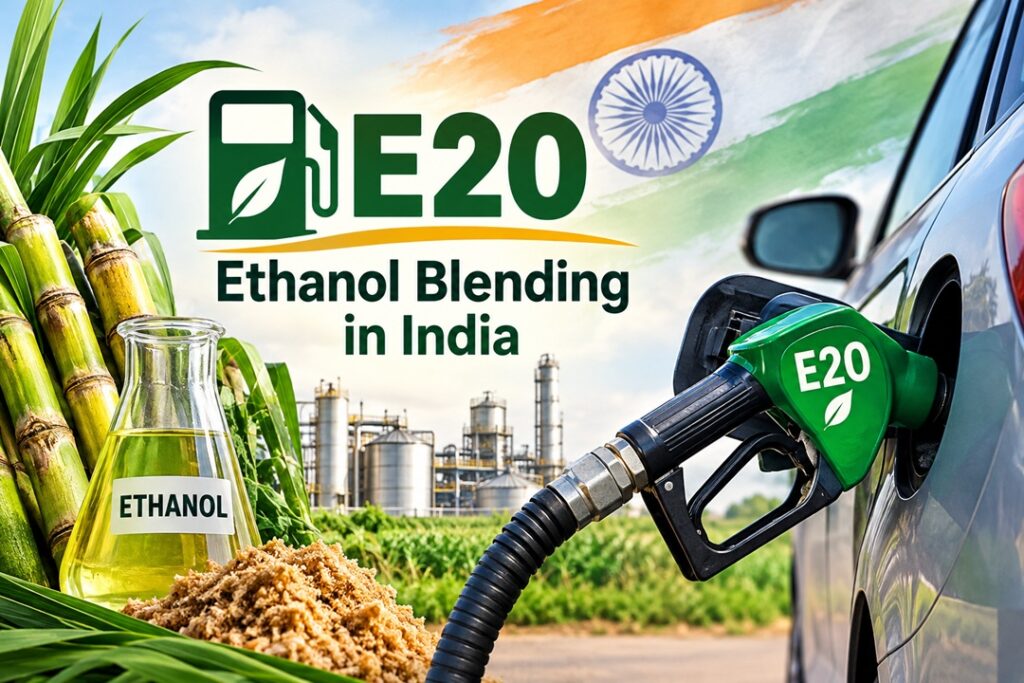
India’s E20 Ethanol Blending
E20 petrol contains 80% petrol and 20% anhydrous ethanol. Commercial rollout began in 2023 and was subsequently expanded under the Ethanol Blended Petrol (EBP) Programme.
The policy has primarily pursued three objectives:
- reducing dependence on imported crude oil;
- limiting exposure to international oil-price fluctuations; and
- lowering greenhouse-gas emissions from road transport.
The Mileage and Consumer-Cost Problem
Testing by ARAI, SIAM and IOCL indicates that E20 can reduce fuel economy by around 2–6%, depending on the vehicle. Since ethanol has lower energy content per unit volume than petrol, vehicles need to consume a greater volume of fuel to cover the same distance.
For instance, a motorcycle delivering 50 km/l on conventional petrol could deliver only about 47–48 km/l with E20.
This creates a distinction between the price paid per litre and the cost of travelling a kilometre. Even when blended fuel is cheaper to produce than imported petrol, unchanged retail prices can mean that motorists effectively bear the cost of the additional fuel required.
The estimated ₹88,234 crore additional expenditure therefore raises an important policy question: whether the gains from import substitution are being adequately shared with consumers.
Environmental Benefits Depend on Vehicle Efficiency
Ethanol has a lower carbon intensity than conventional petrol, but the environmental advantage cannot be assessed solely by comparing emissions per litre.
If the reduction in fuel economy is relatively small, the lower carbon content of ethanol can still produce an overall emissions benefit. However, when mileage deterioration approaches 4–6% or more, the additional fuel consumption can substantially reduce or potentially reverse the expected emissions advantage.
The impact is particularly relevant for older vehicles that were engineered for lower ethanol blends. Some pre-2023 vehicles may face greater mileage losses and problems associated with prolonged exposure to ethanol, including degradation of certain fuel-system components.
Thus, the environmental outcome depends not only on the blending percentage but also on vehicle technology, fleet composition and actual fuel consumption.
Foreign-Exchange Savings and Agricultural Trade-offs
E20 seeks to substitute domestically produced ethanol for a portion of imported petroleum. Yet the broader foreign-exchange impact also depends on what happens to agricultural production and trade.
- Greater diversion of sugarcane towards ethanol can affect the availability of sugar for export.
- Increased use of maize for ethanol can compete with food and animal-feed requirements.
- Higher domestic demand for maize can reduce exportable surpluses and, under certain circumstances, increase import dependence.
Consequently, the foreign-exchange benefit from reduced crude imports needs to be assessed against changes in agricultural exports, feed costs and possible food-related imports rather than considering crude substitution alone.
Food, Fuel and Water Security
The expansion of first-generation biofuels creates a potential competition between energy requirements and agricultural priorities.
Large-scale diversion of maize towards ethanol can increase input costs for poultry and dairy producers, with possible effects on food prices. Similarly, sugarcane cultivation is water-intensive, making extensive dependence on it for ethanol particularly significant in water-stressed regions.
This creates a broader policy challenge: an energy-transition strategy should not unintentionally intensify food inflation, groundwater stress or regional agricultural vulnerability.
Consumer Choice and Legacy Vehicles
A major concern is the limited availability of alternative fuel options for owners of older vehicles. Where E20 becomes the default fuel at retail outlets, consumers whose vehicles were designed around E10 or lower blends may have little practical choice.
Providing E10 and E20 dispensing options would allow consumers to select fuel compatible with their vehicle technology while the transition towards higher ethanol blending continues.
Way Forward
1. Preserve Consumer Choice
Dedicated E10 dispensing facilities can protect owners of older vehicles during the transition and prevent a uniform blending mandate from imposing identical costs on technologically different vehicle fleets.
2. Link Fuel Prices to Energy Content
Fuel pricing could better reflect the lower energy density of ethanol blends. A mechanism that accounts for mileage differences would make the economic burden of E20 more transparent to consumers.
3. Accelerate 2G Biofuels
Greater emphasis should be placed on second-generation biofuels derived from agricultural residues such as paddy straw. This can reduce competition with food crops while also creating productive uses for crop waste.
4. Strengthen Vehicle-Fuel Compatibility
Automakers, fuel suppliers and regulators should coordinate standards for fuel-system materials, engine calibration, warranties and emissions performance as higher ethanol blends become widespread.
5. Account for the Full Environmental Footprint
Policy evaluation should consider the complete lifecycle—from feedstock cultivation and water use to processing, transportation and vehicle combustion—rather than measuring benefits only through the quantity of crude oil displaced.
6. Diversify the Transport Transition
Ethanol blending should form only one component of India’s decarbonisation strategy. Greater investment in public transport, electrification, fuel efficiency and cleaner mobility systems can reduce petroleum dependence without placing the entire burden on fuel blending.
Conclusion
E20 can contribute to India’s energy-security objectives, but its success depends on how its consumer, agricultural and environmental costs are managed. A sustainable transition requires compatibility with the existing vehicle fleet, informed consumer choice, greater reliance on non-food feedstocks and transparent assessment of lifecycle emissions. The objective should therefore be not merely higher ethanol blending, but an energy transition that delivers lower import dependence without disproportionate costs for consumers, food security or water resources.
Source : The Hindu