
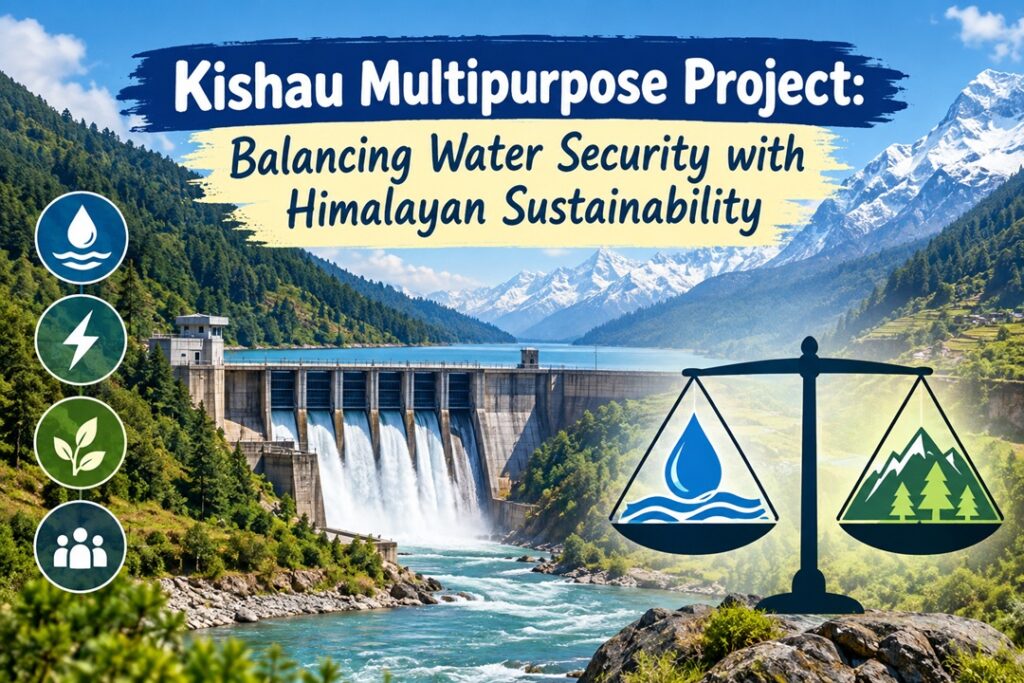
Kishau Multipurpose Project: Balancing Water Security with Himalayan Sustainability
Context
The signing of an agreement by six Yamuna-basin states has renewed attention on the Kishau Multipurpose Project, a major dam planned on the Tons River. While it reflects cooperative inter-state water management, its ecological, seismic and rehabilitation implications require careful assessment.
The Kishau Multipurpose Project is a proposed 232.6-metre-high concrete gravity dam on the Tons River, the largest tributary of the Yamuna by volume. The project lies along the Himachal Pradesh–Uttarakhand border, between Sirmaur and Dehradun districts, and is being implemented by Kishau Corporation Limited, a 50:50 joint venture of the two states. The reservoir is expected to have a storage capacity of around 1,562 million cubic metres.
Importance for Inter-State Water Governance
The agreement involving Uttar Pradesh, Uttarakhand, Himachal Pradesh, Rajasthan, Delhi and Haryana represents an attempt to build consensus over sharing the Yamuna’s waters.
- The project follows a 90:10 funding arrangement between the Centre and participating states, reducing the financial burden on state governments.
- A distinctive water-for-power cost-sharing mechanism allows Himachal Pradesh to transfer part of its water allocation to Delhi and Rajasthan, while these states bear its corresponding share of the project’s power-related capital cost.
- Delhi is expected to receive substantial benefits for municipal water requirements.
- Around 25% of the Yamuna’s water is envisaged as environmental flow, intended to support downstream river health and ecological requirements.
Thus, the project demonstrates how financial arrangements and negotiated resource-sharing can facilitate cooperation within a river basin.
Major Ecological and Seismic Concerns
The project’s location in the Himalayas creates significant environmental and geological considerations.
Seismic vulnerability:
A large dam in a seismically active Himalayan region raises concerns regarding earthquake resilience and reservoir-induced seismicity. The consequences of structural failure would potentially extend far beyond the immediate project area.
Forest and biodiversity loss:
The proposed reservoir would submerge approximately 2,950 hectares of land, including about 2,438 hectares of forest, potentially fragmenting habitats and affecting Himalayan biodiversity.
Question over river rejuvenation:
Using additional upstream water to improve downstream river conditions cannot substitute for controlling pollution at its source. In heavily polluted stretches, particularly around urban centres, sewage treatment and industrial-effluent management remain essential.
Socio-Economic and Rehabilitation Concerns
The project could have substantial consequences for communities located in the submergence zone.
- Estimates indicate that more than 5,498 people belonging to around 701 families could face direct displacement.
- Approximately 512 hectares of agricultural land may be submerged.
- Loss of farmland could affect livelihoods based on crops such as tomato and ginger, alongside animal husbandry and fisheries.
- Concerns have also been raised about the age of socio-economic surveys used for estimating displacement and rehabilitation requirements.
Outdated baseline information can create a mismatch between officially recorded impacts and the actual conditions faced by affected households. This could undermine the adequacy of Rehabilitation and Resettlement (R&R) measures.
Way Forward
- Undertake updated seismic assessments and cumulative impact studies covering the Tons and Yamuna basins.
- Establish an independent technical mechanism to reconcile differences in estimates relating to water availability, power generation and affected populations.
- Conduct fresh, ground-level surveys before finalising R&R packages.
- Ensure compensation and rehabilitation are linked to actual livelihood losses, including agricultural and other community-based occupations.
- Prioritise decentralised sewage treatment, industrial effluent control and pollution-source management rather than treating upstream storage as a substitute for pollution abatement.
- Maintain transparent consultation among basin states and affected communities throughout the project’s implementation.
Conclusion
The Kishau project illustrates both the potential and complexity of cooperative river-basin governance. Its long-term viability will depend not only on water and power benefits but also on credible environmental safeguards, updated social assessments, seismic preparedness and equitable rehabilitation.
Source : Down To Earth