
PM Vishwakarma Scheme: Empowering Traditional Artisans through Skills, Credit and Market Access
Context
The Ministry of MSME marked the third anniversary of the PM Vishwakarma Scheme in Kolkata, highlighting its efforts to bring traditional artisans into the formal economy through skill development, institutional credit, digitalisation and market linkages.
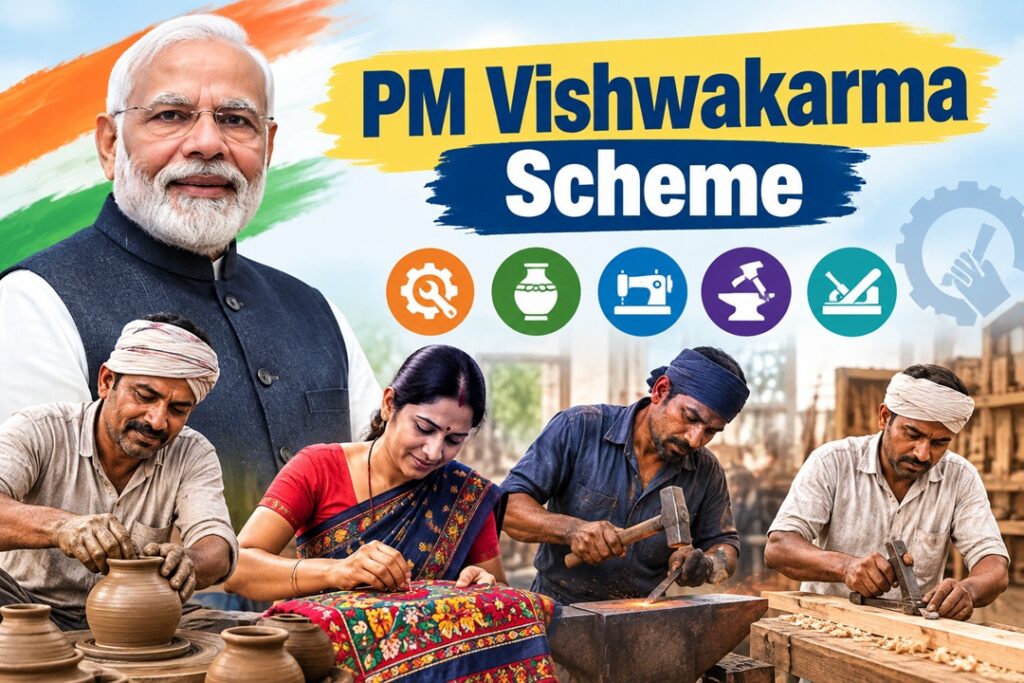
PM Vishwakarma Scheme
Launched on 17 September 2023, PM Vishwakarma is a Central Sector Scheme with an outlay of ₹13,000 crore for 2023–24 to 2027–28. It is designed for informal, self-employed artisans who depend primarily on traditional skills, hands and tools for their livelihoods.
The scheme follows three broad objectives:
- Samman (Recognition): Artisans receive formal identification through PM Vishwakarma certificates and digital identity cards.
- Samarthya (Capability): Beneficiaries receive skill training, exposure to improved tools and assistance in entering the formal MSME ecosystem through the Udyam Assist Platform (UAP).
- Samriddhi (Prosperity): The scheme combines concessional credit, toolkits, digital-payment incentives and opportunities to access wider domestic and international markets while retaining traditional Guru-Shishya knowledge systems.
Progress after Three Years
The scheme has reached its target of 30 lakh registered beneficiaries, following a three-stage verification mechanism involving local bodies, district authorities and state/Union-level screening.
Its major achievements include:
- More than 24 lakh artisans have completed the 5–7 day Basic Skill Training, with a training stipend of ₹500 per day.
- More than 18 lakh toolkits, worth up to ₹15,000 each, have been supplied to beneficiaries.
- Over 6.19 lakh collateral-free loans have been sanctioned, involving more than ₹5,316 crore in credit.
- Credit is offered at a concessional 5% interest rate, supported by central interest subvention.
- More than 8.11 lakh artisans have received digital transaction incentives amounting to over ₹42 crore.
- More than 12,000 artisans have received training in generative AI applications such as packaging, branding and catalogue preparation.
Credit and Formalisation Architecture
The credit component is structured in two stages. Under the first tranche, eligible artisans can access a collateral-free loan of up to ₹1 lakh, generally after completing Basic Skill Training, with an 18-month repayment period.
A second tranche of up to ₹2 lakh becomes available after satisfactory repayment of the first loan and fulfilment of prescribed conditions such as digital-payment adoption or advanced training. This creates an incentive for both credit discipline and progressive skill development.
The Udyam Assist Platform further connects informal artisans with the formal MSME framework by providing an official registration number. This can improve access to institutional finance, government procurement opportunities and other formal-sector benefits.
Three-Tier Verification
To prevent ineligible inclusion and ensure that assistance reaches genuine artisans, beneficiaries undergo multiple levels of scrutiny:
- Local verification: Gram Panchayats or Urban Local Bodies identify and verify artisans.
- District-level scrutiny: District Implementation Committees examine and recommend applications.
- State/Union-level approval: A Screening Committee provides the final approval.
This structure attempts to combine grassroots identification with administrative oversight.
Connecting Artisans with Markets
A major feature of PM Vishwakarma is its attempt to move beyond subsidies and integrate artisans with organised markets.
More than 30,000 artisans have been connected with platforms such as GeM, ONDC, Amazon and Meesho. Opportunities are also being created through One Station One Product (OSOP) outlets at railway stations and AVSAR retail facilities at airports.
Hotel-based sales outlets and packaging workshops conducted with institutions such as the Indian Institute of Packaging can further help artisans improve product presentation and commercial viability.
Key Challenges
Despite strong registration and training numbers, the conversion of beneficiaries into sustainable enterprises remains a concern.
Credit access remains a major bottleneck. The relatively small number of sanctioned loans compared with the 30 lakh verified beneficiaries suggests that registration and training have not yet translated into comparable levels of formal finance.
Digital adoption is uneven. Artisans in remote areas often continue to rely on cash transactions for purchasing raw materials, limiting the effectiveness of digital-payment incentives.
Advanced training faces an opportunity-cost problem. For daily-wage artisans, spending 15 days away from productive work can mean immediate income loss, reducing participation in longer training programmes.
Rising input costs also weaken gains from credit. Higher prices of timber, metal, coir, leather and other raw materials can absorb much of the additional working capital provided through the scheme.
Way Forward
- Improve bank credit conversion: State Level Bankers’ Committees can work with banks and credit-guarantee mechanisms to reduce excessive risk aversion and accelerate loan sanctions.
- Develop Common Facility Centres: Shared machinery, modern tools and processing facilities can complement individual toolkits, particularly in artisan clusters.
- Strengthen government procurement: Greater procurement of artisan-made products through GeM and public institutions can provide a predictable market.
- Create raw-material support systems: Aggregation centres can help artisans purchase standardised inputs in bulk at more affordable prices.
- Promote GI and export linkages: Mapping traditional craft clusters and supporting GI registration, quality standards and export procedures can help connect artisans with international markets.
- Make advanced training more flexible: Modular or cluster-based training, with reduced income-loss burdens, could improve participation among working artisans.
Conclusion
PM Vishwakarma has demonstrated considerable reach by bringing 30 lakh traditional artisans into a structured support framework. The next stage should focus on converting registration and training into sustained income, affordable credit, productive assets and reliable markets, thereby ensuring that traditional skills become a source of durable economic opportunity rather than merely cultural preservation.
Source : PIB