
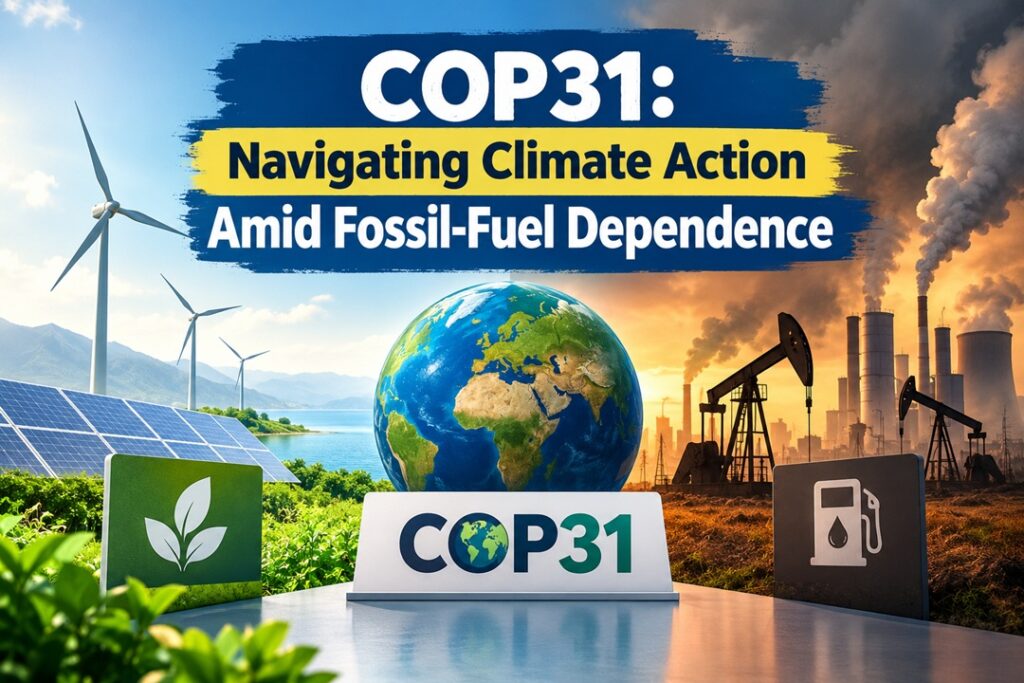
COP31: Navigating Climate Action Amid Fossil-Fuel Dependence
Context
COP31 will be held in Antalya, Türkiye, from November 9–20, 2026. The summit comes amid growing pressure for faster decarbonisation, even as its host countries remain heavily dependent on fossil fuels.
COP31 and Its Key Objectives
The United Nations Framework Convention on Climate Change (UNFCCC) provides the institutional framework for international climate negotiations, while the Conference of the Parties (COP) serves as its principal decision-making forum.
COP31 is expected to promote greater electrification of industry and transport. One of its stated ambitions is to raise the share of electricity in final energy demand from slightly above 20% currently to 35% by 2035.
Fossil-Fuel Dependence of the Host Countries
Both Australia and Türkiye face a difficult balance between climate commitments and energy realities.
- Australia is one of the world’s largest fossil-fuel exporters, while coal, oil and natural gas account for around 90% of its domestic energy requirements.
- Türkiye derives around 80% of its energy needs from fossil fuels.
- Australia’s approval of coal-mine expansion has attracted criticism from environmental groups, creating additional scrutiny around its role in COP31.
Domestic Steps Towards the Energy Transition
Despite their dependence on conventional fuels, both countries are pursuing measures to support decarbonisation.
Australia’s mining and other industries are increasingly investing in hybrid and electric heavy machinery. Electric vehicles have also gained considerable momentum, with EV sales recently surpassing petrol-car sales.
Türkiye has placed zero waste and circular economy initiatives among its COP31 priorities. Greater recycling could also help reduce methane emissions. The rapid growth of its domestic EV industry, particularly the Togg brand, is another component of its transition efforts.
Oceans and Climate Action
Protection of marine ecosystems is also expected to receive attention. Türkiye’s Blue Dialogue, focused on safeguarding marine resources, reflects the growing recognition of oceans as an important component of climate resilience and sustainable development.
Concerns Over the COP31 Agenda
Climate observers and vulnerable countries have raised questions about the absence of some major issues from the stated priorities.
These include:
- A clear commitment to phasing down or transitioning away from fossil fuels.
- Greater emphasis on loss and damage financing.
- A dedicated focus on climate finance.
The increasing frequency and severity of climate-related disasters, including devastating floods in Nepal, have added urgency to demands for stronger mitigation and financial support.
Fossil-Fuel Transition and the Loss-and-Damage Debate
The debate gained further momentum at COP30 in Belém, Brazil, when the European Union advocated a roadmap for transitioning away from fossil fuels.
India did not oppose the proposal but emphasised two principles:
- Common but Differentiated Responsibilities (CBDR): Developed countries should bear greater responsibility in view of their historical contribution to greenhouse-gas emissions.
- Flexible Transition Pathways: Countries should be able to determine energy-transition strategies according to their developmental priorities, economic conditions and energy requirements.
This highlights a central challenge in global climate negotiations: reconciling the urgency of decarbonisation with development, energy security and equity.
Growing International Momentum
Calls for action beyond the formal COP process are also increasing. In April 2026, Colombia and the Netherlands co-hosted the first international conference dedicated to “Transitioning Away from Fossil Fuels” in Santa Marta. A second conference is planned for 2027, to be co-hosted by Tuvalu and Ireland.
Way Forward
Countries can propose additional agenda items during the COP negotiations. COP31 could therefore provide an opportunity to address fossil-fuel transition, climate finance and loss and damage while recognising different national circumstances and transition capacities.
Conclusion
COP31 will test the ability of climate negotiations to balance decarbonisation, development, energy security and climate justice. A meaningful outcome would require stronger climate action alongside equitable support for vulnerable and developing countries.
Source : The Hindu