
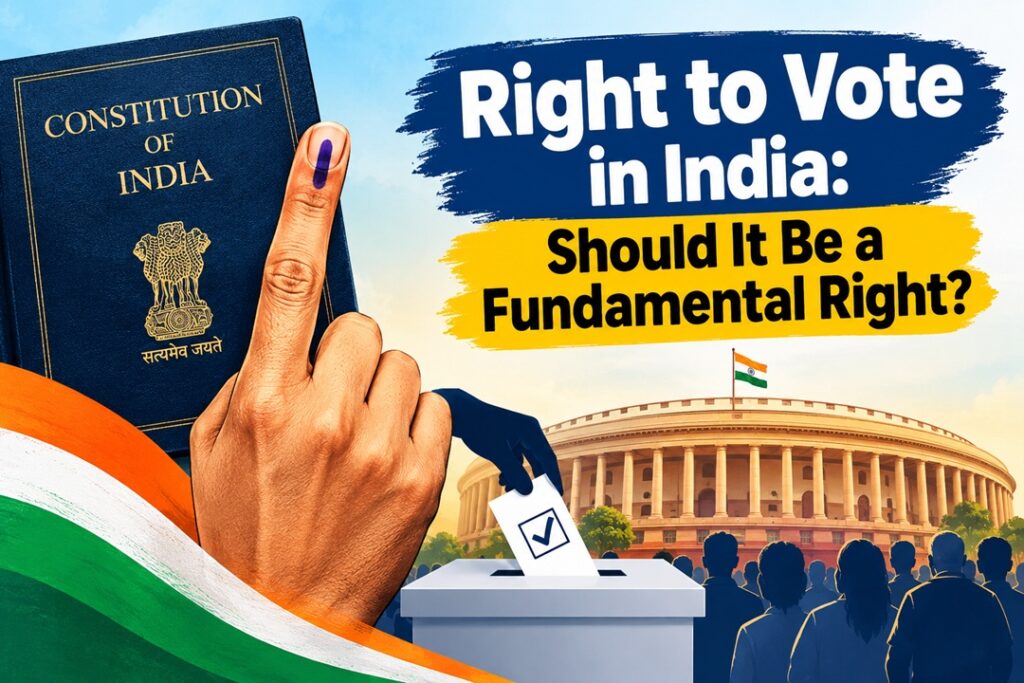
Right to Vote in India: Should It Be a Fundamental Right?
Context
Reported objections within the ECI and the alleged exclusion of 97 verified Goa voters due to ECINet-related issues have renewed debate over electoral safeguards and the constitutional status of the right to vote.
India adopted universal adult suffrage from the commencement of the Constitution. The 61st Constitutional Amendment Act, 1988, later lowered the voting age from 21 to 18 years.
The right to vote is provided under Article 326 but is not expressly included among the Fundamental Rights. In Kuldip Nayar v. Union of India (2006), the Supreme Court treated the right to elect as a statutory right governed by electoral legislation.
Digitalisation and Electoral Exclusion
The reported Goa episode highlights the risks associated with digital electoral administration. According to the information provided, 97 verified voters were reportedly excluded from electoral rolls, while software-related limitations allegedly prevented restoration of their entries.
Such incidents underline the need for effective human verification, correction mechanisms and audit trails. The reported impact on access to Goa’s Mediclaim Scheme also shows how electoral-record errors can affect welfare delivery when public benefits are linked to electoral databases.
Institutional Governance of the ECI
The Chief Election Commissioner and Other Election Commissioners Act, 2023, provides for Commission decision-making through unanimity where possible and majority decisions where disagreements remain.
The reported internal objections concerning electoral-roll revision and IT governance highlight the importance of transparent deliberation, institutional accountability and clearly defined responsibility within the ECI.
Arguments for Recognising Voting as a Fundamental Right
Recognising voting as an explicit Fundamental Right could provide stronger constitutional protection against arbitrary exclusion and strengthen safeguards concerning electoral-roll deletions.
It could also reinforce judicial scrutiny of unreasonable restrictions and provide greater protection against technology-driven exclusion.
Article 25 of the ICCPR recognises citizens’ rights to participate in public affairs and to vote in genuine periodic elections without unreasonable restrictions.
Concerns Regarding Fundamental-Right Recognition
Constitutionalising the right to vote would need to preserve legitimate electoral-roll maintenance, including the removal of deceased, permanently relocated or otherwise ineligible electors.
It could also increase constitutional litigation over electoral disputes. Any expanded judicial remedy would have to be reconciled with Article 329(b), which limits judicial interference in elections and provides for election petitions.
Way Forward
- Strengthen procedural safeguards through advance notice, verification, reasoned decisions and accessible appeals before deleting eligible voters.
- Improve ECINet and related digital platforms by providing authorised officials with effective correction and restoration mechanisms.
- Maintain human oversight so that technology supports rather than obstructs verified administrative corrections.
- Provide alternative verification mechanisms for essential welfare schemes so that electoral-roll errors do not disrupt access to benefits.
- Ensure major electoral and technological decisions involve documented Commission-level deliberation.
- Encourage further constitutional examination of the relationship between voting, political expression, democracy and the existing statutory framework.
Conclusion
India’s democratic system depends on meaningful and inclusive electoral participation. Accurate electoral rolls, accountable institutions and safeguards against digital exclusion are essential, alongside the continuing constitutional debate over the legal status of the right to vote.
Source : The Hindu