
Kashmir as India’s Gateway to Eurasian Economic Opportunities
Context
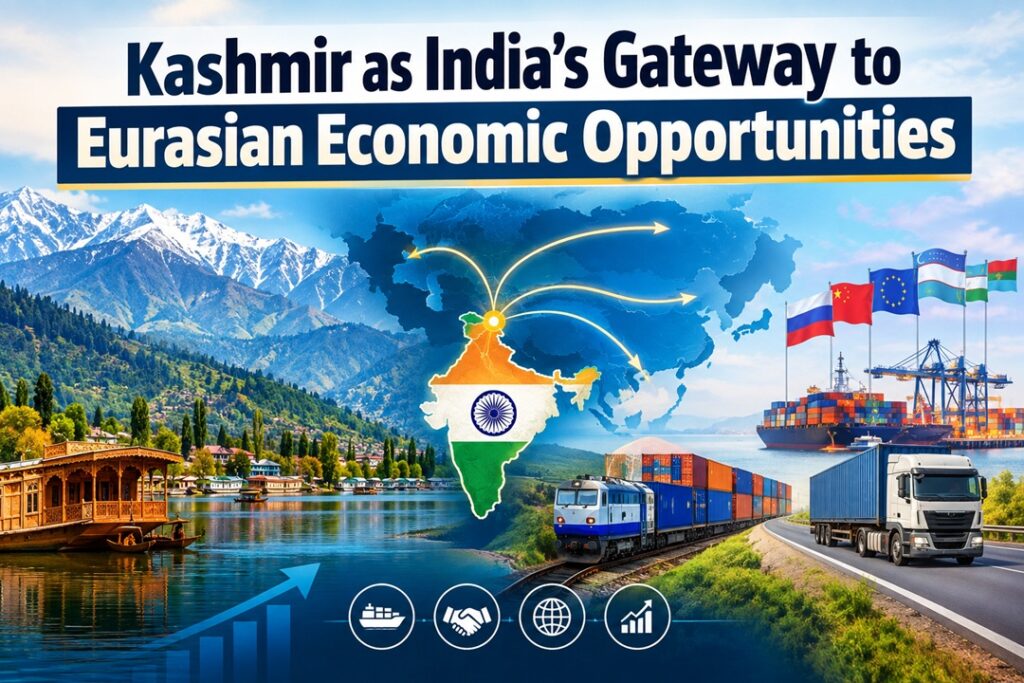
A proposal has emerged to reposition Jammu & Kashmir and Ladakh as a regulated economic bridge between India, Central Asia and the wider Eurasian region, alongside continued attention to security.
Historical Role of J&K and Ladakh
For centuries, Kashmir and Ladakh served as important trans-Himalayan crossroads. Caravan routes connected South Asia with Tibet and Central Asia, enabling the movement of goods as well as ideas, skills and cultural traditions.
Persian and Central Asian influences also shaped Kashmir’s cultural and economic identity. Artisans and scholars contributed to traditions such as carpet weaving, papier-mâché and other handicrafts.
However, the geopolitical changes after 1947, followed by tensions along the Line of Control (LoC) and Line of Actual Control (LAC), disrupted many traditional routes. The region increasingly came to be viewed primarily through a strategic and security lens.
India’s Demographic Opportunity and the Aspiration Gap
India’s relatively young population provides a potential economic advantage as several competing economies face ageing populations and workforce constraints. However, demographic strength can translate into economic gains only when accompanied by adequate employment opportunities.
For young people, widespread access to smartphones and the internet has increased awareness of global opportunities and standards of living. At the same time, limited job creation, delays in recruitment, examination-related problems and inadequate industrial opportunities can create a gap between aspirations and actual economic prospects.
In J&K, therefore, employment, entrepreneurship and economic dignity can form important components of a broader development strategy alongside legitimate security concerns.
Connectivity as a Tool of Economic Integration
A regulated approach to cross-border commerce could potentially complement security objectives rather than necessarily conflict with them. Greater economic interdependence can create incentives for communities and businesses to support stability.
Land-based connectivity can also generate economic activity beyond major urban centres. Transport corridors can support trucking, warehousing, tourism, hospitality, agriculture, construction, trade finance and logistics, thereby creating wider employment opportunities.
For India, carefully managed connectivity through J&K and Ladakh could provide another route towards Central Asian and Eurasian markets and diversify existing trade networks.
Challenges to Trans-Himalayan Connectivity
Geopolitical constraints: Any substantial reopening of traditional routes would involve difficult engagement with Pakistan and China, alongside concerns relating to terrorism, strategic mistrust and the suspension of cross-LoC trade.
Territorial sensitivities: Proposed corridors may involve areas affected by competing territorial claims, making connectivity closely linked to questions of sovereignty and diplomacy.
Difficult Himalayan terrain: High-altitude routes face severe winters, seismic vulnerability, difficult construction conditions and ecologically fragile landscapes. Developing reliable infrastructure would therefore require substantial investment and careful environmental assessment.
Security and regulatory risks: Expanded cross-border trade could also create opportunities for trafficking in narcotics, weapons, counterfeit currency and other prohibited goods unless customs, financial monitoring and cargo surveillance are strengthened.
Way Forward
Begin with controlled pilot corridors: Limited commercial routes could initially be tested at carefully selected locations, with expansion linked to security performance and institutional preparedness.
Develop smart border infrastructure: Modern scanners, RFID-based cargo tracking, digital documentation and secure payment systems can facilitate legitimate trade while improving monitoring.
Use regional platforms for dialogue: Forums such as the Shanghai Cooperation Organisation (SCO) could provide space for practical discussions on connectivity and commerce even when larger political disputes remain unresolved.
Strengthen local economic linkages: Cold chains, dry ports, testing laboratories and improved road connectivity can help connect Kashmir’s horticulture, saffron and handicraft sectors with wider markets.
Combine security with engagement: A gradual approach that gives greater space to dialogue, people-to-people contact and economic cooperation can complement security measures and create additional channels for regional stability.
Conclusion
Recasting J&K and Ladakh as a northern economic gateway could connect regional development with India’s wider Eurasian trade ambitions. Its feasibility, however, depends on secure infrastructure, calibrated diplomacy, environmental safeguards and sustained economic opportunities for local communities.
Source : The Hindu