
Artificial Intelligence in Disaster Management: Strengthening Prediction, Response and Resilience
Context
Recent floods in Nepal and urban flooding in India have highlighted how AI and digital technologies can improve disaster preparedness and emergency response, while also showing that technology must work alongside effective human governance.
Artificial Intelligence in Disaster Management
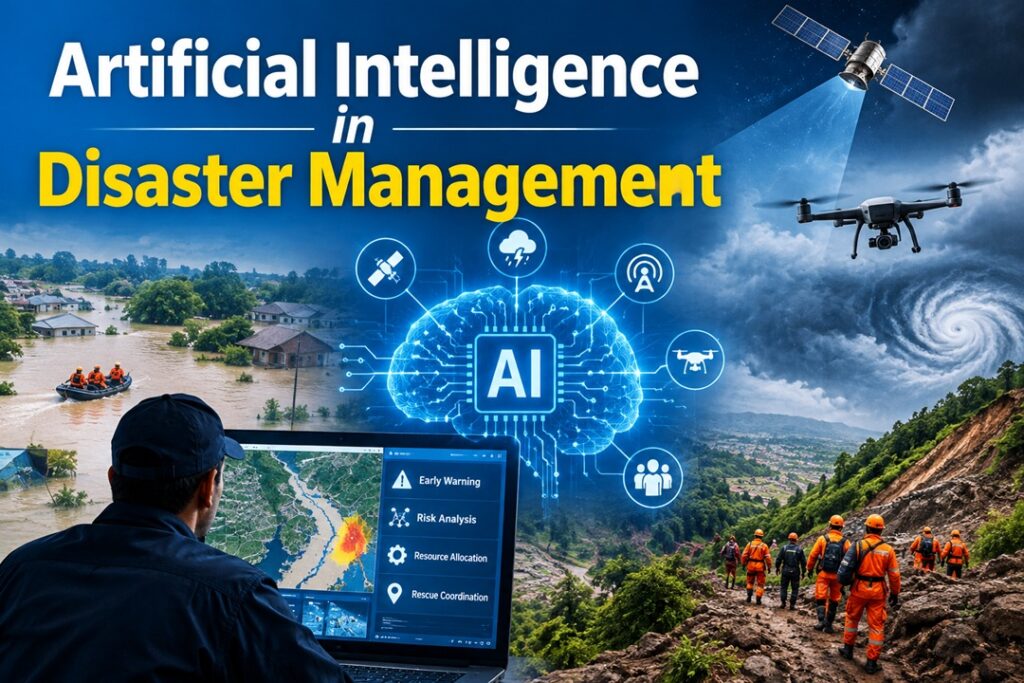
Artificial Intelligence (AI) in disaster management involves using machine learning, computer vision, natural language processing and related technologies to analyse weather, satellite, drone, sensor and citizen-generated data. These tools can support authorities in predicting hazards, coordinating rescue operations and assessing damage.
Changing Nature of Disaster Information
The spread of smartphones, social media and mobile connectivity has enabled citizens to provide real-time information from affected locations. At the same time, drones and commercial satellites can quickly capture high-resolution images of areas that may be inaccessible to rescue teams.
Consequently, AI is being incorporated across different stages of the disaster-management cycle, from early warning and preparedness to rescue, relief and rehabilitation.
Applications Across the Disaster Management Cycle
1. Preparedness and Early Warning
AI-based forecasting can improve the geographical and temporal precision of disaster warnings.
- Machine-learning models developed at IIT Bombay’s Centre for Climate Studies can provide neighbourhood-level forecasts of extreme rainfall and flash floods in Mumbai.
- Google’s Flood Hub uses weather forecasts, river-basin characteristics and historical hydrological information to generate flood warnings several days in advance.
- Systems such as GraphCast, DisasterAWARE and SKAI can combine satellite observations, elevation data and land-use information to develop dynamic assessments of emerging hazards.
2. Emergency Response and Search & Rescue
AI can help rescue teams identify victims and prioritise areas requiring immediate intervention.
- During the September 2026 floods in Nepal’s Trishuli River basin, drones equipped with thermal cameras and computer-vision systems were used to detect human heat signatures beneath debris and mud.
- Digital platforms can help reconcile crowdsourced missing-person reports with hospital, police and other official records.
- Natural Language Processing can process multilingual distress messages and SOS communications, helping identify urgent medical requirements and affected infrastructure.
3. Recovery and Rehabilitation
AI can accelerate post-disaster assessment and improve the distribution of relief.
- Comparing satellite images taken before and after a disaster can help identify damaged roads, bridges and isolated settlements.
- Algorithms can assist in locating suitable landing areas for rescue helicopters.
- AI-supported logistics can help determine efficient routes for delivering food, drinking water and medical supplies according to population vulnerability.
Major Challenges
Despite its potential, AI cannot independently overcome weaknesses in disaster-management systems.
Ground-level implementation gap: Accurate forecasts have limited value when evacuation routes, drainage systems, rescue equipment and emergency personnel are inadequate.
Data inequality: AI models relying on digital and satellite data may underrepresent remote villages, informal settlements and communities with limited connectivity.
Misinformation and unreliable outputs: Social-media rumours and inaccurate machine-generated assessments can distort the understanding of a crisis and potentially divert emergency resources.
Dependence on digital infrastructure: Power failures, damaged communication networks and poor connectivity can make cloud-dependent AI systems unavailable precisely when they are most needed.
Way Forward
Disaster-management authorities should develop stronger partnerships with universities, technology companies and public institutions to create locally relevant and openly shareable disaster data.
AI capabilities should increasingly be deployed on drones, sensors and other edge devices so that essential functions can continue even when communication networks fail. Traditional ecological knowledge, including community-based approaches to flood management and water retention, should also complement technological forecasting.
Most importantly, critical decisions such as evacuation, rescue prioritisation and resource allocation should remain subject to human oversight. AI should strengthen the capabilities of disaster-response institutions rather than replace professional judgment.
Conclusion
AI can make disaster management faster, more predictive and more targeted. However, its effectiveness ultimately depends on resilient infrastructure, reliable institutions, trained personnel and accountable governance. The objective should therefore be to use AI as a force multiplier for human-led disaster response and community resilience.
Source : The Indian Express