
Reducing Food Loss and Waste for Food Security and Sustainability
Context
The International Day of Awareness of Food Loss and Waste on September 29 highlighted India’s need to address losses across farms, supply chains and urban consumption.
Distinguishing Food Loss from Food Waste
Food loss occurs mainly before food reaches retail markets due to poor harvesting, storage, processing and transportation. Food waste occurs later at retail outlets, restaurants, hotels, institutions and households.
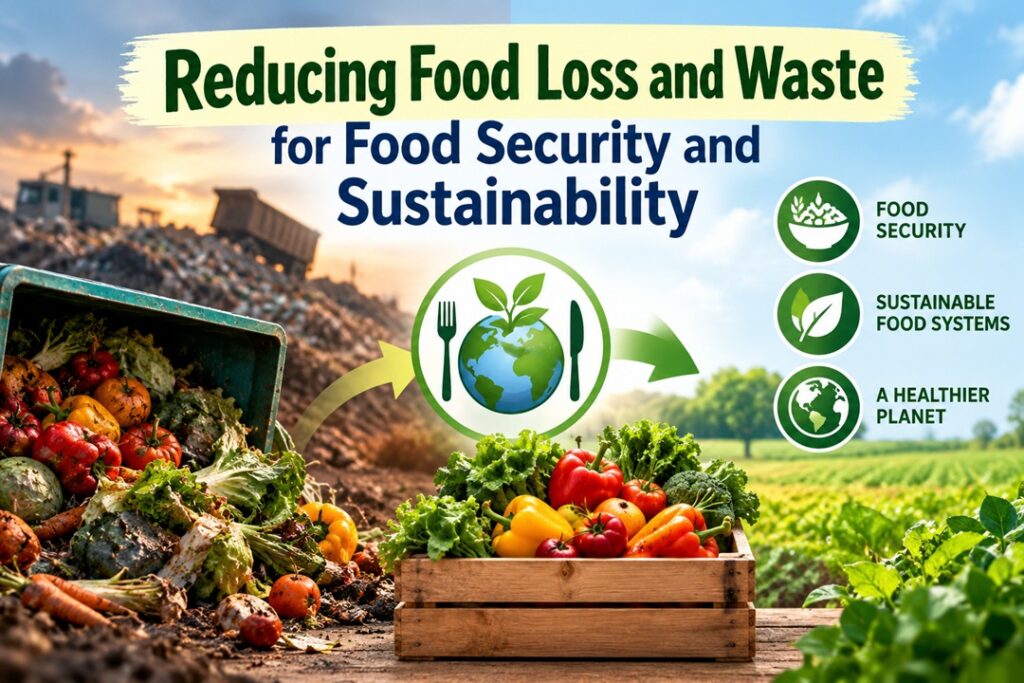
Addressing both can deliver three major benefits:
- Food security: More food can reach consumers without expanding agricultural production excessively.
- Environmental protection: Reducing wastage also saves the water, land, fertilisers and energy embedded in food production and lowers associated emissions.
- Economic gains: Lower losses can improve returns for farmers and food businesses while creating opportunities to convert organic waste into biogas, bio-CNG and compost.
India’s Progress in Measuring Post-Harvest Losses
India has developed a significant evidence base through national surveys conducted by the Ministry of Food Processing Industries.
The first two surveys, undertaken during 2005–07 and 2012–14, covered 45 commodities each. The 2020–22 survey expanded coverage to 54 commodities and assessed losses from the farm-gate to retail stage. A fourth survey is now underway.
These assessments provide important evidence for monitoring SDG 12.3 and the FAO Food Loss Index.
However, India still has limited systematic data on food discarded by households, hotels, restaurants, retailers and other urban establishments.
Wholesale Markets: An Important Intervention Point
Agricultural wholesale markets can generate substantial quantities of organic waste. Assessments involving FAO and the National Council of Agriculture Marketing Boards indicate that major markets can produce up to 100 tonnes of organic waste per day.
India’s wholesale agricultural markets collectively discard an estimated 3.5 million tonnes of organic waste annually. A significant portion ultimately reaches landfills, adding to the municipal waste burden and generating greenhouse-gas emissions.
This waste can instead become an economic resource through circular-economy models.
The Surat bio-CNG model demonstrates how market waste can be processed into clean fuel and bio-fertiliser, while simultaneously reducing methane emissions.
Financing and Technology Solutions
FAO’s collaboration with SIDBI seeks to connect food-loss hotspots with concessional financing. This can support MSMEs, FPOs and agri-aggregators in adopting:
- Solar and hybrid cold rooms.
- Pre-cooling and improved refrigeration.
- Efficient drying and moisture-control systems.
- Digital traceability for perishable commodities.
At the urban level, standardised practices are also being developed to help municipalities measure, prevent, reduce, redistribute and valorise food waste.
Major Challenges
Gaps in Cold-Chain Infrastructure
Insufficient pack-houses, refrigerated transport and advanced storage facilities contribute significantly to spoilage, particularly for fruits and vegetables.
Limited Management of Consumer-Side Waste
Food waste generated by restaurants, hotels, catering services and households is not yet comprehensively measured or managed through a national framework.
Financial Constraints
High initial costs for cold storage, post-harvest machinery and solar drying technologies can restrict adoption by small farmers and FPOs.
Weak Markets for Recovered Resources
Uncertain demand and fragmented distribution systems can make products such as compost and bio-CNG less commercially attractive.
Way Forward
India should expand farm-gate infrastructure for sorting, grading, pre-cooling and drying, particularly through existing agricultural infrastructure and financing programmes.
Major APMCs can adopt organic-waste-to-bio-CNG models, building on successful examples and linking them with initiatives such as SATAT and GOBARdhan.
Urban local bodies should undertake regular food-waste audits and establish stronger mechanisms for safe redistribution of surplus food through food banks and other registered organisations.
Food-loss reduction should also be integrated into India’s climate commitments, recognising the emissions avoided through better storage, transportation, consumption and organic-waste management.
Conclusion
Reducing food loss and waste offers India an opportunity to simultaneously strengthen food security, improve farm incomes and reduce environmental pressures. The next step is to extend India’s strong measurement of post-harvest losses to urban food waste while scaling cold-chain and circular-economy solutions.
Source : The Hindu