
IceCube Observatory: Advancing Neutrino Astronomy
Context
The 2026 Nobel Prize in Physics, according to the supplied information, recognises Francis Halzen’s pioneering contribution to the IceCube Neutrino Observatory in Antarctica. The facility has transformed the study of high-energy particles from space, enabling scientists to investigate some of the universe’s most extreme environments.
What Is the IceCube Observatory and Why Is It Significant?
The IceCube Neutrino Observatory is a large-scale scientific facility embedded deep within the Antarctic ice sheet. It detects neutrinos, electrically neutral subatomic particles that can travel across enormous cosmic distances with very little interaction with matter.
Unlike conventional telescopes that observe visible light, radio waves or other electromagnetic radiation, IceCube uses transparent Antarctic ice as a detection medium. Its development represents a major advance in particle astrophysics and has helped establish neutrino astronomy as a new way of exploring the universe.
The project also illustrates the importance of long-term scientific investment, advanced engineering and international cooperation. Its achievements depend on the combined contributions of researchers, engineers, institutions and funding agencies over several decades.
Why Are Neutrinos Important for Studying the Universe?
Traditional cosmic rays consist largely of charged particles such as protons and atomic nuclei. Although they can carry enormous amounts of energy, their trajectories are altered by magnetic fields in space, making it difficult to identify their original sources.
Neutrinos offer a different approach because of three distinctive properties:
- Electrical neutrality: Their paths are not bent by magnetic fields, allowing scientists to trace detected neutrinos back towards their cosmic origins.
- Weak interaction with matter: They can pass through stars, gas clouds and planets with little chance of interacting, carrying information from otherwise inaccessible regions.
- Connection with energetic astrophysical processes: High-energy neutrinos can emerge when cosmic rays interact with matter or radiation near powerful astrophysical objects.
Consequently, neutrinos can provide evidence of particle acceleration in extreme environments, including supernova remnants and active galactic nuclei. Their detection complements observations made using light and gravitational waves.
How Does IceCube Detect High-Energy Neutrinos?
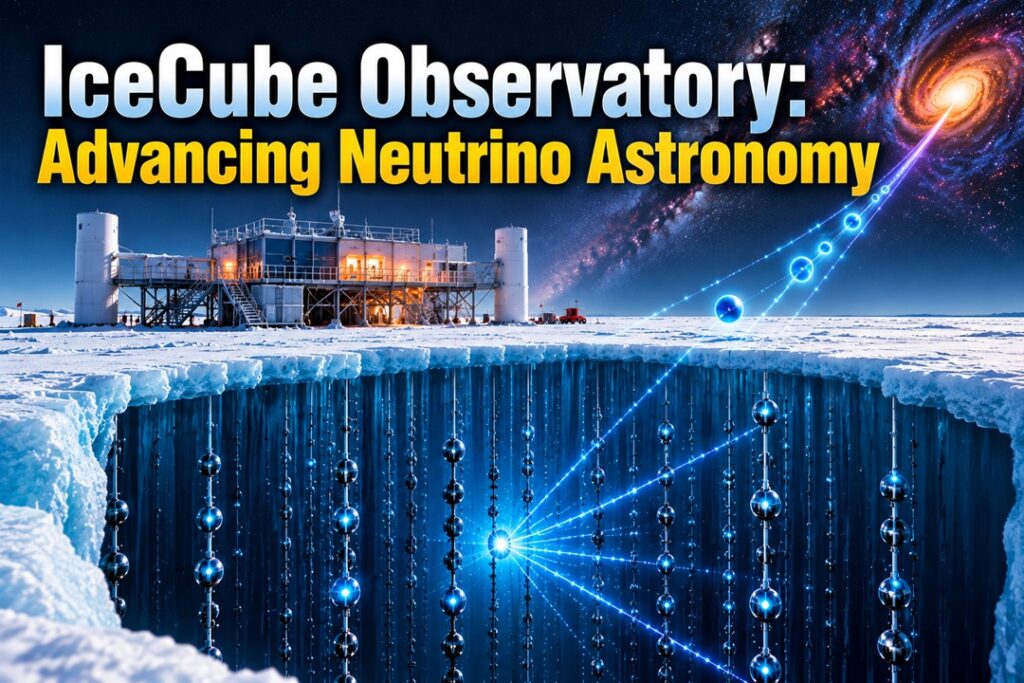
IceCube transforms a vast volume of Antarctic ice into a particle detector, enabling scientists to capture the extremely rare interactions of neutrinos with matter.
- A cubic kilometre of ice: The detector operates approximately 1.5–2.5 km beneath the Antarctic surface, where exceptionally clear ice provides a suitable medium for detecting faint light signals.
- Optical sensor network: It comprises 5,160 Digital Optical Modules (DOMs) installed along 86 vertical strings. These sensors record tiny flashes of light produced by particle interactions.
- Neutrino interaction: Occasionally, a neutrino collides with an atomic nucleus in or near the instrumented ice, generating secondary charged particles, such as muons.
- Cherenkov radiation: When these charged particles travel faster than the phase velocity of light in ice, they produce a cone of faint blue light called Cherenkov radiation. They do not exceed the speed of light in a vacuum.
- Reconstruction of cosmic signals: The sensors record the timing, intensity and distribution of the light. Computer algorithms use these observations to estimate the energy and incoming direction of the neutrino.
This combination of a massive detection volume, sensitive instruments and computational analysis allows IceCube to study particles that would otherwise pass through the Earth undetected.
What Major Scientific Discoveries Has IceCube Enabled?
1. Identification of Astrophysical Neutrinos
In 2013, IceCube identified high-energy neutrinos originating beyond Earth, establishing the feasibility of exploring the universe through these elusive particles. Some detected neutrinos carried energies far exceeding those achievable in terrestrial particle accelerators.
2. Linking Neutrinos to a Distant Blazar
In 2017, a high-energy neutrino detection was associated with the direction of the blazar TXS 0506+056. A blazar is an active galaxy whose central supermassive black hole produces powerful particle jets directed approximately towards Earth. This observation provided important evidence connecting astrophysical neutrinos with active galactic nuclei.
3. Detecting Neutrino Emissions from NGC 1068
IceCube identified a significant concentration of high-energy neutrino events associated with NGC 1068, also known as Messier 77. The active galaxy provides an important opportunity to investigate how supermassive black holes and their surrounding environments produce energetic particles.
4. Advancing Multi-Messenger Astronomy
IceCube has expanded astronomical research beyond electromagnetic observations. Scientists can combine neutrino detections with gamma-ray observations, optical signals and gravitational-wave measurements to develop a more comprehensive understanding of cosmic events.
What Lessons Does IceCube Offer India?
1. Strengthening the India-Based Neutrino Observatory
The proposed India-based Neutrino Observatory (INO), associated with the Theni region of Tamil Nadu, aims to develop domestic expertise in neutrino physics. Its underground detector design differs from IceCube’s Antarctic configuration, but both demonstrate the importance of large-scale facilities for fundamental research.
India should address implementation challenges, maintain transparent environmental and public consultations, and establish clear milestones for scientific infrastructure development.
2. Ensuring Long-Term Research Funding
Mega-science projects often require decades of research, construction and operational support. Predictable funding, independent evaluation and coordination among scientific institutions and government agencies are essential for their success.
3. Developing Indigenous Scientific Technologies
Investment in precision sensors, detector electronics, advanced materials, high-performance computing and data analytics can strengthen India’s technological capabilities and generate expertise applicable to other scientific and industrial sectors.
4. Expanding International Scientific Collaboration
Participation in global research programmes enables Indian scientists to access specialised expertise, share datasets, use advanced facilities and contribute to frontier discoveries.
5. Promoting Scientific Awareness
Public engagement can improve understanding of fundamental research, its environmental implications and its long-term benefits. Transparent communication and meaningful consultation are particularly important when establishing large scientific installations.
Way Forward
- Establish predictable, multi-year funding mechanisms for major scientific research projects.
- Set transparent timelines and measurable milestones for facilities such as INO.
- Strengthen partnerships among universities, national laboratories, industry and international research institutions.
- Develop specialised training programmes in particle physics, detector engineering and computational science.
- Incorporate environmental safeguards and public consultation into the planning of large research installations.
Conclusion
The IceCube Neutrino Observatory demonstrates how scientific vision, technological innovation and sustained international cooperation can open new avenues for understanding the universe. Its achievements highlight the value of fundamental research beyond immediate practical applications. For India, the key lesson is to combine long-term investment in scientific infrastructure with indigenous innovation, skilled researchers and international collaboration to strengthen its contribution to frontier science.
Source : The Hindu