
India and the Global Pandemic Agreement: Balancing Health Equity and National Sovereignty
Context
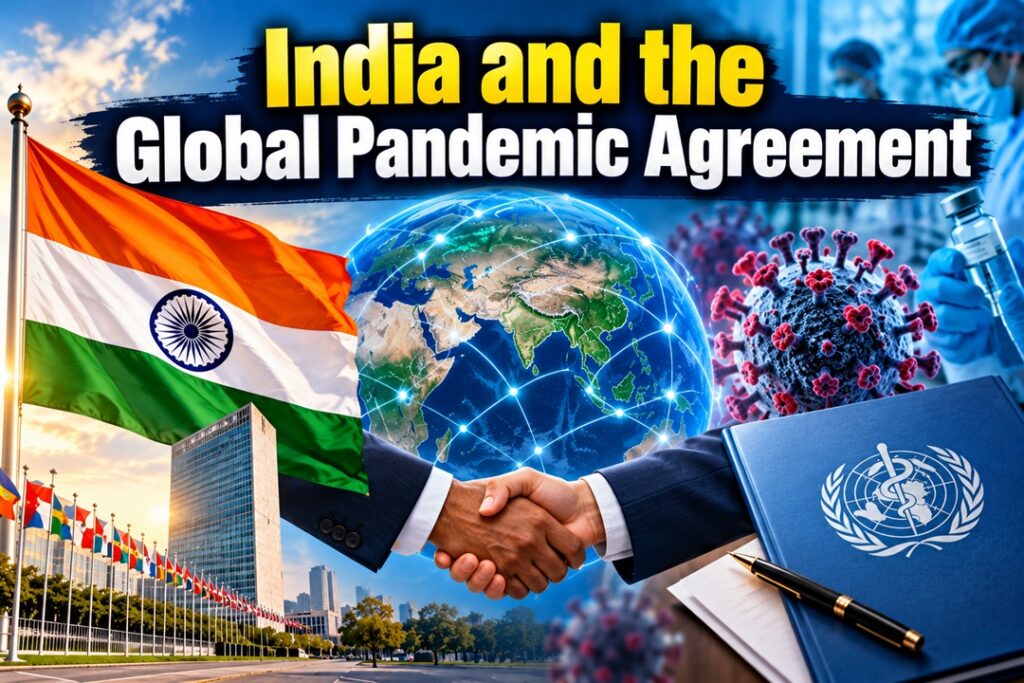
India recently presented its position at the United Nations High-Level Meeting (UN HLM) in New York on the Political Declaration concerning Pandemic Prevention, Preparedness and Response (PPPR). Its intervention highlighted the need to strengthen global cooperation through the World Health Organization (WHO)-led Pandemic Agreement while ensuring equitable access to medical resources and protecting national policy autonomy.
What is the WHO Pandemic Agreement?
The WHO Pandemic Agreement is an international framework adopted by the World Health Assembly in May 2025 to improve the world’s ability to prevent, prepare for and respond to future pandemics. It seeks to address the shortcomings exposed by COVID-19, particularly unequal vaccine distribution, limited manufacturing capacity and disruptions in medical supply chains.
Its major objectives include:
- Disease Prevention: Strengthening surveillance, early-warning systems and coordinated responses to emerging infectious diseases.
- Equitable Access: Improving the availability and affordability of vaccines, diagnostics and therapeutics across countries.
- Technology Transfer: Facilitating the sharing of scientific knowledge and manufacturing capabilities.
- Resilient Health Systems: Supporting countries in developing sustainable healthcare infrastructure and emergency response capacity.
Key Components of the Agreement
1. Pathogen Access and Benefit-Sharing (PABS)
The proposed PABS system is a central element of the negotiations. It seeks to connect the sharing of pathogens and associated genetic information with fair access to the medical products developed using those resources. The outstanding details of this mechanism are important for advancing the agreement’s implementation.
2. International Cooperation
The framework promotes collaboration among governments, the WHO, research institutions and pharmaceutical manufacturers to improve preparedness and coordinate responses to public health emergencies.
3. Fair Distribution of Medical Countermeasures
The agreement seeks to reduce disparities in access to essential medical products, particularly for low- and middle-income countries that experienced difficulties obtaining vaccines and treatments during COVID-19.
4. Strengthening Manufacturing Capacity
Greater regional production, knowledge-sharing and diversified supply chains can help reduce dependence on a limited number of manufacturers during international health emergencies.
Why Is the Agreement Important for India?
1. Protecting India’s Pharmaceutical Interests
India is a major global supplier of affordable generic medicines and vaccines. However, its ability to manufacture certain advanced vaccines and treatments can depend on access to specialised technologies, intellectual property and imported inputs.
A balanced agreement can help India expand its manufacturing capabilities while improving access to innovations developed worldwide.
2. Reducing Dependence on Imported Pharmaceutical Inputs
India’s pharmaceutical industry remains exposed to disruptions in the supply of active pharmaceutical ingredients (APIs), key starting materials and specialised manufacturing equipment.
Diversifying international suppliers and strengthening domestic production would improve the country’s capacity to maintain medicine supplies during global emergencies.
3. Advancing the Interests of the Global South
Developing countries often face financial, technological and infrastructural barriers in responding to pandemics. India can use its pharmaceutical expertise, digital public infrastructure and development partnerships to promote more inclusive global health arrangements.
4. Safeguarding National Sovereignty
International health commitments must account for differences in national healthcare systems, administrative capacities and economic conditions. India has an interest in ensuring that surveillance and preparedness obligations remain practical, adequately supported and compatible with domestic priorities.
5. Strengthening Health Security
Better disease surveillance, laboratory networks and cooperation between human, animal and environmental health agencies can help India identify emerging infections earlier and reduce the risks of cross-border outbreaks.
Major Challenges in Global Pandemic Governance
1. Unequal Sharing of Benefits
Countries that provide pathogen samples or genetic information may not necessarily receive timely access to vaccines and treatments developed from those resources. This creates concerns about fairness, trust and participation in international surveillance systems.
2. Disagreement over Intellectual Property
Developed countries and pharmaceutical companies often emphasise voluntary licensing and existing intellectual property protections. Many developing countries seek stronger technology-transfer arrangements, particularly during public health emergencies.
The challenge is to protect incentives for medical innovation while enabling affordable access and expanding manufacturing capacity.
3. Financial Constraints
Effective pandemic preparedness requires sustained investment in laboratories, healthcare workers, surveillance networks, research and emergency stockpiles. Countries with limited fiscal resources may struggle to meet international expectations without predictable financial and technical support.
4. Fragmented Medical Supply Chains
Concentrated manufacturing and dependence on imported pharmaceutical ingredients can create bottlenecks during emergencies. Export restrictions, geopolitical tensions and transport disruptions may further limit access to essential products.
5. Tensions Between Global Coordination and National Autonomy
Countries differ over the extent of international oversight required during health emergencies. Global coordination is necessary to manage cross-border threats, but national governments remain responsible for implementing public health measures within their jurisdictions.
6. Integrating the One Health Approach
The One Health framework recognises the links between human, animal and environmental health. However, implementing it requires veterinary infrastructure, trained personnel and reliable monitoring systems, which may be difficult to establish in resource-constrained regions.
India’s Role in Strengthening Global Health Cooperation
1. Promoting Equity Alongside Sovereignty
India can advocate for arrangements that combine timely international information-sharing with clear commitments on access to medical countermeasures. This would help build confidence among countries with different levels of scientific and manufacturing capacity.
2. Expanding Digital Health Cooperation
India’s experience with digital public infrastructure and health information systems provides opportunities to support affordable disease surveillance and healthcare delivery in partner countries. Such cooperation should incorporate data protection, cybersecurity and appropriate safeguards for public health information.
3. Strengthening South–South Partnerships
India can collaborate with countries in Asia, Africa and other developing regions to improve vaccine production, laboratory capacity, medical training and emergency preparedness.
4. Supporting Multilateral Negotiations
Through the WHO, the G20 and other international forums, India can encourage negotiations that address the concerns of both technology-producing countries and countries seeking affordable access to medical innovations.
5. Building Regional Manufacturing Networks
Partnerships for regional vaccine and medicine production could diversify supply chains, reduce dependence on concentrated manufacturing centres and improve access to essential health products during emergencies.
Way Forward
– Finalise an Equitable PABS Mechanism: Establish transparent rules linking pathogen sharing with predictable access to vaccines, diagnostics and treatments, while clarifying the responsibilities of participating countries and manufacturers.
– Strengthen Domestic Pharmaceutical Manufacturing: Expand support for the production of APIs, key starting materials and advanced biological products to reduce exposure to external supply disruptions.
– Develop Technology-Transfer Partnerships: Promote licensing arrangements, voluntary cooperation and other agreed mechanisms that enable developing countries to build sustainable manufacturing capabilities.
– Ensure Predictable International Financing: Strengthen financial and technical support for surveillance, laboratories and healthcare infrastructure so that preparedness obligations are matched by implementation capacity.
– Integrate One Health into National Planning: Improve coordination among public health authorities, veterinary services, environmental agencies and research institutions to identify zoonotic threats early.
– Improve Governance and Accountability: Establish transparent monitoring, periodic assessments and clear responsibilities to ensure that international commitments translate into measurable improvements in pandemic preparedness.
– Protect Scientific Collaboration and Data Security: Develop safeguards that encourage timely sharing of relevant health information while respecting privacy, biosecurity and legitimate national interests.
Conclusion
The WHO Pandemic Agreement represents an important effort to improve international preparedness for future health emergencies. For India, its significance extends beyond disease prevention to pharmaceutical security, technological access and its engagement with the Global South. A credible global pandemic framework must ensure that countries sharing biological resources can also benefit from resulting medical innovations. By combining domestic manufacturing strength with equitable international cooperation, India can contribute to a more resilient, accessible and accountable global health system.
Source : The Hindu