
Transforming Indian Agriculture: From Food Security to Farmers’ Income Security
Context
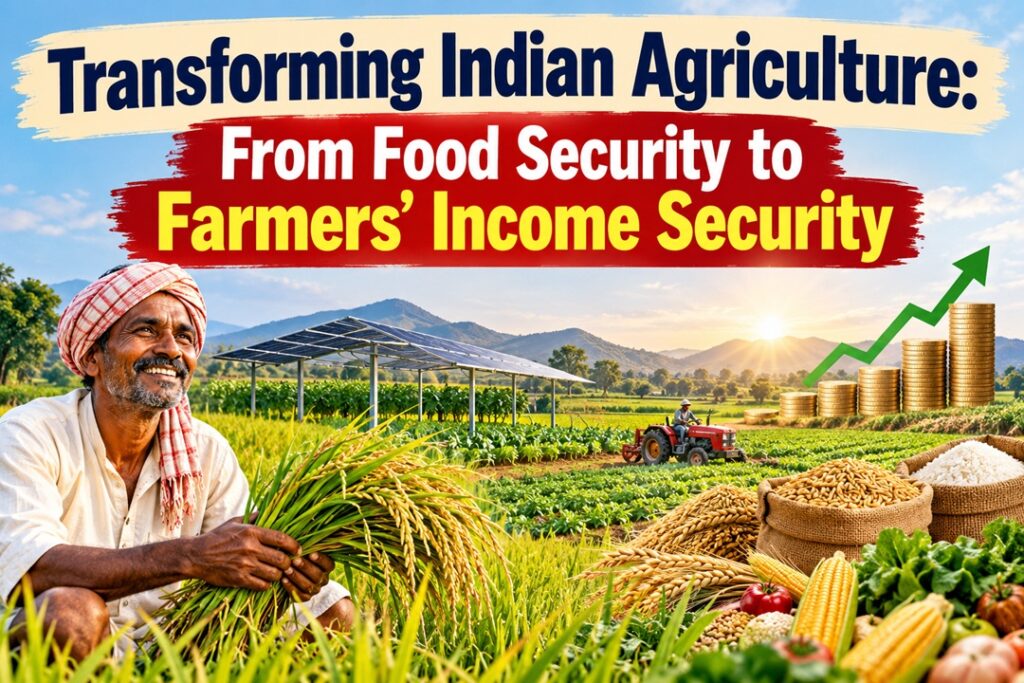
Recent discussions on agricultural policy have highlighted the need to improve farmers’ incomes through structural reforms, crop diversification and agrivoltaics (the combined use of land for agriculture and solar energy generation). Although India has strengthened its food production capacity, ensuring remunerative returns, sustainable resource use and stable rural livelihoods remains a major challenge.
Performance of Indian Agriculture
- Steady economic growth: Agricultural GDP grew at an average annual rate of around 4% between 2014–15 and 2025–26.
- Expansion of irrigation: Irrigation coverage reached nearly 60% of the gross cropped area, improving agricultural productivity and reducing dependence on rainfall.
- Strong export position: India has emerged as a major producer and exporter of rice and a net exporter of agricultural products.
- Favourable trade balance: Agricultural exports stood at approximately $53 billion in 2025–26, compared with imports of around $40 billion. Edible oils and pulses account for a significant share of imports.
Despite these gains, higher agricultural output has not consistently translated into adequate and stable incomes for cultivators.
Major Challenges Facing Indian Agriculture
1. Imbalance Between Production and Consumption
India produces substantial surpluses of rice and wheat but continues to depend on imports to meet domestic demand for pulses and edible oils. This mismatch reflects the limited diversification of cropping patterns and the influence of existing procurement and subsidy arrangements.
The use of nearly 7 million tonnes of rice for ethanol production also raises questions about the competing demands for food, fuel and water. In Punjab and Haryana, intensive paddy cultivation contributes to groundwater depletion.
2. Failure to Achieve the Income-Doubling Objective
The objective of doubling farmers’ real incomes remains unfulfilled. According to estimates associated with the Ashok Dalwai Committee, achieving this goal within the targeted period would have required agricultural GDP growth of approximately 10.4% annually.
Low farm-gate prices, rising input costs, fragmented landholdings, post-harvest losses and limited access to remunerative markets continue to constrain farm profitability.
3. Unequal Distribution of Agricultural Support
Benefits from irrigation infrastructure, minimum support price (MSP) procurement, institutional credit and subsidies vary considerably across regions and categories of farmers. Smallholders, tenant farmers and sharecroppers may face additional barriers to accessing government assistance.
4. Climate and Resource Stress
Erratic rainfall, heatwaves, declining soil fertility and groundwater depletion threaten long-term agricultural productivity. Excessive dependence on a few water-intensive crops can further increase the vulnerability of farming systems.
How Crop Diversification Can Improve Sustainability
- Promoting pulses and oilseeds: Expanding domestic production can reduce import dependence, strengthen nutritional security and create additional income opportunities.
- Reforming subsidy structures: Financial incentives should gradually become more balanced across crops, rather than disproportionately encouraging water-intensive cultivation.
- Conserving groundwater: Farmers in water-stressed regions should receive support to shift towards less water-intensive crops suited to local agro-climatic conditions.
- Improving public expenditure: Savings from more efficient electricity, fertiliser and irrigation support can help finance diversification, agricultural research and rural infrastructure.
- Developing high-value agriculture: Horticulture, livestock, fisheries, beekeeping and food processing can diversify income sources and reduce reliance on conventional foodgrain cultivation.
Government Initiatives to Improve Farmers’ Incomes
A. Schemes Supporting Farm Income and Productivity
| Scheme | Contribution to farmers’ income |
|---|---|
| 1. PM-KISAN | Provides eligible landholding farmer families ₹6,000 annually through Direct Benefit Transfer (DBT). |
| 2. Pradhan Mantri Fasal Bima Yojana (PMFBY) | Provides insurance protection against specified crop losses caused by natural calamities, pests and diseases. |
| 3. Modified Interest Subvention Scheme (MISS) | Enables eligible farmers to access concessional short-term agricultural credit through the Kisan Credit Card framework. |
| 4. Minimum Support Price (MSP) | Announces support prices for notified crops, with actual benefits depending on procurement access and market conditions. |
| 5. PM-AASHA | Supports remunerative prices for eligible notified crops through approved procurement and other price-support mechanisms. |
| 6. PM Krishi Sinchayee Yojana (PMKSY) | Expands irrigation and promotes water-use efficiency, including micro-irrigation under Per Drop More Crop. |
| 7. Soil Health Card Scheme | Provides soil nutrient information and fertiliser recommendations, helping improve soil management and reduce unnecessary input expenditure. |
| 8. Sub-Mission on Agricultural Mechanization (SMAM) | Facilitates access to farm machinery and custom hiring centres, improving operational efficiency and reducing labour constraints. |
| 9. Formation and Promotion of 10,000 FPOs | Enables collective input purchases, bulk marketing, stronger bargaining power and improved market access. |
| 10. Agriculture Infrastructure Fund (AIF) | Facilitates financing for eligible warehouses, processing facilities and other post-harvest infrastructure. |
B. Schemes Promoting Diversification and Supplementary Earnings
| Scheme or initiative | Contribution to farmers’ income |
|---|---|
| 11. PM-KUSUM | Supports eligible solar pumps and decentralised solar power projects, creating opportunities to reduce energy costs and earn from electricity sales. |
| 12. Mission for Aatmanirbharta in Pulses | Promotes domestic pulses production, productivity improvements and procurement support under the mission framework. |
| 13. PM Dhan-Dhaanya Krishi Yojana | Targets selected agricultural districts to improve productivity, irrigation, diversification, storage and access to credit. |
| 14. Mission for Integrated Development of Horticulture (MIDH) | Encourages fruits, vegetables, spices and other horticultural crops that can offer higher-value market opportunities. |
| 15. National Beekeeping and Honey Mission (NBHM) | Promotes honey production, pollination services and beekeeping-based rural enterprises. |
| 16. National Livestock Mission (NLM) | Encourages entrepreneurship in poultry, sheep, goats, pigs and feed-related activities. |
| 17. Pradhan Mantri Matsya Sampada Yojana (PMMSY) | Supports fisheries, aquaculture, infrastructure and value-chain development to improve the earnings of fishers and fish farmers. |
| 18. Paramparagat Krishi Vikas Yojana (PKVY) | Supports organic farming clusters, certification and marketing to facilitate access to suitable premium markets. |
| 19. Kisan Rail and agricultural logistics initiatives | Improve the transportation of agricultural produce, especially perishables, helping reduce post-harvest losses and expand market reach. |
| 20. Digital Agriculture Mission | Develops farmer registries, crop databases and digital services to improve access to information, credit and agricultural markets. |
Collectively, these interventions seek to improve productivity, lower cultivation costs, reduce risks and strengthen agricultural value chains. Their impact, however, depends on effective implementation, accessibility and coordination across states.
Institutional and Implementation Gaps
- Exclusion of vulnerable cultivators: Tenant farmers and sharecroppers may be unable to access certain benefits because of land ownership and documentation requirements.
- Regional inequalities: Differences in irrigation, procurement infrastructure, storage and institutional credit create unequal opportunities for farmers.
- Weak agricultural extension: Inadequate access to scientific advice and market information slows the adoption of improved farming practices.
- Fragmented implementation: Limited coordination among Central ministries, State governments, research institutions and local bodies can reduce the effectiveness of agricultural programmes.
- Insufficient value addition: Inadequate processing, cold chains, grading and storage facilities prevent farmers from capturing a larger share of the final consumer price.
Way Forward
- Align incentives with sustainability: Gradually redesign subsidies and public investment to encourage crop diversification, nutritional security and efficient water use.
- Strengthen Farmer Producer Organisations: Improve access to working capital, professional management, processing facilities and direct market linkages.
- Expand affordable institutional credit: Develop suitable credit mechanisms for tenant farmers, smallholders and agricultural entrepreneurs.
- Invest in agricultural innovation: Promote precision farming, climate-resilient seeds, digital advisories, affordable mechanisation and improved extension services.
- Adopt region-specific policies: Align cropping patterns and irrigation investments with local soil conditions, water availability and market demand.
- Promote integrated farming: Combine crop cultivation with horticulture, livestock, fisheries and other allied activities to create diversified revenue streams.
- Scale up agrivoltaics: Encourage suitable models that combine farming with solar energy generation, supported by research on crop compatibility, water use, land rights and benefit-sharing.
- Strengthen post-harvest infrastructure: Expand storage, cold chains, food processing and rural logistics to reduce losses and improve farmers’ share in value addition.
Conclusion
India’s next agricultural transformation must move beyond increasing foodgrain production towards assured income growth, resource conservation and climate resilience. A balanced approach combining crop diversification, institutional reforms, technological innovation and agrivoltaics can strengthen farm profitability while protecting natural resources. Realising the vision of Surya Khet Kranti requires an agricultural system that treats farmers not merely as producers of food but also as participants in diversified, sustainable and remunerative rural enterprises.
Source : The Indian Express