
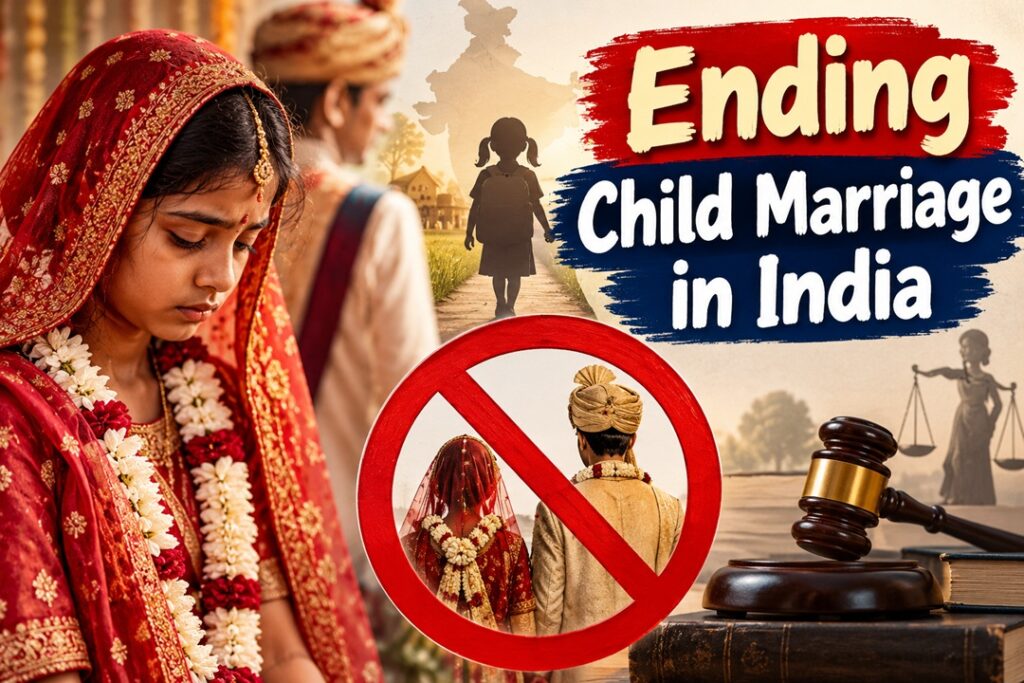
Ending Child Marriage in India: From Legal Intervention to Social Transformation
Context
Despite a steady decline in child marriage prevalence, the practice remains a serious concern in India. In Telangana, authorities intercepted more than 2,000 child marriages between 2025 and August 2026. However, the persistence of poverty, school dropouts, gender discrimination and social pressure demonstrates that preventing wedding ceremonies alone cannot eliminate the problem.
What Is Child Marriage?
Child marriage refers to a formal marriage or informal union in which at least one person is below the legally prescribed minimum age of marriage. In India, this age is 21 years for males and 18 years for females.
It violates children’s rights by restricting their freedom, disrupting education, compromising health and exposing them to exploitation before they attain physical, emotional and economic maturity.
Trends and Key Statistics
- National progress: According to the provided NFHS-6 figures for 2023–24, 20.1% of women aged 20–24 were married before turning 18, compared with 23.3% under NFHS-5 and 47.4% under NFHS-3.
- Telangana’s position: The prevalence declined from 23.5% to 17.9%, but rural areas continue to report higher levels (19.6%) than urban areas (12.9%).
- Preventive action: Telangana prevented 1,245 child marriages in 2025–26 and another 825 between April and August 2026. The cumulative number of recorded interventions since 2014–15 reached 10,710.
- Regional disparities: Vikarabad reported 878 interventions, followed by Mahabubnagar with 759 and Sangareddy with 715, while Rajanna Sircilla recorded 54.
- Educational vulnerability: A total of 777 children identified during interventions from 2025–26 through August 2026 had already discontinued schooling, highlighting the close relationship between educational exclusion and early marriage.
These figures indicate that legal intervention has improved the detection and prevention of child marriages, but deeper socioeconomic inequalities continue to expose girls to risk.
Why Does Child Marriage Persist?
1. Poverty and Economic Insecurity
Families struggling to meet basic expenses may perceive daughters’ marriages as a means of reducing their financial responsibilities. The absence of stable livelihoods and social protection makes early marriage more likely among economically disadvantaged households.
For instance, a single mother dependent on daily wages may arrange her adolescent daughter’s marriage because she cannot afford to support the household independently.
2. Family Crises and Health Emergencies
The illness, disability or death of a breadwinner can push children into wage labour and early marriage. Girls may be expected to assume domestic responsibilities or enter marriage when their families lose financial stability.
3. Patriarchal Norms and the Idea of Family Honour
In conservative communities, restrictions on girls’ mobility and concerns about their sexuality can encourage parents to arrange marriages soon after puberty. Social acceptance of early marriage often weakens resistance to the practice, even when it violates the law.
4. Exploitation by Local Power Structures
Landlords, moneylenders and marriage brokers may exploit indebted or vulnerable families by facilitating unequal marriage arrangements. Economic dependence and unequal bargaining power can prevent parents and girls from challenging such decisions.
5. Digital Communication and Adolescent Elopements
Unsupervised online interactions and adolescent relationships may sometimes lead to secret unions or underage marriages. However, digital contact itself is not the root cause; inadequate counselling, limited awareness of legal rights and insufficient support for adolescents can aggravate the risk.
6. School Dropouts and Limited Opportunities
When girls leave school because of financial difficulties, domestic responsibilities, poor access to secondary education or unsafe travel, their vulnerability to early marriage increases. The absence of credible educational and employment pathways can make marriage appear to be the only socially accepted future.
Legal and Institutional Measures in India
Prohibition of Child Marriage Act, 2006
The Act provides a legal framework to prevent child marriages, penalise specified persons involved in facilitating them and empower Child Marriage Prohibition Officers to intervene. It also provides for injunctions to prevent proposed ceremonies. The legal status and consequences of a child marriage depend on the applicable statutory provisions.
Protection of Children from Sexual Offences (POCSO) Act, 2012
The Act protects individuals below 18 years from sexual offences. Marriage does not provide a general exemption from criminal liability for sexual acts involving children.
Child Helpline 1098 and Sakhi One Stop Centres
Child Helpline 1098 facilitates reporting and assistance for children in distress. Sakhi One Stop Centres provide support to women affected by violence, including access to counselling, legal assistance and other services.
Community-Level Monitoring
Anganwadi workers, ASHA workers, schools and District Child Protection Units can identify warning signs such as irregular school attendance, sudden withdrawals from school and reports of planned underage marriages.
Telangana’s Awareness Campaigns
The state’s Balya Vivaham – Bathuku Aagam campaign seeks to challenge social acceptance of child marriage and promote awareness through community engagement and cultural platforms.
Despite these measures, effective implementation requires better coordination between law enforcement, education departments, welfare agencies and local communities.
Consequences of Child Marriage
1. Adverse Maternal and Reproductive Health Outcomes
Adolescent girls may not have attained full physical maturity, and early pregnancy can increase the risks of maternal complications. Pregnancy during adolescence can also intensify nutritional deficiencies, particularly where anaemia and inadequate healthcare are prevalent.
2. Long-Term Effects on Children’s Health
Early pregnancy is associated with increased risks of preterm birth and low birth weight. Poor maternal nutrition and inadequate healthcare can contribute to adverse child development outcomes, potentially perpetuating disadvantage across generations.
3. Disruption of Education and Career Aspirations
Marriage frequently increases domestic responsibilities and reduces the likelihood that girls will complete secondary or higher education. Without appropriate re-enrolment support, those who leave school may struggle to regain foundational learning and access skilled employment.
4. Greater Exposure to Violence and Exploitation
Child brides may lack the bargaining power, financial independence and social support necessary to resist abuse. Large age differences and unequal relationships can intensify power imbalances and expose girls to sexual violence, coercion and domestic abuse.
5. Intergenerational Poverty
The loss of educational and vocational opportunities limits girls’ future earning potential. Economic dependence can then continue into adulthood, reinforcing the same poverty that contributed to early marriage in the first place.
6. Violation of Rights and Personal Autonomy
Child marriage undermines children’s rights to protection, education, health and development. It also restricts their ability to make informed decisions about relationships, careers and their future.
Way Forward
1. Move from Rescue Operations to Effective Legal Accountability
Authorities should investigate not only the proposed marriage but also the adults and intermediaries responsible for facilitating it. Consistent enforcement, timely prosecution where warranted and protection for children who report violations can strengthen deterrence.
2. Make Secondary Education Economically Accessible
Targeted scholarships, conditional cash transfers and financial assistance for vulnerable households can reduce the economic incentives for early marriage. Support should encourage girls to complete secondary education, with appropriate safeguards for children facing exceptional hardship.
3. Reintegrate Girls Who Have Dropped Out
Rescued girls should receive bridge courses, flexible learning opportunities, counselling and vocational education. Schools and institutions such as Kasturba Gandhi Balika Vidyalayas can play an important role in supporting eligible girls to resume their education.
4. Strengthen Early-Warning Mechanisms
Local authorities should establish clear reporting and referral systems involving schools, Anganwadi centres, ASHA workers, panchayats and child protection officials. Irregular attendance and sudden school withdrawals should prompt supportive intervention rather than punitive treatment of families.
5. Provide Social Protection to Vulnerable Households
Widows, single-parent families, households affected by chronic illness and families dependent on precarious employment need accessible healthcare, food security, livelihood support and social assistance. Addressing these pressures reduces the circumstances that can push girls into early marriage.
6. Challenge Gender Stereotypes Through Community Participation
Panchayats, self-help groups, teachers, religious leaders and youth organisations should promote the value of girls’ education and reject the belief that puberty signals readiness for marriage. Boys and men must also participate in changing discriminatory social norms.
7. Support Adolescent Agency and Digital Awareness
Age-appropriate education on relationships, consent, online safety and legal rights can help adolescents make informed decisions. Confidential counselling and accessible support services are essential so that young people can seek help without fear of punishment or social stigma.
8. Improve Data-Based Governance
District-level monitoring should track not only the number of marriages prevented but also school retention, successful re-enrolment, access to welfare schemes and the long-term well-being of rescued children. Such indicators can help authorities identify persistent vulnerabilities and direct resources to high-risk communities.
Conclusion
The decline in child marriage reflects progress in awareness, public policy and law enforcement, but its continued occurrence reveals the persistence of poverty, gender inequality and educational exclusion. Preventing a ceremony is only the first step; lasting change requires protecting girls’ right to education, health, safety and personal autonomy. India must move from merely stopping child marriages to creating social and economic conditions in which every girl can choose her own future.
Source : The Hindu