
Digital Public Infrastructure in India: Enabling Inclusive and Efficient Governance
Context
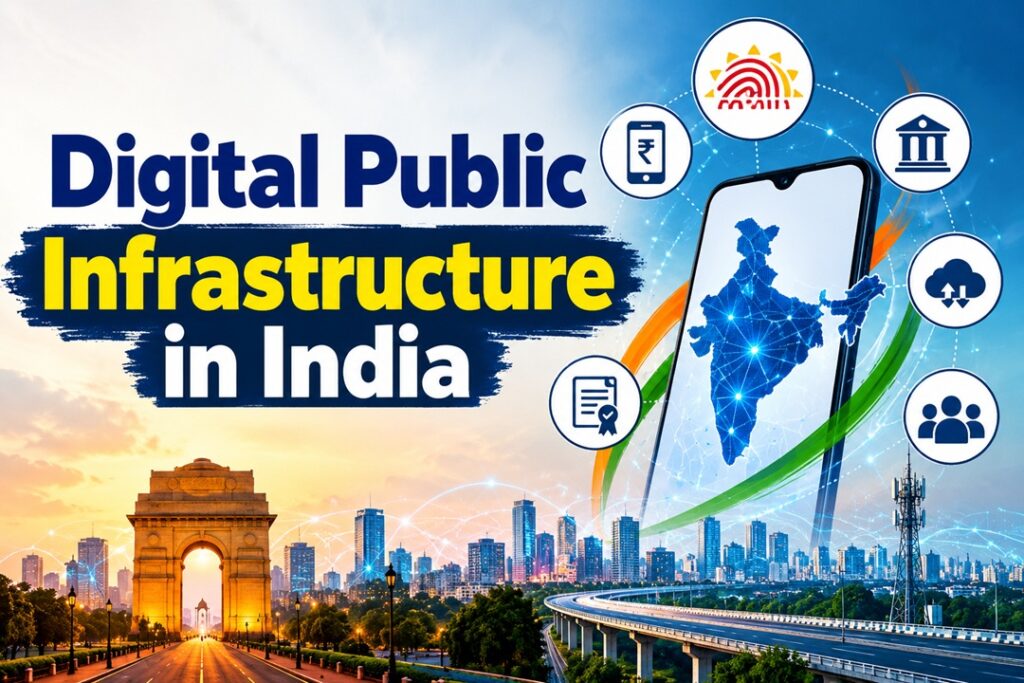
India’s Digital Public Infrastructure (DPI) has transformed the delivery of public services, digital payments and financial services by creating accessible, interoperable and scalable digital systems. Its experience demonstrates how technology can function as a public good, promoting financial inclusion, administrative efficiency and economic participation while offering a potential model for other developing countries.
What is Digital Public Infrastructure?
Digital Public Infrastructure refers to a set of foundational digital platforms and systems that enable secure interactions among citizens, businesses and government institutions. Similar to roads, railways and electricity networks, DPI provides the essential infrastructure upon which multiple services can operate.
Its key principles include open standards, interoperability, universal accessibility, data security and public-interest regulation. Unlike closed proprietary platforms, DPI enables different service providers to build applications over shared digital systems, encouraging competition and innovation.
Key Developments in India’s DPI Ecosystem
India’s digital ecosystem has expanded through the integration of digital identity, banking, payments, connectivity and electronic commerce.
– Aadhaar and financial inclusion: More than 144 crore Aadhaar numbers have been generated, while the Pradhan Mantri Jan Dhan Yojana (PMJDY) had 57.71 crore bank accounts by March 2026. These initiatives have expanded access to formal financial services and strengthened identity verification.
– Digital connectivity: India recorded 125.87 crore wireless subscribers, with 5G coverage extending to 99.9% of districts. Improved connectivity provides the foundation for delivering digital services across urban and rural areas.
– Digital payments: The Unified Payments Interface (UPI) processed 21.70 billion transactions worth ₹28.33 lakh crore in January 2026. Its expansion has facilitated rapid, low-cost payments for individuals, businesses and merchants.
– Direct Benefit Transfer (DBT): The Public Financial Management System (PFMS) and DBT ecosystem has enabled cumulative transfers of ₹49.09 lakh crore, with reported fiscal savings exceeding ₹4.31 lakh crore through better-targeted welfare delivery and the reduction of leakages.
– Digital public procurement: The Government e-Marketplace (GeM) recorded 3.27 crore procurement orders worth ₹16.41 lakh crore. Micro and Small Enterprises accounted for 44.8% of the procurement value, widening opportunities for smaller businesses.
These developments illustrate how interconnected digital systems can improve the scale, speed and transparency of governance.
Major Pillars of India’s Digital Public Infrastructure
1. Digital Identity
Aadhaar provides a widely used digital identity framework, while DigiLocker facilitates the storage and verification of electronic documents. Together, these systems can simplify identity checks, reduce paperwork and make services more portable across institutions.
2. Digital Payments
UPI and the Aadhaar Enabled Payment System (AePS) support interoperable digital transactions. They enable individuals and merchants to make or receive payments without relying exclusively on cash or traditional card-based infrastructure.
3. Consent-Based Data Sharing
The Account Aggregator framework enables individuals and businesses to share financial information with authorised institutions through consent-based mechanisms. This can improve credit assessment and expand access to formal lending, particularly for small enterprises with limited collateral.
4. Digital Commerce and Procurement
The Open Network for Digital Commerce (ONDC) seeks to connect buyers and sellers across different platforms through an open network. GeM digitises public procurement by connecting government buyers with vendors, improving transparency and creating opportunities for smaller businesses.
Together, these pillars form an ecosystem in which identity, payments, data and commerce reinforce one another.
Significance of DPI for India
1. Strengthening Financial Inclusion
Digital identity and low-cost payment systems help bring previously underserved households and small businesses into the formal financial system. They can reduce dependence on physical banking infrastructure and expand access to savings, payments and credit.
2. Improving Governance and Service Delivery
Digital verification and DBT can help governments deliver welfare benefits directly to intended recipients. Automated records and traceable transactions also improve monitoring, reduce administrative delays and make public expenditure easier to audit.
3. Promoting Entrepreneurship and Innovation
Open digital infrastructure allows banks, fintech firms, startups and local businesses to develop services without independently building every underlying system. This lowers entry barriers and creates opportunities for new business models.
4. Supporting MSMEs and Rural Enterprises
Digital payments, open commerce and digital procurement can connect small producers with wider markets. Combined with appropriate credit facilities, these platforms can help rural entrepreneurs, artisans and small merchants expand their economic participation.
5. Enhancing India’s Global Role
India’s experience offers lessons for countries seeking affordable digital identity, payment and service-delivery systems. Through international cooperation and the sharing of reusable digital architectures, India can contribute to digital development across the Global South.
Challenges Associated with DPI
Despite its achievements, the expansion of digital infrastructure presents several economic, technological and governance challenges.
1. Digital Divide and Limited Digital Literacy
Access to smartphones and internet connectivity does not automatically translate into the ability to use digital services safely and independently. Rural communities, elderly people, persons with disabilities and less digitally literate users may continue to face barriers.
For instance, some welfare beneficiaries depend on Common Service Centre operators or informal intermediaries to access banking services and check benefit payments.
2. Cybersecurity Threats and Digital Fraud
The growth of instant payments has created opportunities for phishing, identity theft, impersonation and social-engineering fraud. Users unfamiliar with digital transactions may be particularly vulnerable to fraudulent QR codes and deceptive payment requests.
3. Authentication Failures and Technical Dependence
Biometric mismatches, connectivity failures, server outages and technical errors can prevent genuine beneficiaries from accessing essential services. Manual labourers whose fingerprints have worn down and elderly people may experience difficulties with biometric authentication.
Such failures are especially serious when digital verification becomes a barrier to receiving food subsidies, pensions or other essential entitlements.
4. Concentration in Consumer-Facing Platforms
Although the underlying payment infrastructure is interoperable, a substantial share of transactions may be concentrated among a small number of applications. This can increase dependence on dominant platforms and create risks relating to competition, resilience and bargaining power.
5. Data Privacy and Surveillance Risks
The integration of identity, financial and service-delivery databases raises concerns about unauthorised access, excessive data collection and the misuse of personal information. Weak safeguards can undermine public trust in digital governance.
6. Uneven Access to Connectivity
Remote, hilly and underserved regions may experience unreliable internet access or limited digital infrastructure. Consequently, services designed primarily for continuous connectivity may not adequately serve all citizens.
Way Forward
– Strengthen digital literacy: Expand community-based digital education through schools, local governments, self-help groups and Common Service Centres. Training should cover secure transactions, fraud prevention, privacy and the use of essential government services.
– Adopt a citizen-centric approach: Essential welfare services should provide accessible grievance redressal, assisted access and practical alternatives when biometric authentication or connectivity fails. Technology should facilitate access to entitlements rather than become a condition that excludes genuine beneficiaries.
– Improve cybersecurity and consumer protection: Strengthen fraud detection, rapid complaint resolution, transaction alerts and coordination among banks, payment providers and law-enforcement agencies. Public awareness campaigns should target common digital fraud techniques.
– Ensure effective data protection: Implement the Digital Personal Data Protection framework through appropriate safeguards, accountability mechanisms and transparent data practices. Data collection and sharing should be limited to legitimate purposes, with effective protection against unauthorised use.
– Promote competition and resilience: Encourage a diverse ecosystem of banks, domestic payment applications and service providers while strengthening interoperability and reducing excessive dependence on a few consumer-facing platforms. Offline-capable payment options can improve resilience in low-connectivity areas.
– Expand DPI internationally: Share open-source solutions, technical expertise and implementation experience with developing countries through international cooperation and the Global Digital Public Infrastructure Repository (GDPIR). Adoption should be adapted to local laws, institutional capacities and social conditions.
– Integrate digital commerce with formal credit: Connect ONDC and other open digital networks with consent-based financial data-sharing systems to help small businesses establish transaction histories and access suitable working capital.
Conclusion
India’s Digital Public Infrastructure demonstrates how shared digital systems can support inclusive growth, improve welfare delivery and stimulate innovation. However, the success of DPI must be measured not only by transaction volumes or technological reach, but also by whether citizens can access services securely, reliably and without discrimination. A combination of strong data protection, cybersecurity, digital literacy, competition and accountable governance will be essential to ensure that DPI remains a public-oriented foundation for India’s digital and economic transformation.
Source : Sansad TV